


Scout missed the second porch step on Friday morning. He did not fall. His back feet crossed, his hips tipped against the railing, and he sat so abruptly that Claire almost laughed. At five months old, he was always arriving in pieces—ears before head, paws before judgment, enthusiasm several seconds before balance. Then he looked at the step he had climbed every morning for seven weeks and did not try again.
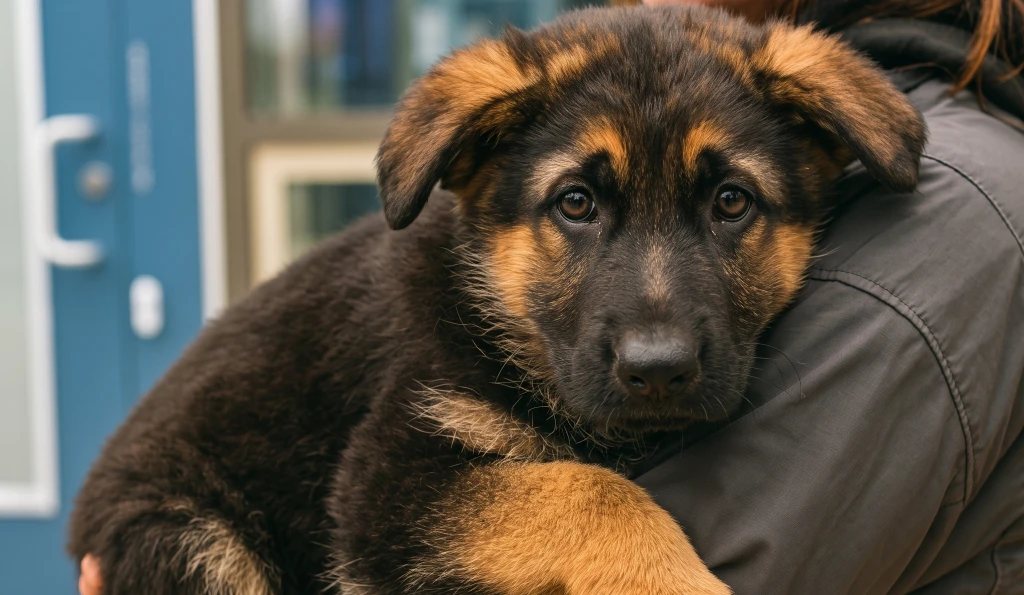
Claire crouched beside him. “Come on, Scout.”
His right ear stood tall. The left still folded at the tip, giving him a permanently unfinished look. He followed her hand with brown eyes and leaned into the scratch beneath his collar. When she stopped, his usual demand for more came only halfway. He lifted one oversized paw toward her wrist, but it slipped back to the boards.
Daniel was pulling his truck keys from the bowl inside. Claire called his name once, sharply enough that he came without asking why.
He tested Scout’s legs with the careful hands he used to square cabinet doors. “Maybe he overdid it yesterday.”
“Both back legs?”
“I said maybe.”
Claire took out her phone and recorded Scout trying to stand. Her work as a speech-language pathologist had trained her to notice small changes before a child learned to compensate for them. On the video, Scout’s rear nails scraped the porch. He managed two steps and sat again.
By noon they were in their veterinarian’s office. Scout wagged at the receptionist but could no longer keep his hindquarters straight. The veterinarian found no obvious injury, spinal pain, or fever. Bloodwork was unremarkable, and X-rays showed nothing broken or displaced.
“That’s good news,” Claire said too quickly.
“It rules out some things,” the veterinarian replied. “It doesn’t tell us what this is.”
She mentioned inflammation, a toxin, or a neuromuscular disorder. A veterinary neurologist in Missoula could see him Monday, sooner if a cancellation opened. Until then, Scout was to rest. They were to return immediately if the weakness moved forward or if his voice, swallowing, or breathing changed.
Daniel repeated the warning signs to make sure he had them right. To Claire, each one sounded like the next number in a countdown.
At home, Scout slept on the kitchen floor while Daniel canceled an afternoon installation. Claire sat beside the water bowl and replayed the porch video until the scrape of his nails against wood sounded louder than it had in person.
Seven weeks earlier, when they had brought him home from Sapphire Mountain Shepherd Rescue, he had been all noise. His bark was absurdly deep for a puppy whose left ear could not yet stand, and he announced every delivery truck, laundry basket, and reflection in the oven door. He stole only left shoes and surrendered them for a frozen green bean.
Whenever Claire stopped rubbing his chest, he laid his right paw over her wrist and held it there until she resumed.
Daniel called it extortion. Claire rewarded it every time.
That afternoon Scout woke and tried to bark at the mail carrier. What came out was a thin, papery sound.
Claire and Daniel looked at each other across the kitchen.
“That was on her list,” Claire said.
Daniel was already reaching for the phone.
The regional emergency clinic told them to come at once. While Daniel moved the car closer to the porch, Scout dragged himself toward the water bowl. His forelegs shook. Claire supported his chest and held the bowl beneath his muzzle, but he managed only a few laps. Water ran from the side of his mouth.
“Easy,” she whispered, tipping the bowl higher.
He coughed once—a weak, hollow sound—and Daniel took the bowl from her.
“Stop.”
“He’s thirsty.”
“He can’t swallow it.”
“Then what am I supposed to do?”
Daniel set the bowl in the sink too hard. “Get his blanket and his rope.”
The drive to Bitterroot Emergency Animal Hospital took forty minutes. Claire sat in the back with Scout’s head on her thigh. Every few miles, she placed two fingers against his ribs, not because she understood the rhythm but because contact felt better than imagining its absence.
The ER team carried him inside on a padded stretcher. A doctor examined him while a technician placed an IV catheter and checked his oxygen level. During intake, the technician searched his ears, feet, belly, coat, and beneath the edges of his collar. Scout’s thick ruff and the padded buckle hid the skin behind his left ear. Handling his head made his breathing harder, so a closer clipped examination would wait until he was stable.
Asked about recent camping or hiking, Claire said no. She did not think of the fenced rescue property as wilderness.
Claire showed the porch video, then another she had taken in the kitchen. By then Scout could no longer stand. His rear legs were nearly limp, and the weakness had begun to take his front legs too, though he remained awake and turned his eyes whenever Claire spoke.
The first ER doctor called it rapidly progressive neuromuscular weakness. Several conditions could look that way at first. Some were treatable. Some could require weeks of nursing or paralyze the muscles that drew air into the lungs.
“Which one does he have?” Daniel asked.
“I don’t know yet.”
They authorized oxygen, monitoring, repeat bloodwork, and an overnight telephone consultation with the on-call neurology service. Claire handed the receptionist the credit card they had been using for kitchen cabinets. Daniel signed the estimate without mentioning the half-finished room at home.
For three hours they sat beneath a television with the sound turned off. Daniel coiled and uncoiled Scout’s red leash across his knees. Claire called Ruth Keller at the rescue and left a message. She called the neurology practice twice, though the ER had already called. After the third search result mentioned respiratory paralysis, she closed the browser.
Shortly before midnight, the ER doctor returned. Scout’s breathing had grown shallower. His blood tests showed no organ failure or clear infection. The leading possibilities were now a severe peripheral nerve disorder or toxin exposure, but confirming the cause could take time they might not have.
“If he loses more respiratory strength,” the doctor said, “we’ll need to place a breathing tube and begin mechanical ventilation here. We can provide short-term support. If he needs it longer, the nearest specialty hospital with an available ventilator is two hours away. Transfer carries risk, and I can’t promise recovery.”
Claire heard only available. “Then reserve it.”
Daniel asked, “How distressed is he now?”
The doctor paused. “We’re keeping him comfortable, but he is working harder to breathe.”
“And if we don’t put him through the transfer?”
Claire turned on him. “Don’t.”
Daniel kept looking at the doctor. “I asked a question.”
The answer came gently. They could continue stabilization and attempt transfer. They could intubate there if Scout failed before a bed opened. Or, if they believed the burden and uncertainty had become too great, they could choose humane euthanasia before he experienced a full respiratory crisis.
Claire went to see Scout in the oxygen kennel. He lay on his chest with rolled towels supporting him, his head turned toward the door. When she knelt, his eyes found hers. His tail moved once against the blanket. He tried to lift his right paw but could not clear the floor.
She told herself that alert meant hopeful. The doctor told them alertness could remain even as the muscles failed.
Daniel stood beside her with one hand against the glass. “We said we wouldn’t make him suffer because we were scared to lose him.”
“We said that when he was healthy.”
“That’s when you’re supposed to say it.”
They waited another hour for a specialty hospital with an available ventilator to call back. None did. Scout’s breathing became more uneven. When the doctor explained what intubation and transport would require, Claire looked at the puppy who had filled their house for only seven weeks and could no longer raise his head without help.
She asked for another examination, whether the bloodwork might be wrong, whether Monday’s neurologist could come early. At last there were no new questions, only older ones in different words.
Daniel said Scout’s name in the full, solemn voice he had used when registering his microchip.
“Scout Mercer.”
Then he asked for the consent form.
The clinic moved them to a quiet room with a floor lamp instead of fluorescent panels. A fleece blanket covered a low padded table. The technician removed Scout’s mask but kept oxygen flowing near his muzzle while Claire held him. A clear line from the IV catheter remained taped to his foreleg.
He seemed smaller without the machines around him. Claire sat on the floor and gathered him against her chest, taking the full weight of his head in the bend of her elbow. His coat smelled faintly of disinfectant beneath the warm, dusty scent that was still Scout. She pressed her mouth between his ears.
“I’m sorry about the water,” she whispered. “I’m sorry I couldn’t find what was wrong.”
Daniel knelt on the other side of the table. For most of the night he had kept one hand busy—with the leash, the phone, the forms—but now both were empty. He stroked the bridge of Scout’s muzzle with his thumb.
“You were a good dog,” he said, his voice breaking on good. “Even when you were a criminal.”
Scout’s eyes moved toward him. Daniel bent until his forehead touched the puppy’s.
Claire told Scout he did not have to be brave for them. She told him the porch was waiting, his dented water bowl was waiting, and Daniel’s left work shoe was still under the dining table where Scout had hidden it.
Then she told him he could rest.
“You don’t have to stay because we’re afraid to let you go.”
The words caught in her throat, but she forced herself to finish them.
Claire tried to sign the form. She wrote the C and part of the l, pressing hard enough to dent the paper, but her fingers would not make the next stroke.
Daniel took the pen.
She watched him sign and hated him for being able to finish.
The overnight veterinarian entered as he set the pen down. She was a compact woman in her early fifties, with silver beginning at her temples and reading glasses pushed onto her head. Her badge read MAYA ALVAREZ, DVM. A paper cup of tea cooled untouched beside the sink.
“I’m taking over Scout’s case,” she said. “I’ve read the notes, but I need to examine him myself before we do anything. Is that all right?”
Daniel nodded. Claire gathered Scout closer.
Dr. Alvarez listened to his chest, checked his gums, and tested his response when she touched each paw. She watched his eyes track her hand. Her face did not brighten, but she repeated several checks and asked when the weakness had first appeared.
“This morning,” Claire said. “The back legs first. Then his bark changed. Then the front.”
“Any vomiting?”
“No. He coughed after water.”
“Any possible chemical exposure? Compost? Dead wildlife? Medication he could have reached?”
“Nothing.”
Dr. Alvarez glanced at the records again. “Camping? Trails? Tall grass?”
Daniel shook his head. Claire opened her mouth to agree, then remembered the rescue reunion last Saturday: Scout and his littermate Boone vanishing into waist-high grass beyond Ruth’s foster barn, both returning with burrs in their coats. Claire had brushed Scout’s belly and legs beside the car. He had squirmed when she reached his neck, planted a muddy paw on her wrist, and made Ruth laugh.
“A rescue property,” Claire said. “Last Saturday. Woods and tall grass. I didn’t think of it as—”
Scout stirred against her.
He pushed his muzzle weakly beneath her chin. His right foreleg rose, trembled, and settled across her wrist in the old familiar claim. As he drew his paw toward her, one claw caught the lower edge of his collar. The strap had the ordinary two-finger slack Daniel left for a growing puppy. It rolled, lifting the buckle from behind his left ear.
Dr. Alvarez leaned closer.
For an instant Claire thought the gray-blue oval beneath the buckle was a small skin growth.
Then something at its base moved.
Dr. Alvarez’s hand came up.
“Tessa, stop. Don’t give anything.” Her eyes stayed on the spot behind Scout’s ear. “Claire, hold him exactly where he is…”
To read the rest of the story – CLICK the NEXT button 👇👇👇