


When I turned into my driveway, my bed was waiting in the garage. It stood between the lawn mower and two bicycles, made up with the blue quilt I had slept under for twenty-three years. My nightstand had been placed beside it, and my reading lamp was plugged into an orange extension cord that ran under the door to the laundry room. Brooke had even set my novel facedown on the pillow, as though the trouble was not what they had done but whether they had remembered my page.
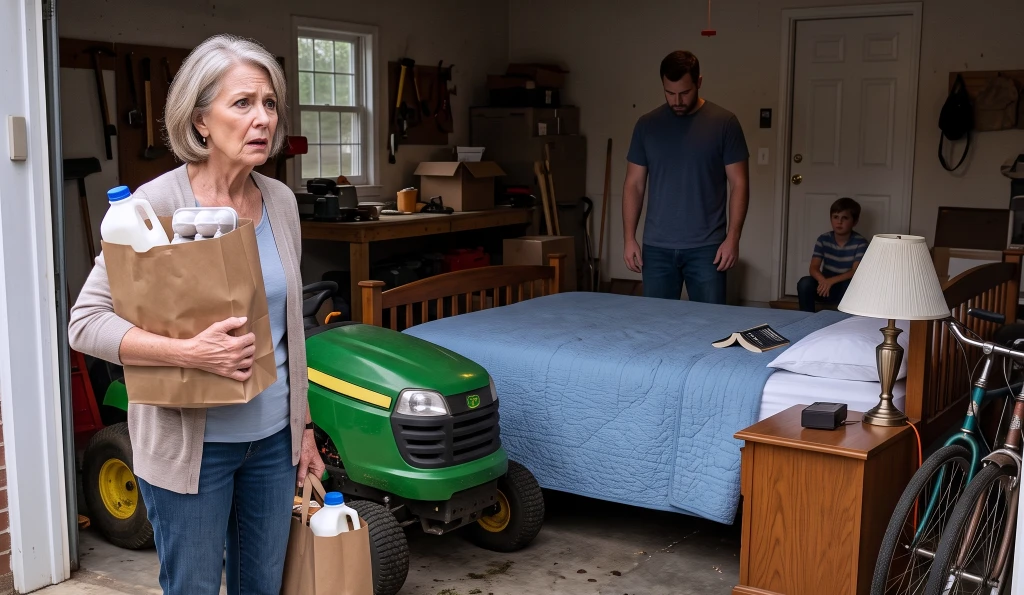
I sat behind the wheel until the warning bell began chiming because I had left the car door open. A carton of eggs rested in my lap. Milk sweated inside a grocery bag on the passenger seat.
My son came out through the mudroom. Mike was thirty-six, broad through the shoulders like his father, though lately he carried himself as if he were trying to take up less space.
“Mom,” he said. “Before you get upset—”
“Who moved it?”
He glanced toward the house. “We both thought—”
“Who carried my bed down the stairs?”
His eyes dropped to the concrete. “I did.”
Children in my third-grade classroom used to say a window broke when what they meant was that they had thrown a kickball indoors. Mike had offered me the grown man’s version, and I had made him put himself back into the sentence.
Brooke appeared behind him with a tape measure clipped to the waistband of her jeans. She had tied her dark hair up for work, and a pencil was tucked through the knot. When she and Mike first moved in, I had admired the brisk competence with which she repaired a loose stair rail I had ignored for months. At the time, I had liked her certainty.
“It looks unfinished right now,” she said, “but once the contractor is through with the den on Monday, we can put your bed there and finish making it a proper first-floor bedroom.”
I looked at the mower. Grass clippings still clung to one wheel.
“There’s no bathroom.”
“The powder room is through the kitchen.”
“The window doesn’t open.”
“Mike brought down a fan.”
Six weeks earlier, I had missed the bottom stair while carrying towels and bruised my hip. Brooke had driven me to urgent care, then installed a second rail the next morning. Her concern had been real; at sixty-nine, I could admit that without granting her the right to decide where I slept.
It was the last Wednesday in August. The garage held the day’s heat like a closed car, and the small window above the workbench had been painted shut since the first Bush administration.
“And tonight?”
Brooke’s mouth tightened. “Tonight you can use the den if you’re uncomfortable.”
I was already uncomfortable. She knew it.
Eight months earlier, Mike had called to say the estimating firm where he worked had eliminated his department. Brooke’s home-staging business had lost two builders in the same month, and the lease on their townhouse was ending. He had asked whether they, along with my ten-year-old grandson Owen, could stay for twelve weeks.
“Come home,” I had said before he finished explaining.
At first the house felt younger. Owen did math homework at the kitchen table and read superhero comics in the bathtub until the water went cold. Brooke cooked on Tuesdays, and when she came home late from an installation, Mike warmed her dinner and sat with her while she ate. He cleared snow from the walk, and I woke to voices in rooms that had been quiet since my husband died.
Twelve weeks passed. Then sixteen.
My painted mugs from family trips were replaced by white stoneware because Brooke said open shelving looked calmer when everything matched. Tom’s recliner moved to the basement. A framed photograph of Mike at fourteen, grinning beside his father’s battered fishing boat, disappeared from the hall and turned up in a plastic bin.
Every change was small enough to make an objection sound petty. I did not want Owen learning to listen for tension in adult voices, so I swallowed each complaint and called it patience. Now my patience had a headboard and casters.
I lifted the grocery bags from the car. Mike reached for them, but I stepped around him.
“Put the bed back.”
Brooke exhaled through her nose. “Owen needs a real room, Evelyn. The small bedroom barely fits his desk, and your room gets the best light. Giving Owen that room and updating the upstairs would add more value to the house.”
“I didn’t ask you to add value.”
“We’re trying to make the house work for everybody.”
“You made it work for everybody by removing me from it?”
Mike rubbed the back of his neck. “It’s temporary. The contractor is coming Monday, and we had to clear the room so he could measure.”
“A contractor for what?”
Neither answered quickly enough, so I took the milk into the kitchen. My old yellow canisters were gone from the counter, replaced by glass jars with wooden lids. In the dining room, flooring samples covered the table Tom and I had bought with our first joint tax refund; a contractor’s card was clipped to the top sample.
Brooke followed me. “We’ve talked about updating the upstairs for months.”
“You have talked. I have been in the room.”
“You said you wanted us to feel at home.”
“I did.”
“Then I don’t know why every practical decision turns into a referendum on whether we love you.”
The sentence was unfair, but not wholly false. I had never told her the mugs and photographs bothered me, and I had never asked when they planned to leave. I had kept quiet to avoid a fight. That still did not make the garage a bedroom.
“No one touches another thing upstairs,” I said. “The bed goes back.”
Brooke looked at Mike. He stared at the flooring samples.
I carried a pillow and blanket into the downstairs den. The sofa there was narrow but clean, and the powder room was six steps away. At dinner, I stayed behind the closed door because I could not trust myself to sit across from my son without asking what part of carrying his mother’s mattress past the family photographs had felt reasonable.
Around eight, someone tapped twice. Owen slipped inside holding a plate covered with foil. His baseball T-shirt was on backward, which meant he had dressed himself after his shower.
“I saved lasagna,” he said. “Dad thought you were resting.”
“That was kind.”
He set the plate on the coffee table and looked at the sofa. “Are you sleeping here?”
“Tonight.”
“What about your bed?”
“We’re working that out.”
Owen picked at the foil. “Mom said I’m getting your room, but I didn’t ask for it.”
“I know you didn’t.”
“And if you slept in the garage, where would you brush your teeth?”
The adults had discussed resale value, floor plans, and safe aging. The child had noticed the missing sink.
“That is an excellent question,” I said.
He leaned against me for a moment, all warm hair and soap, then went upstairs. I ate the lasagna cold.
Near midnight I heard Brooke and Mike in the kitchen. The den door was thin, and they had stopped lowering their voices around me.
“Once the market analysis comes back, she’ll see the numbers,” Brooke said.
“Not yet.”
“When, then? We can’t keep living month to month while she sits on all that equity.”
Mike said something too softly for me to catch, but Brooke’s answer was clear.
“She won’t live here forever.”
The refrigerator motor came on. I lay in the dark and watched a stripe of hall light beneath the door. No one contradicted her.
At five-thirty the next morning, I climbed the stairs. My bedroom looked larger without my life in it. Pale rectangles marked the places where pictures had hung, and blue painter’s tape ran along the baseboards. The only thing untouched was the cedar closet Tom had built across the east wall the year Mike started kindergarten.
It was not a walk-in closet. Tom disliked wasted space, so he had fitted shelves and drawers behind two heavy doors, planing each edge until a nickel could pass through the gap without catching. The brass lock had darkened with age.
A strip of blue tape crossed the trim. In Brooke’s block lettering, it said REMOVE? I pulled it off and folded it around itself until the word disappeared.
The key was in Tom’s old red toolbox in the basement, where I had put it after his funeral eighteen years earlier. I had opened the closet only twice since then, both times to add something I could not bear to throw away. I had avoided sorting any of it.
The lock turned with a dry click. Cedar, dust, and old paper breathed out. Tom’s Navy peacoat hung at the far end beneath a clear garment bag. Boxes filled the shelves, labeled in his square carpenter’s hand: TAXES. SCHOOL. HOUSE. Inside the right doorframe, pencil marks climbed the jamb, each one dated and initialed for Mike.
My fingers stopped at the line marked AUG 2004 — 5’8″. Three inches above it was the last line Tom had drawn.
On the top shelf sat a blue document folder from the year of hospital appointments. HOUSE / TRUST was written on the tab, with RACHEL MONROE — ORIGINALS AT FIRM beneath it in smaller letters.
I knew the trust held title; every property-tax statement had arrived in its name for nineteen years. What I had not looked at since Tom’s death was the succession page. The certificate bore both our signatures, notarized in 2007, and named me sole acting trustee upon the death or incapacity of Thomas Ward.
Footsteps sounded behind me. Mike stood in the bedroom doorway, barefoot and rumpled from sleep. His gaze moved from the open closet to the blue folder in my hands. “Did Dad leave me the house…”
To read the rest of the story – CLICK the NEXT button 👇👇👇