


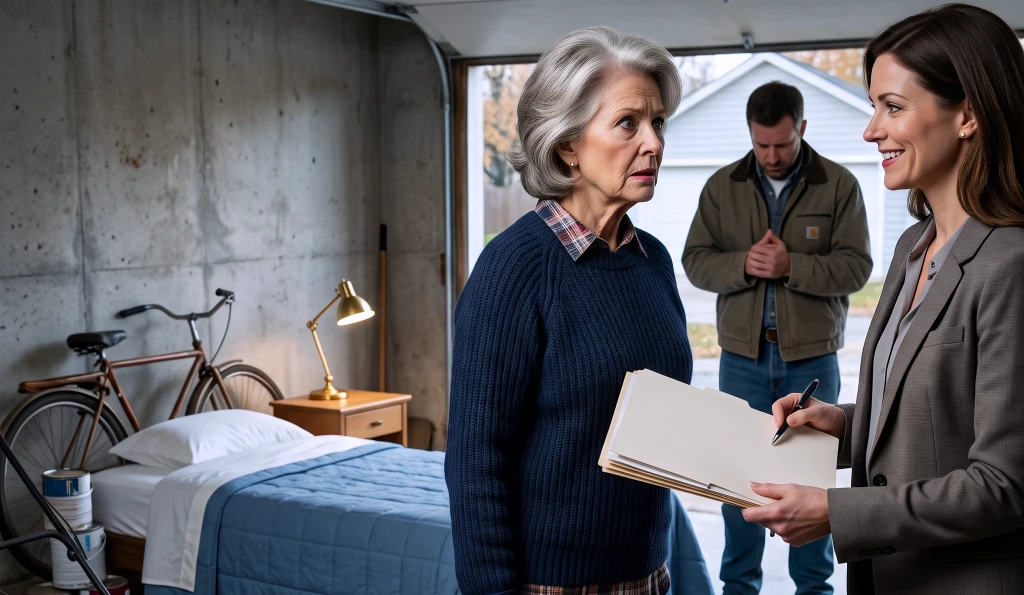
The first thing I noticed was that Ben had made the bed. He had made it in the garage. My blue quilt was folded across the foot, and the little brass lamp from my nightstand glowed at the end of an orange extension cord. Behind the headboard stood two bicycles, a stack of paint cans, and the mower with dried grass still clinging to its wheels. A maple leaf had blown in beneath the half-open garage door and landed in the middle of my clean white sheet.
The only part of my bedroom they had not managed to move was the cedar closet Tom had built into the upstairs wall. Claire had asked twice for its key. It was still hidden in my jewelry box.
Ben came through the door from the kitchen before I had set down my grocery bags. At forty-two, my son had his father’s height and my habit of rubbing one thumb across the opposite palm when he was ashamed.
“Mom, before you get upset, this is temporary.”
Claire appeared behind him, holding a folder against her chest. “We tried to make it comfortable.”
I looked at the folding screen beside the water heater, then at the small area rug they had placed over the oil-stained concrete. It was late October in Worthington, Ohio. The night before, the temperature had dropped to thirty-eight.
“Put it back,” I said.
Ben glanced at Claire. It was a small movement, but after seven months of watching them make decisions in my house, I knew what it meant. They had rehearsed this.
“The flooring crew is coming tomorrow afternoon,” he said. “They need the room empty.”
“I didn’t hire a flooring crew.”
Claire shifted the folder to her other arm. “Ruth, we talked about the stairs. You nearly fell last spring, and the garage conversion would give you everything on one level. This is only the first stage.”
I had missed a step while carrying laundry and bruised my hip. Claire had driven me to urgent care and sat with me for three hours, feeding quarters into a vending machine because neither of us had eaten lunch. Her concern now borrowed the voice of that kindness, which made it harder to answer.
“A conversion has walls,” I said. “And heat. Usually a ceiling that doesn’t open for cars.”
Ben winced. Claire’s mouth tightened.
“Owen needs a room where he can do schoolwork,” she said. “Your room gets the best light, and this arrangement lets us start improving the house instead of putting everything off.”
There were three other bedrooms upstairs. Owen already occupied one of them.
Claire offered me the folder. “These are just the contractor authorizations. If you sign tonight, they won’t lose another day.”
I did not take it. She placed it on the garage workbench instead.
Seven months earlier, when Ben called to say his company had eliminated his position and Claire’s home-staging business was struggling, I had answered before he finished asking.
“Come home,” I said.
I had meant the words. Ben had not always arrived carrying excuses; during Tom’s last six months, he drove his father to every radiation appointment I could not leave school for, bringing the same terrible gas-station coffee each time. At sixty-nine, after thirteen years alone, I liked hearing Owen run down the hall in his socks. He was ten and built elaborate cities from cereal boxes, complete with paper traffic lights and tiny parks no adult would have thought to include. He did homework at my kitchen table while I cooked, and every Wednesday we made what he called emergency brownies, although there was never an emergency.
Claire had been kind when she arrived. She cleaned out my gutters before the first autumn rain. She found the source of a leak beneath the dishwasher that I had been pretending not to notice. For my birthday, she took a shoebox of loose photographs and had them copied because, she said, one set of family pictures was too easy to lose.
She also kept every receipt in labeled envelopes and checked the utility account twice if a bill arrived a day late. I had taken that vigilance for good organization.
The changes began in ways that were easy to forgive. Claire boxed the mismatched coffee mugs Tom and I had collected on road trips because the open shelves looked crowded. Ben moved Tom’s leather chair to the basement so Owen would have more floor space. My sewing table became Claire’s desk when she said she needed somewhere to rebuild her business.
I could spot an excuse in any third grader, but with Ben I kept supplying the excuses myself. He was scared about money, Claire was trying to save her business, and Owen needed calm. Every time I meant to object, I repeated those facts and said it was fine.
Then Claire began calling it our house. Ben began saying renovations would help all of us. My framed wedding photograph disappeared from the mantel and turned up in a plastic bin beneath the basement stairs. When I objected, Claire apologized and put it back for two days. Then it vanished again.
I looked past my son into the kitchen. Through the doorway, I could see pale boards stacked along the hall and rolls of underlayment leaning against the staircase.
“You ordered all of this before I agreed.”
Ben lowered his voice. “We thought once you saw the plan—”
“You thought the hard part would be done.”
Owen’s footsteps sounded overhead. Ben looked toward the ceiling, and I saw relief on his face. He was counting on my unwillingness to argue where his son could hear.
That, more than the bed, steadied me.
I picked up the contractor folder and slid it beneath my grocery bags. “No one starts work tomorrow. My bed goes back upstairs.”
Claire drew a controlled breath. “The deposit is nonrefundable.”
“Then you should have waited.”
I carried the groceries into the kitchen. Ben followed, speaking softly about schedules and delivery charges, but I stopped listening. On the wall beside the stairs, the light rectangle where Tom’s Navy photograph had hung was visible against the newer paint.
At dinner, Claire laid the unsigned folder beside my plate, and Ben kept explaining delivery charges while the lasagna cooled. After five minutes, I carried my barely touched plate to the garage because Owen was watching the three of us with the careful face children wear when they have begun storing information for later.
He came out after nine with half a piece of lasagna under foil.
“You hardly ate,” he said.
“Neither did you.”
He sat beside me on the edge of the mattress, his sneaker heels tapping the bed frame. “Are you in trouble?”
I had prepared answers for Ben and Claire. I had not prepared one for him.
“No, honey.”
“Then why did Dad put your bed where the car goes?”
I smoothed his hair. It was the same stubborn brown as Ben’s at that age. “That’s something your dad and I have to work out.”
Owen considered this, then handed me the plate. “I don’t think your bed should be where the car goes.”
I kissed his forehead and sent him upstairs.
I did not sleep in the garage. I called my friend Diane, who listened without interrupting and said, “Bring a toothbrush. We’ll figure out the rest tomorrow.” Before leaving, I went upstairs for clothes.
My bedroom looked larger without my life in it. The curtain rod was bare. Pale rectangles marked the places where my bookcase and dresser had stood. At the far end of the room, untouched amid all that absence, was the cedar closet Tom had built from floor to ceiling during our second winter in the house.
He had been a finish carpenter after leaving the Navy, and he distrusted anything assembled with a tiny hex key. The door was solid oak, fitted so closely that even after thirty-four years it met the frame without a gap.
The key was in the lining of my jewelry box. I had not opened the closet since the first year after Tom died. At the time, the smell of cedar and his wool dress coat had driven me back into the hall before I could touch anything.
That night I turned the key.
The small space held his square metal toolbox, Navy records, tax files, photo albums, and the cigar box where he kept ticket stubs and hospital bracelets. Pencil marks climbed the inside doorjamb. BEN—8, BEN—9, BEN—12. Tom had written each date in a carpenter’s compact block letters.
On the highest shelf sat a gray document case I remembered signing papers from during Tom’s illness. A cream envelope had been taped to the front.
RUTH—HOUSE AND ESTATE PAPERS, Tom had written.
Inside was a two-page attorney’s explanation in ordinary language, Ellen’s card, and a copy of the trust we had signed. Tom had underlined one paragraph in blue ink.
You are the surviving settlor and sole trustee. The trust permits you to amend or revoke it, and the house remains under your control. Ben’s successor role gives him no authority while you are able to act. Before signing any deed, mortgage, guaranty, or power of attorney involving the property, obtain independent legal advice.
I read the paragraph twice. Then I remembered the folder beneath my groceries.
Downstairs, the contractor packet still lay where I had left it. The first page said OWNER AUTHORIZATION in large friendly letters. On the fourth page, beneath a paragraph Claire had marked with a yellow arrow, the print changed size.
The heading read LIMITED POWER OF ATTORNEY…
To read the rest of the story – CLICK the NEXT button 👇👇👇