


The first hard gust knocked the puppy sideways. The heel of bread flew from his mouth and landed crust-down in the snow beside Callahan’s Market. Eli Mercer expected the dog to leave it. Shelter was twenty feet away beneath the loading awning, and the wind coming off Lake Superior already had enough force to push powder through the seams of Eli’s coat. Instead, the puppy crawled back, closed his teeth around the bread, and kept walking toward the last streetlight in Loon Harbor.
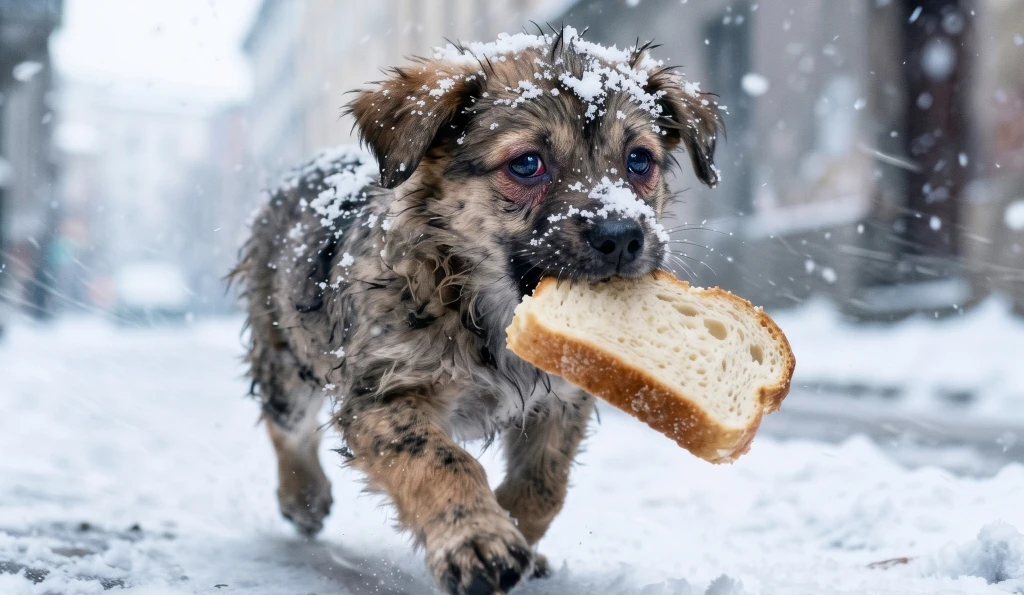
He was young, though not as tiny as he had first appeared—perhaps four months old, with the narrow legs and unfinished paws of a shepherd mix. His coat was rust-red over the back, cream along the chest, and clotted with ice beneath the belly. He followed the edge of the plowed road with his head low, carrying the dense piece of bread as carefully as if biting down too hard might ruin it.
Eli stood beside his truck and watched him go.
“You can stop looking like that,” Ruth Callahan said behind him. “I tried giving him the soft part.”
She had come out through the back door in a flour-dusted apron, holding a metal bowl of water. At sixty-one, Ruth moved through her store with the briskness of someone who had been told too often that she should slow down.
“What’s wrong with the soft part?” Eli asked.
“He won’t carry it. Tears when it gets wet.”
Eli turned from the road. “Carry it where?”
“If I knew that, I wouldn’t be standing here talking to you.”
Ruth set the bowl beneath the awning, though the puppy was already beyond the snow-covered gas pumps. “He ate two crumbs from my hand and drank. Then he waited for that heel.”
“Most strays aren’t choosy.”
“He isn’t choosing. He’s packing lunch.”
The humor left her face as she followed Eli’s gaze. “This makes three mornings. Same time. Same direction.”
Eli looked back at her. “You’ve seen him before today?”
“Tuesday and yesterday. He comes from the east before six-thirty, waits until I put something out, then carries one piece back the way he came.”
“Does he come back?”
“Not before the next morning. Yesterday he disappeared past that light, and today he was back before dawn.”
The puppy had reached the last streetlight. Beyond it, County Road Six curved between a shuttered campground and a line of black spruce before disappearing along the frozen shore. The nearest occupied house in that direction was more than four miles away.
Eli knew because, for eighteen winters, he had measured Loon Harbor by what could go wrong between one warm building and the next.
The lighthouse itself had not needed a keeper in decades. Its beacon turned automatically, but the historical society paid Eli to watch the pipes, clear the vents, record storm damage, and discourage tourists from climbing onto shelf ice for photographs. It was not the Coast Guard, though he still woke before dawn and logged the barometric pressure in the same square handwriting he had used at twenty-five.
The puppy passed beneath the streetlight and vanished behind blowing snow. Eli had seen him make that turn the day before. He had followed in his truck as far as the county plow turnaround, then lost sight of the small red body where wind swept the pavement bare. He had told himself the dog knew where he was going. There were cabins farther inland, hunting camps not marked on the public map, and people who disliked strangers nosing around their property.
Mostly, Eli had told himself he would look again tomorrow. Now tomorrow had arrived with a winter storm warning and a falling barometer.
Nearly two hours later, a white veterinary SUV turned into the lot. Claire Mercer parked beside Eli’s truck, climbed out, and opened the rear hatch.
“Ruth, your cat food came in on my order,” she called. “You still want all four cases?”
“Unless my cats have found work, yes.”
Claire lifted one case, saw her father, and studied him over its cardboard edge. “You’re still here.”
“So are you.”
“I work across the street.”
Eli took the case from her before she could object. Claire was forty-one, with her mother’s dark hair and his habit of narrowing one eye when she suspected an incomplete answer. She had returned to Loon Harbor eighteen months earlier to cover its struggling mixed-animal clinic for one winter. She had never quite managed to leave again.
“There was a dog,” Ruth said.
“There still is,” Eli added. “Just farther away.”
Inside the store, Ruth described the three visits while Claire put the cat food behind the counter. Her expression changed when Ruth mentioned the bread.
“Did he eat anything here?”
“Two mouthfuls yesterday. Less today.”
“And nobody could catch him?”
“I got within arm’s reach Tuesday. He backed off until I stopped trying, then took the bread.”
Claire was pulling on her coat again when Ruth looked past her toward the loading door.
The puppy had returned. He came through the snow without the bread, limping on his left hind leg. Ice covered his whiskers, and he swayed once before lowering himself beside the water bowl. He drank until Claire gently slid it away.
“He’s never come back this early,” Ruth said.
“Easy,” Claire said. “You’ll make yourself sick.”
She crouched sideways rather than reaching over his head. After a moment, he allowed her to touch his shoulder. Claire ran her hand along his ribs and legs, speaking in the same low, practical voice she used with frightened horses.
“Male. About sixteen weeks. Twenty pounds, maybe a little less than he should be.” She turned one paw toward the light. “Pads are cracked. No serious frostbite yet.”
“Yet?” Ruth asked.
“He can’t keep making that trip.”
The puppy’s coat was dense enough to have protected him better than Eli first assumed. Around one hip, caught in the fur, were threads of blue fiberglass insulation and a small piece of frayed nylon netting.
Claire noticed them too. “Where did you sleep?”
Ruth set down a dish of canned dog food. The puppy swallowed several bites, but when she offered another, he turned away and stared at the bakery door.
“Don’t give him the middle,” Ruth said quietly.
She brought out the thick end of a day-old wheat loaf. The puppy rose at once, although his hind leg trembled. He took the heel and started toward the road.
Claire reached for a slip lead. He dodged it, dropped the bread, recovered it, and scratched at the outer door.
“He needs warmth and rest,” she said.
“Tell him,” Eli replied.
“I’m serious, Dad.”
“So is he.”
Claire watched the puppy pull toward the east road. “He isn’t wandering. He knows exactly where he’s going.”
“That’s what worries me.”
The bell over the front entrance rang, and Wade Turner came in carrying a coil of orange survey ribbon. Snow covered the shoulders of his public works jacket.
“If any of you plan to drive east, don’t,” he said. “The weather service moved the storm up. County’s closing the shoreline road at noon.”
Eli pointed at the dog. “What’s beyond the campground?”
“Trees.”
“Beyond those.”
“The old Harlan fish camp.”
Ruth leaned against the counter. “Those buildings are still standing?”
“Standing is generous.” Wade looked through the glass door at the puppy. “I chained the net shed Monday after the wind tore the latch loose. The rest are marked condemned.”
“How far from here?” Claire asked.
Wade pulled out his phone and opened the county maintenance map. His thick finger traced the service trail from Callahan’s Market, through the campground, then along the shore.
“One point eight-five miles to the net shed.”
Eli looked at the insulation in the puppy’s coat. The old Harlan buildings had been lined with blue fiberglass before fishermen discovered better ways to keep their hands warm.
“Any people out there?” he asked.
“Not since October.”
“Other buildings?”
“Nothing with heat.”
The puppy scratched the door again. Claire called county animal control, but the nearest officer was already handling livestock stranded south of town and could not reach Loon Harbor before the road closure. Waiting until morning, the dispatcher told her, would be safer for people.
Eli looked at the bread held between the puppy’s teeth. “Maybe for people.”
Wade stepped between him and the door without touching him. “You’re not walking out there alone.”
“I didn’t ask you.”
“That has never been the reassuring part.”
“I can still cover two miles.”
“On a dry sidewalk, possibly.”
Claire gave Wade a brief look of gratitude that irritated Eli more than the words.
He buttoned his coat. “Then I’ll go before the storm gets here.”
“You’ll go when I have two radios, a rescue sled, a return time logged with dispatch, and enough equipment to bring back more than one dog.” Wade glanced at the puppy. “Give me seven minutes.”
Ruth stayed at the store with one radio as their base contact. Wade brought a tracked utility vehicle from the public works garage and loaded snowshoes, a shovel, a rescue pulk, a tool kit, a folded canvas litter, headlamps, reflective route stakes, insulated blankets, and two animal carriers. Claire added her field bag, wrapped warming packs, water, and soft towels.
At nine-twenty, Wade reported their route and turnaround time to county dispatch. The puppy did not wait for the preparations to finish. He started east with the bread, forcing Wade to circle ahead and bring the tracked vehicle alongside the road.
They followed him through the closed campground, moving slowly enough that he remained in sight. The puppy did not take the easiest-looking route. He used the lee side of the snowbanks, ducked behind cabins, and passed through breaks in the old snow fence where the wind had packed the ground hard.
At a bent culvert marker, he stopped and looked back until they caught up.
“He’s checking on us,” Claire said.
“Or checking whether we’ll steal his bread,” Wade replied.
The puppy dropped it twice. Each time, he turned the frozen edge away and found a softer place for his teeth. He ate nothing.
Beyond the campground, the service trail narrowed between cedar and spruce. Wade planted reflective stakes at the turns where blowing snow might erase their route. The tracked vehicle could go no farther after a fallen tree blocked the trail, so they strapped on snowshoes and continued with the rescue pulk.
Eli took the lead for the first hundred yards before Wade passed him without comment. Claire noticed Eli switching his walking pole from hand to hand.
“You tell me before you need to stop,” she said.
“You’ll know.”
“That’s what Mom used to say.”
Eli watched the puppy’s tail disappear around the next drift. “Claire.”
“I’m not doing that twice.”
Wade raised one gloved hand. Ahead, a black shape showed through the trees: the broken roofline of Harlan Fish Camp.
The storm had not yet reached full force, but snow swept sideways across the open ground between them and the shore. Lake ice boomed beyond the shelf, a sound like something heavy striking the underside of the world.
The puppy left the service trail and struggled through a drift gathered against the net shed. He disappeared behind the north wall.
Wade tested the structure before allowing Claire and Eli closer. The roof sagged toward the lake, but the frame remained solid enough on the inland side. Snow had packed against the outward-opening main door, and a chain secured the damaged latch.
“Drain gap,” Wade called.
Near the foundation, the puppy was squeezing through an opening no larger than a mailbox. The bread scraped the wood and fell outside. He backed up to get it; on the second attempt, he turned his head sideways and vanished with it.
Wade cleared snow from the side entrance while Eli held the light. The wood had swollen in its frame, and after several minutes with a pry bar, it opened far enough for Wade and Claire to enter.
Eli followed. The shed smelled of old rope, wet wood, and the iron scent of frozen lake water. Torn nets lay in heaps along the walls, and blue insulation hung from a damaged ceiling panel—the same color as the fibers in the puppy’s coat.
The beam of Claire’s flashlight moved across an overturned table, a rusted stove, two old crusts marked by small teeth, and a fresher heel torn open along one edge.
Then it reached the far corner.
A brindled dog lay on a bed of netting and burlap. She had curled herself into a tight crescent around two smaller puppies. Frost silvered the hair along her muzzle. One foreleg lay awkwardly extended, and her eyes were closed.
The red puppy stepped over the two old crusts and placed the fresh bread directly in front of her mouth. He nudged her nose. No one spoke. Then the dog everyone had taken for dead opened one eye…
To read the rest of the story – CLICK the NEXT button 👇👇👇