


By the time Maribel Crowley realized Huck had not touched his breakfast, the old hound had been sitting outside the unused foaling stall for nearly four hours. He was not barking or scratching at the gate. He simply sat with his front feet planted squarely in the aisle and stared through the gap beside the hinge, so still that a strand of cobweb had settled across one folded ear.
“There’s nothing in there worth missing bacon for,” Maribel told him.
Huck did not turn.
The April sun had climbed above the cottonwoods along Mercy Creek, but the barn still held the blue chill of night. Maribel broke ice from the horses’ water buckets, forked hay into two mangers, and tried not to let the dog’s silence work on her. Since Eli’s death, every change in an animal’s routine had seemed to arrive carrying bad news. A lame step meant a ruined season. A horse looking at its flank meant a night spent walking a colic. An untouched bowl meant a decision she might have to make alone.
Fourteen months should have loosened that reflex. It had not.
She set down the fork. “Huck.”
His nostrils widened once. His gaze stayed fixed past her.
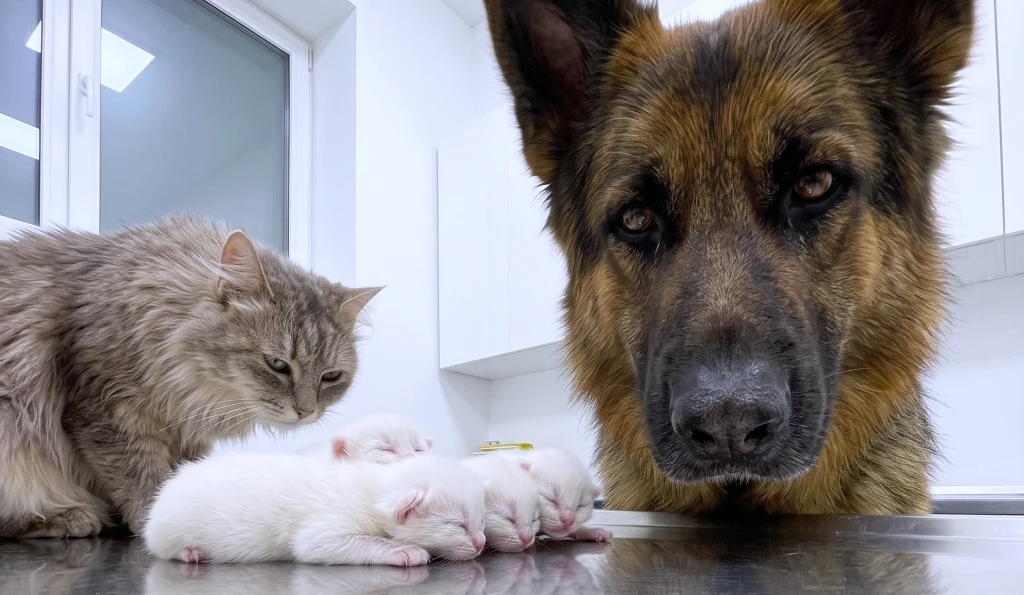
Daisy had disappeared the previous afternoon. That was not unusual for a barn cat, except that Daisy had lost her litter five days earlier and had spent every night since in a towel-lined apple crate inside the unused stall. Maribel had found one tiny stillborn kitten and no others. Rowan Hensley, the veterinarian in town, had told her the cat would search for a while and that her milk would dry up. Daisy had searched until her voice went hoarse.
Now Maribel heard a soft, busy sound behind the stall gate. Not a meow. More like tiny claws pulling at cloth.
She reached for the latch. Huck rose at once, arthritis forgotten, and pressed his chest between her and the gate.
“You’ve been good with that cat since she could fit in my glove.”
He leaned harder.
Huck had belonged to Eli in the complete way some dogs chose one person and accepted everyone else as part of the arrangement. When Eli volunteered on winter carnivore surveys, Huck rode beside him in the old Forest Service truck, nose at the crack in the window. He had never been a certified detection dog. Eli used to say Huck failed obedience because he considered every command a proposal. But a biologist had taught Eli how to collect hair and scat samples, and somewhere along those miles Huck had learned the work too. At a scent that mattered, he sat. Then he stared until Eli followed.
Maribel had not thought about that in more than a year.
“Is that what this is?” she asked.
Huck’s tail struck the dirt once. She opened the gate. He followed two steps behind, no longer crowding her now that she had agreed to pay attention.
The stall smelled of alfalfa dust, old pine boards, and the mineral sweetness of melting snow tracked in on boots. Near the far wall, Daisy lay in the apple crate Maribel had prepared after the cat went into labor. Her front paws kneaded the towel. Her eyes were half closed, and the rusty motor of her purr filled the narrow space.
Two babies were pressed against her belly. Relief reached Maribel before reason did.
“Oh, honey.”
Daisy had found kittens. Or perhaps the kitten Maribel had buried had not been the whole litter after all. She lowered herself to her knees, feeling the first clean happiness she had felt in days. The babies were larger than she expected, their pale coats smudged with gray along the spine, but mixed litters could look like almost anything. One nursed with both front feet braced against Daisy’s ribs. The other slept on its side with a round belly exposed.
Huck stopped six feet away. He did not growl. That disturbed her more than a growl would have. He held his body forward over his feet, nose working, his attention divided between the babies and the open stall door behind them.
Maribel inched closer. “Daisy, where did you get these two?”
The sleeping baby rolled upright. Its movement was wrong—not the loose, uncertain scramble of a kitten, but a low, muscular turn. Its paws looked too broad for its legs. When it opened its mouth, the sound that came out was a rough little chirr, deep enough to belong to something hidden under the floorboards.
Daisy licked its head with proprietary calm. Maribel reached no farther. Huck moved in front of her hand and planted himself again.
“All right,” she whispered. “I see it.”
She took three photographs from a distance and called Rowan. The first call went to voicemail. On the second, he answered with a cow bawling behind him.
“If this is about Daisy’s milk, warm compresses and time,” he said. “I’m shoulder-deep in a cow with opinions here.”
“She found babies.”
“Her babies?”
“I don’t think so.”
The cow bellowed again. Rowan said something muffled to his assistant, then returned. “Send the pictures.”
Maribel did. She heard his breath change when the images arrived.
“Don’t touch them.”
“I haven’t.”
“If you can move the apple crate into a carrier without handling them, do it. Keep Huck back and come through the side door.”
She looked at the hound, who had spent all morning doing the opposite of staying back. “Do you know what they are?”
“I know what they aren’t. Get here carefully.”
The large farm carrier was wide enough to hold the apple crate. Maribel set it beside Daisy, opened the door, and slid the shallow crate inside without touching any of its occupants. The babies rolled against one another with an awkward strength that tightened the skin between Maribel’s shoulders.
Huck supervised without moving closer. Only when she latched the carrier did his rigid posture ease.
The drive to town took thirty-eight minutes in good weather. That morning, snowmelt had turned the county road into alternating stretches of mud and washboard, and the carrier shifted at every bend. Daisy objected. The babies answered with those low, rasping chirrs. Huck stood behind the passenger seat, staring through the carrier door as if he could hold all three animals in place by watching them.
Maribel kept both hands on the wheel. A waxed-canvas smell in the cab bothered her. At first she assumed it came from an old coat behind the seat, but the coat was nylon. The smell grew stronger whenever the heater blew across the carrier: wet canvas, spruce pitch, and something metallic beneath it.
It reminded her of Eli’s survey pack. She shut the thought down before it could open into anything else.
Hensley Veterinary occupied a low brick building between the feed store and the volunteer fire station. Rowan had the side door propped open when she arrived. He was fifty, lean from a life spent ducking under gates and wrestling other people’s livestock, with a crease between his eyebrows that deepened whenever he was trying not to alarm someone.
That crease was already there.
“Daisy’s doing fine,” Maribel said as he helped lift the carrier. “Whatever they are, she’s nursing them.”
“That may be why they’re alive.”
He carried the carrier into the large-animal treatment room rather than an exam cubicle. Stainless-steel bowls, a folded net, heavy gloves, and a clear plastic tub waited on the table. His technician, Ellie Tran, closed the hall door behind them, then settled Huck in an empty kennel off the side hall, away from the other patients.
Rowan dimmed the overhead light. Through the grate, Daisy’s pupils widened. One baby had pushed partly against her shoulder and was gripping the towel with long, curved claws Maribel had not noticed in the hay.
Rowan crouched. For several seconds, he did nothing but look.
“Those feet,” he said. Ellie leaned closer. “Fisher?” “Too heavy through the skull. And look at that hind foot. Five toes, full claws.” The second baby turned toward him, blunt nose lifted. Ellie bent toward the lower latch, which had not seated fully because the apple crate pressed against the carrier door. Before her fingers reached it, the baby drove its head against the gap. The door flexed outward. Rowan slapped the door flat with his palm and snapped the latch home. “Stop. Keep your hand away from that gap. These are not cats…”
To read the rest of the story – CLICK the NEXT button 👇👇👇