


The first knock came an hour before daylight, too low on Nathan Rourke’s door to belong to a person. He stopped with a carburetor float pinched between his fingers. Rain drove sideways against the cabin, and the cedars above Lake Crescent bent until their wet branches scraped the roof. Then came the sound again—three measured taps near the bottom panel, a pause, and one rough scrape of claw on wood. Nathan knew that signal.
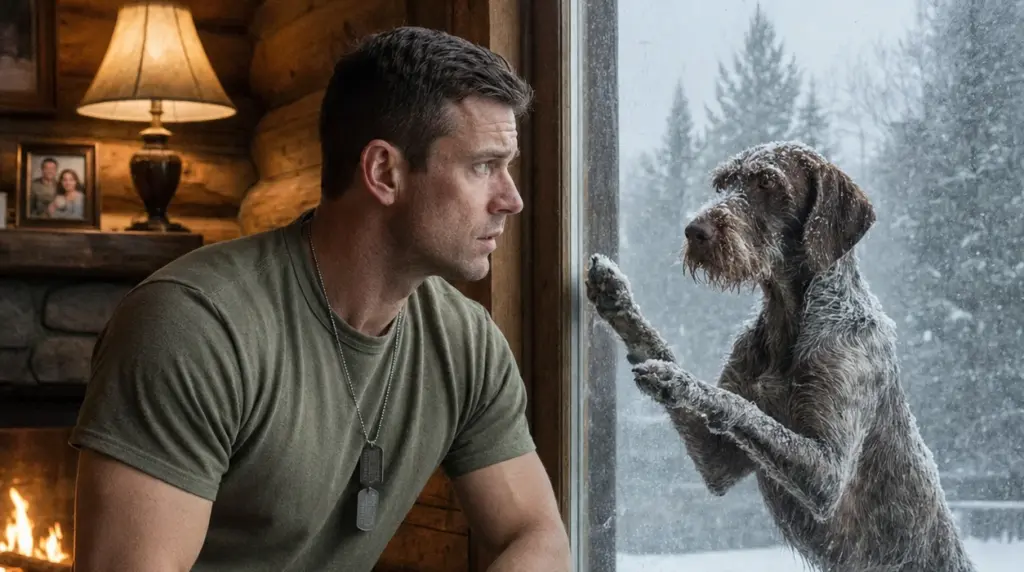
He crossed the kitchen without turning on the porch light. For eight years, Caleb Ford had taught his dog to ask at doors instead of throwing his weight against them. Nathan had helped, mostly by standing on the wrong side of this same door with smoked salmon in his hand while Caleb laughed from the yard.
Caleb had been dead for three years. The dog had been declared dead with him.
Nathan opened the door. Atlas stood in the rain with one paw still raised. The sable German shepherd had once been broad through the chest and fast enough to climb a six-foot wall as if gravity were a suggestion. Now his coat hung in wet ridges over visible ribs. Gray had spread around his muzzle, one ear carried its old torn edge, and his right hind leg rested lightly on the porch as though the bone had learned a bad angle and kept it. His amber eyes found Nathan’s face and held there.
“Atlas.”
The dog’s ears came forward. He did not wag. He stepped over the threshold, turned once to study the room, and chose the strip of floor beside the wall where he could see the door, the windows, and Nathan’s hands.
Nathan closed out the wind. Since leaving the SEAL teams, he had spent the last two years repairing pumps, generators, and outboard motors for people who did not ask why he lived alone. Machines offered causes. A clogged jet, a corroded contact, a bearing run dry. Put the missing thing back and the machine either worked or told you precisely why it would not. Atlas was not supposed to exist.
Nathan set the carburetor aside and crouched several feet from him. The dog smelled of rain, old straw, and the sour skin odor of an animal that had gone too long without care. A leather collar lay buried under his neck fur. Fresh rub marks showed where it had been tightened over older scars.
“Can I look?”
Atlas watched him. Nathan moved slowly, touched the collar with two fingers, and felt the shepherd’s body go rigid without retreating. The brass tag was the one Caleb had ordered when the county retired Atlas into his care.
ATLAS FORD
RETIRED K-9
RETURN TO EVELYN FORD
The telephone number below had been scored almost smooth. Nathan knew it anyway.
He called. The line rang until Evelyn’s recorded voice told him to leave his name after the tone. He called again and got the same answer.
Atlas rose and went to the door. His bad leg shook, but he put the other front paw against the wood.
Tap. Tap. Tap.
“I heard you.”
The dog looked back at him. Nathan had also heard Caleb’s last call. That was the trouble.
He found cooked chicken in the refrigerator, poured water into one bowl, and put a small amount of meat in the other, forcing himself not to give the dog everything at once. Atlas came toward the food hard enough for his claws to skid, then stopped with his nose inches above it. Hunger ran visibly through him. Still, he waited.
Caleb’s release word sat in Nathan’s throat like something with edges.
“Take it.”
Atlas ate without lifting his head, quick but controlled. Halfway through, he stopped to look at the door again.
“All right.”
Nathan pulled on rain gear, packed a blanket and first-aid kit, and took the long flashlight he kept charged by the stove. The weather radio warned of water over low roads west of Port Angeles and trees down near the Elwha. The dispatcher who answered his call said fire crews were tied up across the county but would check Evelyn’s address.
“Check faster,” Nathan said.
The dispatcher’s voice sharpened. “Sir, I need you to stay out of moving water and wait for responders.”
Nathan looked at Atlas.
“I’ll leave the porch light on.”
He hung up before she could mistake that for agreement. Atlas tried to jump into the truck and failed. Nathan caught him under the chest before he struck the running board. The dog gave him a look of grave offense while Nathan spread the blanket across the passenger seat and lifted him in.
“Put it in your report.”
Atlas faced forward. The storm had turned the highway into a corridor of black water and moving branches. Nathan drove by the pale reach of his headlights, slowing where runoff crossed the pavement. Before a fallen cedar limb came into view, Atlas lifted his nose and whined at the wet, splintered smell drifting around the curve. Nathan slowed; the branch filled half the road.
Atlas had traveled this route beside Caleb often enough to recognize its grades and turns, and pain had not taken that from him.
Evelyn’s orchard sat above Little River Road behind a weathered sign Caleb had repainted every spring and the rain had erased every winter. One gate sagged open. Beyond it, rows of old apple trees bent in the wind, their bare branches flicking water against one another.
The farmhouse was dark. Nathan parked on high ground and opened Atlas’s door. The shepherd landed carefully this time, sniffed once, and pulled toward the rear orchard. Nathan caught the collar but did not stop him. Mud sucked at his boots as they passed the root cellar and the cider press Caleb had rebuilt from salvaged oak.
“Evelyn!”
Wind carried his voice away. Atlas veered toward the low pump shed beside the drainage ditch and barked once.
A cottonwood limb had come down through the roof. One wall leaned outward, and brown water coursed around the foundation. Under the broken rafters, someone struck metal against metal three times.
Nathan went through the half-collapsed doorway on his knees. Evelyn Ford lay behind the pump assembly with a shelf across her lower leg. At seventy, she was small without being frail, white hair loose from its pins and rainwater running down the lines beside her mouth. Caleb’s old deputy jacket covered her nightgown. She held a wrench in one hand.
“Took you long enough,” she said.
“Good morning to you, too.”
“Is the pump running?”
“No.”
“Then it isn’t good.”
Atlas pushed past Nathan’s shoulder. Evelyn’s wrench fell into the water.
The dog lowered his head under her palm. For several seconds she did not move, as if any motion might finish waking her and take him away. Then her fingers entered the wet fur behind his torn ear, found the familiar notch there, and closed.
“Oh, Caleb,” she whispered.
Atlas pressed closer. His whole body trembled now, not only the injured leg.
Nathan checked the shelf and the roof above it. The limb had pinned the structure but also held part of it up. He could not cut anything without changing the load. He fetched the bottle jack and a length of cribbing from his truck while Evelyn kept one hand on Atlas and criticized his speed.
“The county is coming,” he told her when he returned.
“The county has been coming for twenty years.”
“On three, I raise. You pull your leg toward me.”
“I know how a jack works, Nathan.”
He looked at her.
She looked back. “Caleb described you.”
The jack took the shelf’s weight a fraction at a time. Wood complained above them. Nathan wedged the cribbing, set his shoulder under the beam, and lifted enough for Evelyn to drag her boot free. Atlas backed out when Nathan told him, then stood in the rain until Nathan carried Evelyn through the doorway.
By the time the volunteer fire truck reached the orchard, she was wrapped in Nathan’s blanket on the farmhouse porch with Atlas’s head across her knees. A medic examined the swelling below her knee and the cut at her temple. Evelyn answered every question except whether she was in pain.
“He needs a veterinarian,” she said, pointing at Atlas. “Megan Ellis. Harbor Animal Clinic.”
“You need an X-ray,” the medic said.
“Then we can both have disappointing mornings.”
Nathan knelt to fasten the blanket around her shoulders. His rain jacket had opened at the throat, and the metal tag he wore beneath his shirt slipped into view.
Evelyn’s gaze fixed on the stamped name.
MILES TURNER.
She touched the tag with one cold finger. “Caleb told me why you still wear his name.” Then she looked at Nathan as if the storm had cleared only between them.
“Caleb called you that night,” she said. “Why didn’t you answer…”
To read the rest of the story – CLICK the NEXT button 👇👇👇