


By the time Eli Mercer saw the wolf, his truck was already sliding. Wet snow swept sideways through the headlights, whitening the hood faster than the wipers could clear it. The late-April storm had dropped across the Kettle Range in northeastern Washington, turning runoff to slush without slowing it. Eli had taken the lake road home because the pass was closing, believing the lower route would be safer. He eased off the brake, turned into the skid, and felt the rear tires catch six feet short of the washed-out shoulder. Beyond the glass, a gray animal strained against something at the base of a spruce.
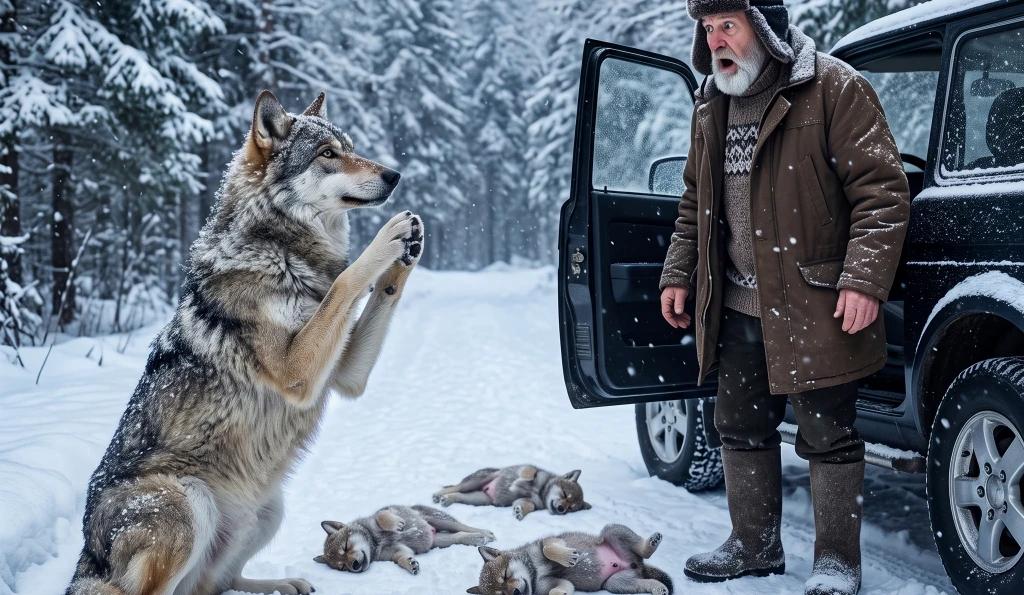
Then a smaller shape rolled in the brown water spilling from the culvert.
Eli killed the engine. In the sudden quiet he heard the creek pushing under the road, the tick of hot metal beneath the hood, and a thin sound he first mistook for a branch rubbing another branch. It came again. A pup.
The female wolf stood with her front legs braced and her hindquarters low. A cable ran from her right rear leg to a spruce root, bright where her pulling had stripped away the snow. One ear ended in an old ragged notch. Her belly hung loose with milk, and between her and the culvert lay six pups no bigger than work gloves, their dark fur pasted flat by meltwater.
Their eyes were still sealed; they were not two weeks old, if that. The world should still have been dirt walls, their mother’s body, and sleep.
Eli’s left knee had begun its weather ache twenty miles ago. Now it went quiet beneath a cleaner kind of pain.
He reached for the charged satellite phone secured above the visor. Hannah had mailed it to him after he fell on the woodshed steps two winters earlier and lay there until he managed to crawl to the porch. He had called the gift an expensive orange worry brick and left it in its box for three months. Tonight its screen found a signal before his cell phone did.
The county dispatcher transferred him to Ben Vang, the Washington Department of Fish and Wildlife officer on call. Eli gave the road, the culvert number, the cable, the litter, and the water rising around them.
“Stay outside her reach,” Ben said through the small speaker. Wind worried the connection, but his voice stayed level. “Do not cut that cable. If she gets loose frightened and injured, we lose her in the storm. Can you move the pups without crossing the length of the line?”
Eli studied the churned snow. The cable let the wolf reach the ditch but not the asphalt. Four pups lay beyond its sweep on the road side; one was lodged against a stone in the shallow runoff. A fifth lay deeper in the water at the arc’s outer edge. The sixth remained between the female’s forelegs, close enough for her nose to touch its back whenever she lunged.
“Five of them,” he said. “The sixth is inside her reach.”
“Move only the ones the water can take. Use a barrier. Dr. Mercer is coming with me.”
Eli closed his eyes once.
Of course Hannah was coming. She directed the large-carnivore program at Kettle River Wildlife Center and held the state wildlife-rehabilitation permit and large-carnivore endorsement required to receive the family there. She was also his daughter, which meant she could identify every variety of his stubbornness before he had finished arranging it into an argument.
He took a plastic storage tote from beneath the truck cap, lined it with the wool blanket he kept for winter breakdowns, and used the tailgate as a windbreak. With the rigid lid between him and the ditch, he moved only the four pups well beyond the cable’s full sweep. The female struck at the snow when he reached for the nearest one, but the line stopped her well short of him.
“Easy,” he said, though he knew the word meant nothing to her.
His voice might have. It was the same low register he had once used in a transport bay full of diesel smoke and frightened nineteen-year-olds, when a calm lie could keep a man still long enough to stop the bleeding. Eli hated that the voice had survived when some of the men had not.
The pup against the stone was cold and slack. He lifted it with both hands anyway.
One. Then another whose mouth opened soundlessly against his thumb. A third made the faint branch-rubbing cry. The fourth kicked once when the blanket touched it.
Snow collected on Eli’s shoulders while he stood calculating cable, distance, water, and time. He had spent twenty-one years after the Army rebuilding diesel engines because machines admitted what they needed: pressure, fuel, compression, heat. Ignore a damaged part and the failure still made sense when it came.
The pup gave him no gauge, only a mouth too cold to cry.
The current turned the fifth pup slowly, nose toward the culvert. Eli pulled the truck’s snow shovel from behind the seat, lay flat on the edge of the road, and extended the broad plastic blade into the ditch. He did not touch the wolf. He guided the pup across six inches of water until he could reach it without entering the cable’s sweep.
The female lunged. The wire drew tight, and she fell hard enough that Eli heard her breath leave.
He almost rose and went to her. The old impulse arrived whole: move toward the body, take the weight, do something before thought had time to become fear.
Then he saw Andre Bell beneath a broken wall outside Ghazni, one hand visible through dust while the lieutenant shouted that the roof was still coming down. Eli had gone in once and brought out two men. When he turned back, the doorway folded into the street.
For years he had remembered only the step he had not taken.
Tonight he stayed where he was because Ben had told him what another step could cost. He slid the fifth pup into the tote and backed away.
The sixth remained between the female’s forelegs. She lowered herself over it, sides heaving, her torn ear flattened into the wet fur of her neck.
“Five in the truck,” Eli told Ben. “One with her.”
“Good. That is enough. Keep the cab warm, not hot. Don’t feed them. We are eleven miles out.”
Eleven miles took forty-three minutes in the storm. Eli spent them moving between the cab and the edge of the headlights. He warmed the pups gradually beneath layers of dry cloth, then stood where the female could see him without being crowded. Each time he checked, her eyes found his hands first.
Twice, a white light appeared among the trees above the creek. It was too low and steady to be lightning. The second time, Eli heard the thin whine of a snowmobile moving away without its headlamp.
He reported it. Ben’s pause was brief but not empty.
“Do not follow it.”
“Wasn’t planning to.”
“That answer would comfort me more if I didn’t know you.”
Ben had helped search for Eli after the woodshed fall. Hannah had apparently given him the complete operating manual.
Amber roof lights finally pushed through the snow. A state truck stopped behind Eli’s, followed by Hannah’s high-roof veterinary van rocking in the ruts. Ben stepped out first, compact and deliberate in a green field jacket. Hannah came around the van carrying a hard-sided case, her dark hair twisted under a knit cap and melting snow bright on the shoulders of her coveralls.
At thirty-nine she had acquired the stillness of people who worked near teeth. She looked at the wolf before she looked at Eli.
“Tell me what changed,” she said.
No hello. No question about his knee. He was grateful and irritated in equal measure.
He gave her the count, the time, the cable, the light in the trees. Hannah listened while pulling on gloves. When he finished, she glanced at his wet jeans and the red scrape along one wrist.
“Did she get you?”
“Spruce branch.”
“I’ll decide whether I believe you after daylight.”
Ben’s mouth shifted, though not quite into a smile. He closed the road at both ends by radio while Hannah prepared the equipment she needed. She approached only after the female had been safely immobilized from a distance. Even then, nobody hurried. Hannah checked breathing and circulation before Ben cut the cable and slipped it, mud and all, into an evidence bag.
The wolf’s right rear leg was swollen, the skin beneath the loop raw but not crushed. The torn ear was long healed. Worn teeth and scattered scars suggested an adult female who had survived several hard seasons, not the ancient creature Eli’s first glance had invented.
They found the sixth pup still tucked against her chest. It was warmer than the others and protested when Hannah lifted it. That small, indignant sound made Eli turn toward the truck because the alternative was letting three people watch his face.
The rescue team used his capped truck bed as a windbreak while Hannah worked on the litter. Heat packs were wrapped, not pressed against skin. Airways were cleared. Numbers were called softly and written down. One pup began to move with purpose. Another rooted weakly against a folded towel.
Two never responded.
Hannah did not work less carefully after she knew. She listened again, changed position, waited, and finally covered the two small bodies with a clean cloth. Then she sat back on her heels.
“Four,” she said. Her professional voice held. Her daughter’s voice did not quite. “We have four.”
Eli nodded. He had counted bodies beneath another kind of weather and spent years rearranging the order in which he might have reached them.
The pass to Kettle River was closed by a jackknifed plow, so Ben authorized one night of emergency stabilization in Eli’s heated workshop, five miles down the lake road. Hannah rode with the sedated female in the transport van. Ben followed with the evidence. Eli drove first, his wet gloves steaming on the heater vents.
His workshop had housed transmissions, a canoe with a split keel, and once a neighbor’s mare during a wildfire. It had never held a wolf family. They banked the woodstove, screened off the tool benches, and positioned the secure transport enclosure so the mother could recover near the pups without anyone reaching through the barrier. When she began to wake, the four living pups were warm enough to nurse.
During storms that threatened the power lines, Wade Pritchard usually arrived before dawn with generator fuel and coffee. Eli had stopped arguing with the habit years ago.
The wolf lifted her head unsteadily at the first sound the pups made. Her gaze passed over Hannah, Ben, and the walls, then fixed on Eli standing nearest the door. He placed one hand flat on the concrete and kept the other at his side. After a long moment, she turned from him and lowered her muzzle to the litter.
The pups disappeared against her belly, four small movements under gray fur.
Ben crouched beside the sealed evidence bag. The cable was dark except for a short sleeve of red plastic near the stop. Outside, snow softened the tire tracks on Miller Creek Road, including whatever the unlit snowmobile had left behind.
“We’ll go back at first light,” he said. “Who knew wolves were using that crossing?”
Eli looked at the red sleeve and remembered a trail-camera image from three weeks earlier: a torn-eared female stepping across Miller Creek at dusk. He had texted it to Wade Pritchard after Wade lost a bred heifer on the north pasture. Two days before, Wade had complained that officials would not believe him until somebody held a wolf still long enough for them to see it. Eli had treated the remark as anger.
Wade had texted back, Where exactly? Hannah watched the answer form in his face. “Dad,” she said. “Did you send Wade the pin…”
To read the rest of the story – CLICK the NEXT button 👇👇👇