


The exterior camera showed that Roscoe had been outside the quarantine barn for at least twenty minutes, lying with his black muzzle pressed to the gap beneath a steel service door. Each time the blind calf called from Stall Three, the engraved brass tag on his collar clicked once against the concrete.
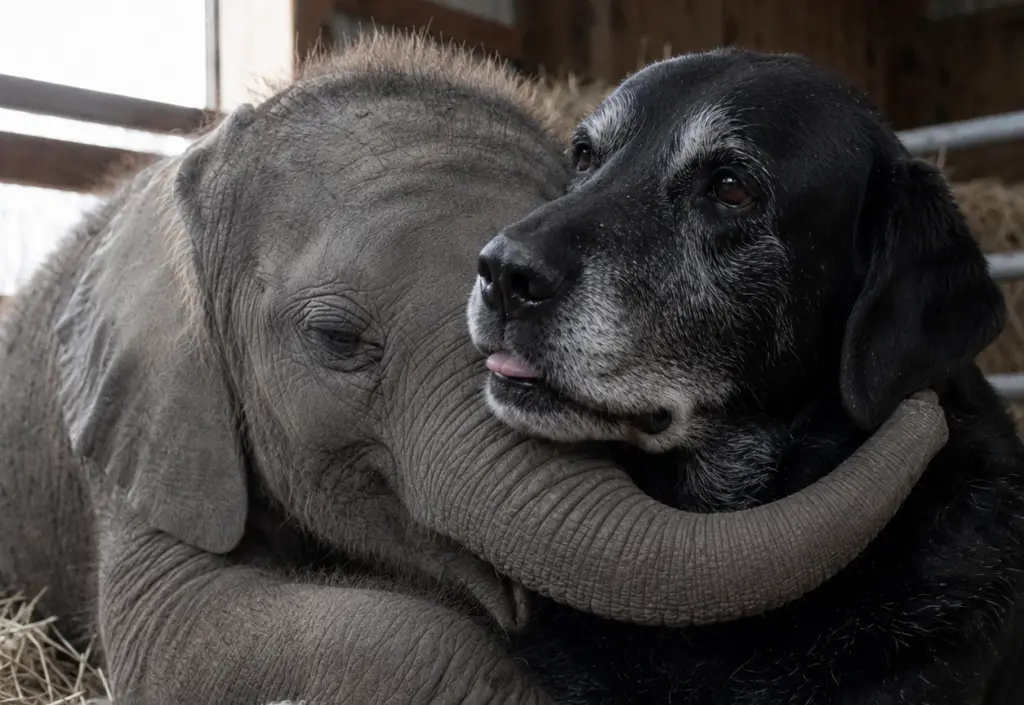
Tess Larkin, Hickory Bend’s fifty-one-year-old senior elephant-care manager, knew every sound in the quarantine wing—the exhaust fan above the wash bay, the soft alarm from the fluid pump, the scrape of an elephant’s foot against rubber flooring. The tag did not belong among them.
Inside Stall Three, five-month-old African elephant Nia had taken only a few voluntary mouthfuls of formula since a court-ordered transfer brought her from a private Florida animal park six days earlier. Dense, opaque corneal scars left by inadequately treated ulcers had made her permanently blind, and her mother had died before the transport team arrived.
Two restraint-assisted feedings and supportive fluids had kept the calf alive, but each forced intervention made her more frightened of human approach. If she could not begin taking meaningful milk by choice, Tess and Dr. Lena Ortiz would soon have to decide how much more treatment Nia could bear.
Tess stepped into the exterior service yard and found Roscoe exactly where the monitor had shown him. He did not lift his head when the door opened. His ears moved, but his eyes stayed on the dark slit beneath it.
“You can’t be here,” Tess said.
The dog’s tail brushed the concrete once, but he did not rise.
Six weeks earlier, Roscoe would have risen at the first sound of Tess’s voice. Since Walter Greene’s death, the dog had begun leaving some meals unfinished and sleeping beneath the workbench in the empty maintenance cottage.
From inside Stall Three came another low, rough call. The sound ended in a breathy catch. Roscoe raised his head.
Tess reached for his collar. Before her fingers touched it, the dog stood and stepped away without cowering. The brass tag struck the buckle with a light double tap. Behind the door, the calf went quiet.
Tess held still. She waited for the usual movement inside—the restless sweep of a trunk over the floor, the bump of a shoulder against the padded wall. Nothing came.
“Lena,” she called through the open service door. “Come listen.”
Dr. Lena Ortiz appeared in the inner corridor with her reading glasses pushed into her hair. She had changed out of her field clothes hours ago, but a crescent of dried formula still marked one sleeve of her scrubs.
“If that dog crossed the red line—”
“He didn’t.” Tess pointed to the outer door. “Listen to Nia.”
Lena looked through the narrow inspection window. Nia stood near the rear wall, angled away from them. She was already too large for any person to move without a transport platform and a trained crew, yet illness had left her gaunt. Her ribs and hips showed beneath loose skin, and both eyes were opaque with old scarring.
Tess had spent twenty-seven years watching elephants from the feet upward. Feet told her whether the body might move. Ears told her how soon. A trunk could be searching, warning, asking, or defending before a human saw any difference at all. Now Nia’s right ear was turned toward the outer service yard.
Lena heard the tag when Roscoe shifted his weight. Her expression changed, though only slightly.
“Coincidence,” she said.
“Maybe.”
“And even if it isn’t, he stays outside.”
“I know.”
They returned to the feeding port. Tess warmed a fresh bottle in the water bath while Lena checked the calf’s line and listened to her chest through the bars. The formula smelled faintly sweet and grassy. It had been mixed for Nia by the refuge nutrition team, adjusted twice since her arrival, and offered in every approved nipple they owned. The formula did not appear to be the immediate problem.
Tess crouched beside the protected-contact panel and set the bottle in the low cradle they had bolted to the bars. She did not reach through. She spoke before moving it, the same plain sequence she had used at every feeding.
“Bottle coming, Nia. Low and left.”
The calf’s trunk lifted. For one hopeful second, it drifted toward Tess’s voice. Then the scent of the rubber toe guard on Tess’s dedicated quarantine boot reached her. Nia jerked backward. Her rear foot skidded on the rubber, and her head struck the padded wall with a flat, sickening sound. Tess pulled the bottle away.
“Enough,” Lena said.
“She barely touched it.”
“I said enough.”
Nia had not always recoiled from Tess. On the first afternoon, feverish and exhausted, she had let Tess wipe discharge from her face. On the second night, the team had used brief sedation to place an IV catheter and a temporary enteral tube. When her condition declined again the next day, Tess authorized a second restraint-assisted feeding.
She could still hear herself giving the order to close the shift gate while Nia searched for an exit with her trunk. The procedure had bought them time. Tess feared it had also made the calf link human boots, the feeding setup, and a narrowing gate.
Lena removed her glasses from her hair and rubbed the bridge of her nose. “Supportive care is keeping her stable. It won’t do that indefinitely.”
“I know what the chart says.”
“Then stop arguing with me as if I wrote it to be cruel.” Lena lowered her voice. “If she keeps refusing meaningful feeds, we have to decide how much more intervention she can bear. Not next month. Soon.”
Tess looked at Nia’s trunk, coiled tight beneath her chin. “I’m not asking to restrain her again.”
“You were about to ask for one more try.”
She had been. That was the part Tess could not defend.
The outer tag clicked again. Nia’s trunk loosened by an inch. This time Lena saw it.
Callie Greene came across the gravel service yard in rubber clogs and Walter’s old canvas jacket, carrying Roscoe’s leash. Unable to sleep, she had been clearing a cabinet in the maintenance cottage before dawn when the dog nosed through the half-latched yard gate.
Walter had raised Roscoe from a pup, and for seven years the dog had ridden beside him in Hickory Bend’s dented maintenance truck. After Walter’s death, Callie had taken legal responsibility for Roscoe and brought him to the fenced cottage yard during the day. Lena had examined him and cleared him to be on the grounds, but not inside an animal-care area.
Callie apologized for the loose gate first. Her next question was sharper after Tess explained what they had observed.
“You want to put him in with an elephant?”
“No,” Lena said before Tess could answer. “He does not enter the stall, the inner corridor, or the clean side of the quarantine line.”
Tess showed Callie the layout. Stall Three opened through elephant-rated vertical bars onto an empty keeper lane. A clear sealed panel on the far side separated that lane from an independently ventilated exterior observation bay, leaving several feet between Nia’s full reach and the dog. Sound carried through the structure, but the animals could not share air, floor space, or physical contact.
“Ten minutes,” Lena said. “Roscoe stays in his harness, with the lead in your hand. If either animal shows sustained distress, you leave. He gets to leave before that if he wants to.”
Callie glanced down at the dog. “And nobody makes him perform.”
“Agreed,” Tess said.
Callie studied her long enough that Tess knew agreement had not yet become trust. Tess opened the controlled exterior gate, and Callie walked Roscoe into the service bay.
Nia heard his nails before he came into view of the clear panel. Her head lifted. The right ear moved first, then the left. Roscoe stopped beside Callie’s knee and listened to the breathing and shifting feet on the other side.
He did not bark. He looked at Nia once, turned sideways, and lowered himself to the concrete.
The calf remained at the rear wall. Tess watched the pressure shift through her feet. One forefoot eased forward, then the other. Her trunk uncoiled and moved over the floor in a slow arc.
Roscoe laid his head on his paws. His tag touched the concrete.
Tap. Nia took one step.
Nobody spoke. Callie held the lead short enough to stay off the floor without tightening it. Lena stood near the remote gate controls. Tess remained beside the feeding cradle with both hands visible.
Nia crossed half the stall, stopped, and stretched her trunk between the inner rails. The tip hovered over the empty lane as she tracked the faint clicks and floor vibrations. Roscoe lifted his head from beyond the clear panel. He could have backed away deeper into the bay.
Instead he moved one forepaw to the base of the clear panel. Nia lowered her trunk to the concrete on her side. Gray skin and black fur came to rest opposite each other across the empty lane.
Nia snatched her trunk back, but Roscoe did not rise. His tail struck the concrete once, and the brass tag gave another small click. The calf reached again. This time she left the tip of her trunk on the floor opposite his paw for the length of two breaths. Tess slid the bottle into the cradle from the side.
Nia found the nipple while her trunk still pointed toward Roscoe’s side of the barrier. She mouthed the rubber, released it, then returned. Tess kept her hands off the bottle. The calf drew in a little formula and swallowed.
The sound was small. Tess felt it in her chest anyway.
Nia took three more swallows before Roscoe stood. Callie checked the wall clock and gathered the leash without tightening it. At the first step toward the exterior gate, Nia dropped the nipple and gave a low contact call. Roscoe stopped.
Callie did not pull him back. Tess did not say his name. The dog looked at the open gate, then at the calf, and turned on his own. He lay down where he had been, the tag settling against his chest. Nia found the nipple again.
Callie’s hand remained loose around the leash. “What happens when she only drinks because he’s here…”
To read the rest of the story – CLICK the NEXT button 👇👇👇