


The first time Mosi made the shape of an embrace, Ray Calder had a transfer key in his hand and no idea why. He stood in the keeper aisle at Rainwood Wildlife Center, safely outside the gorilla dayroom. Every animal door showed secured on the status board, and the second keeper—Tessa Moreno—was six feet away with the checklist. Nothing dangerous had happened. Ray had simply stopped in the middle of a sequence he could once have performed half-asleep, rubbing his thumb over the blue plastic tag marked SOUTH as if the next step might return through friction.
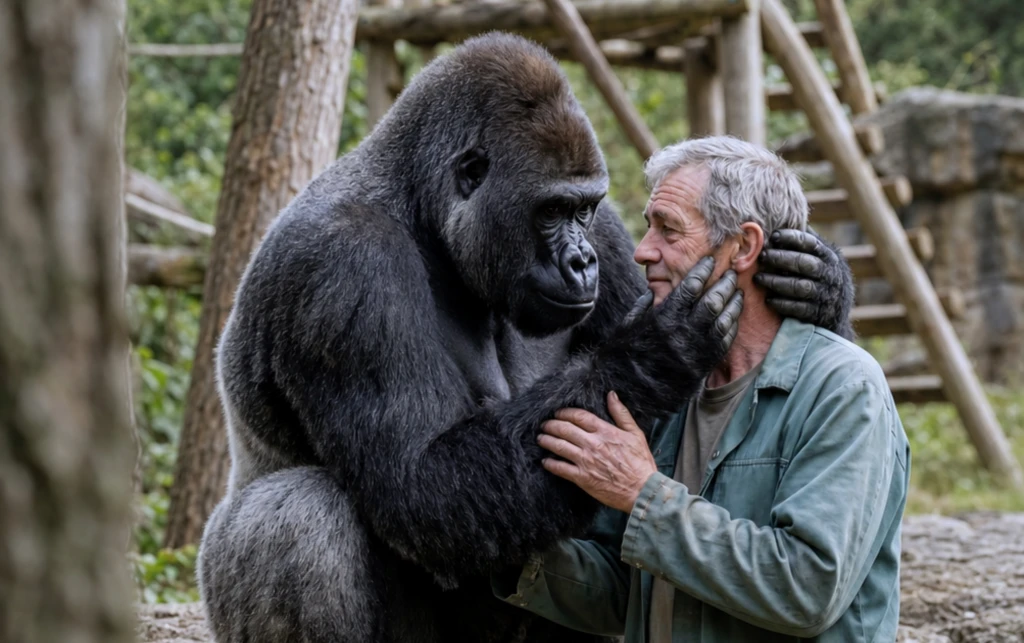
Mosi noticed before Tessa spoke. The silverback left half a fig on the concrete, crossed the dayroom, and settled at the designated protected-contact training panel, where the steel openings were too small for a grasp. He placed one broad palm on either side of Ray’s shoulders, then curved his forearms along the barrier. Steel separated them, but the shape around Ray was unmistakable, and a low, rolling sound came from Mosi’s chest.
Ray looked at the blue tag again. South dayroom. Check the upper latch indicator, read the door number aloud, wait for Tessa’s confirmation, then use the key.
“Door six secured,” he said.
Tessa checked it. “Confirmed.”
The instant Ray completed the sequence, Mosi eased back. He did not return to the fig. He sat close to the mesh and watched Ray finish the shift.
In the daily log, Tessa wrote: Mosi left food and “embraced” R.C. at mesh during pause in transfer routine.
Ray drew a line through “embraced.”
“Sustained proximity,” he wrote above it.
Tessa leaned over his shoulder. At thirty-six, she still had the habit of reading upside down that Ray had failed to break in eleven years. “He put both arms around you.”
“Around the general location of me. There was a barrier in between.”
“That’s why I wrote ‘at mesh.’”
Ray capped the pen. “If Elise sees ‘embraced,’ we’ll spend the afternoon explaining to administration that I have not been cuddling a four-hundred-pound silverback.”
“You could leave it in quotation marks.”
“Quotation marks are where people put words they want to get away with.”
Tessa smiled, but she did not change the entry back.
Mosi was twenty-nine and sparing with contact, even by gorilla standards. He lived with three females and a young male in the center’s western complex, and his keepers worked protected contact: human on one side of a barrier, gorilla on the other, always. Ray, fifty-six, had been lead gorilla keeper for fourteen years. Mosi cooperated because the routine gave him choices, not because anyone mistook trust for tameness.
Ray had helped build that trust from the year Mosi arrived at Rainwood. At first, the young gorilla would not approach a training panel if a person faced him directly. Ray learned to turn one shoulder, lower his eyes, and wait. It took nine months before Mosi placed two fingers against the mesh opposite Ray’s knuckles. After that came small permissions—an offered shoulder for inspection, an open mouth for dental checks, a steady hand presented for blood draws. The work accumulated too slowly to impress visitors and mattered too much to rush.
Ray knew the pale scar under Mosi’s left wrist and the way his lower lip tightened before he refused a request. Mosi knew the drag in Ray’s right step from an old knee injury, the three-note whistle that began the morning shift, and the sound of his key ring before he turned the corner. Their shared language was mostly timing.
That was what troubled Ray about the pause at door six. Not that Tessa had seen it, or even that Mosi had. It was that Mosi had answered it.
Over the next three weeks, the behavior returned. Mosi came to the mesh when Ray lost the name of a piece of equipment and stood staring at the item in his own hand. He came when Ray began the morning whistle, stopped after two notes, and had to start again. Once, during enrichment preparation, Ray asked Tessa where the frozen berries were, listened to the answer, and asked the same question less than a minute later.
Mosi had been across the room stripping bark from a willow branch. At the second question, he carried the branch to the mesh and sat with his shoulder pressed against it until Ray found his place on the prep list.
Tessa stopped joking about quotation marks. Dr. Elise Navarro, the center veterinarian, examined Mosi and found no sign of pain or illness. The animal-care team checked changes in food, staffing, construction noise, the females’ cycles, and the young male’s behavior. Nothing explained why Mosi sought the barrier only with Ray, or why he did it most often when Ray stalled.
Ray had explanations ready. He was sleeping badly. The heat had dragged into September. Everyone forgot a word now and then, and Tessa, for all her good intentions, had begun watching him with the concentration she usually saved for a lock that refused to show green.
Most of those things were true. The truth was in a folder beneath old tax returns at home: after months of appointments and testing, a neurologist had diagnosed mild dementia from younger-onset Alzheimer’s. Ray had known for eight days and had told no one at Rainwood.
On a Wednesday morning, Ray found his pocket notebook in the produce cooler. He had gone in for kale and come out with nothing, leaving the book beside a crate of yams. Tessa returned it without comment, but Ray saw the damp mark from Tessa’s thumb on the cover.
His phone lit on the counter before he could pocket it: NEUROLOGY FOLLOW-UP, 2:15 P.M. Tessa read the reminder and said nothing. Ray turned the screen facedown.
“You’ve been keeping track,” Ray said.
They were alone in the prep kitchen. Through the small window in the door, Mosi’s dayroom showed in gray pieces: climbing timber, straw, one massive dark shoulder passing the glass.
Tessa set a tray of cut peppers on the counter. “I keep track of everything in this building. You taught me to.”
“Not like this.”
“You put the wrong date on his weekly weight check yesterday.”
“I corrected it.”
“I corrected it.”
Ray opened the notebook. His own handwriting covered the pages in tight black lines—feeds, weights, training goals, a reminder to replace the cracked handle on the south hose. On the previous page, halfway down, he had written tell Dana before Friday. He closed the book before Tessa could see it.
The morning shift began late. Ray told himself that was why he lost the sequence again. The indicators were green and the locks were checked, but when he opened his mouth to read the transfer-door number aloud, the number was gone. Tessa waited with her checklist raised. Mosi crossed to the mesh.
This time Ray did not pretend to inspect the latch. He stood while the silverback placed his hands wide and brought his face close to the barrier. Mosi’s breath warmed the air between the steel squares. He made the quiet rolling sound once, then waited.
Ray rested his open palm against the mesh without touching Mosi’s fingers, then looked at the status board and forced himself to read the line from the beginning. The door number returned. So did everything else: the neurologist’s careful voice, June gripping both arms of a kitchen chair, the folder he had pushed beneath old tax returns because hiding paper was easier than hiding what it said.
After the shift, Tessa followed him into the service corridor.
“Ray.”
“We’re behind. Start the browse.”
“Does Dana know you’ve been seeing a neurologist…”
To read the rest of the story – CLICK the NEXT button 👇👇👇