


The left front caster on Miles Carter’s cleaning cart squealed once every revolution. He had oiled it twice, then put in a replacement request, and now it announced him up and down Calder Hall with the regularity of a smoke alarm whose battery no one intended to change. Most professors closed their doors when they heard it. Dr. Helen Avery did not seem to hear it at all.
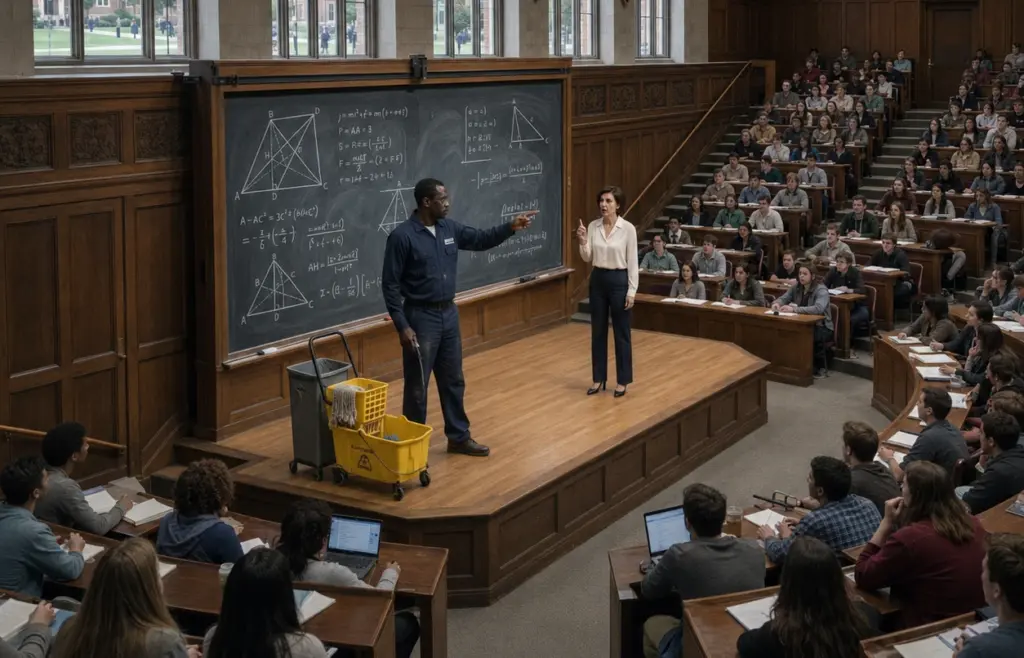
At 9:12 on a Tuesday night, she was still at the board in Room 414, holding six graduate students past the end of their working seminar. Miles waited in the hall with one hand on the cart. Through the open door, he could see three sliding panels layered with symbols and Helen’s narrow handwriting climbing toward the ceiling.
He had learned her habits during eighteen months on the north-campus shift. She used white chalk for statements, yellow for assumptions, and blue for anything she did not trust. She left coffee cups on the window ledge and never food. She thanked him if he held a door, though she always looked at the door while saying it.
Tonight there was no blue on the board.
“The cancellation happens here,” she said, drawing a clean diagonal through two boundary terms. “Once those vanish, compactness gives us the limit.”
Nora Patel, the doctoral student nearest the board, stared at her notes. The others had begun closing laptops, but Nora still held her pencil above the page as if lowering it would commit her to something.
“What if the gluing map reverses orientation?” she asked.
Helen did not sigh, though Miles saw the small pause before she answered. “Then you choose the compatible chart on the second piece.”
“But I thought the chart was fixed by the construction.”
Professor Leland, a visitor from another university, shifted in his chair. “Nora, if you’re going to challenge a standard reduction, you should probably arrive with a counterexample.”
Helen turned from the board. “She’s allowed to ask before she has one.”
The sharpness in her voice was not aimed at Nora. The student’s shoulders lowered by half an inch, and Miles watched Helen take the question seriously, walking back through two panels of work instead of dismissing it. That was the part of her the building rarely discussed: she could be ruthless about an argument and unexpectedly protective of the person making it.
She reached the yellow assumption near the upper corner and tapped it twice.
“The construction fixes the boundary as a set,” she said. “Not pointwise. That gives us enough freedom.”
It did not.
Miles looked at the clock. Rosa would be waiting for him to finish the fourth floor before they locked the chemical cage at ten. He could let the class leave, wipe away the boards, and go home to the apartment where his mail gathered unopened beneath the brass slot. By morning, Helen Avery’s false cancellation would still be in Nora Patel’s dissertation chapter, wearing the confidence of white chalk.
He tightened his hand around the cart.
On the board, Helen added a final equality and underlined it. “There. If anyone finds a defect in that step before I do, I’ll give them my invited lecture next spring.”
One of the students laughed. Professor Leland said, “Only the lecture?”
Helen’s smile came quickly, a practiced answer to a room that wanted wit from her. “Fine. The lecture, my office, and my hand in marriage. But I’m keeping the parking space.”
The students laughed more freely this time. Miles looked at the crossing arrows in the gluing diagram and heard himself say, “They have the same sign.”
The laughter stopped unevenly. Helen turned toward the door, and for the first time that night she looked directly at him.
“Excuse me?”
Miles could still have pretended he was speaking into his radio. Instead he pointed toward the two terms she had crossed out.
“The orientation changes twice. Those terms add. They don’t cancel.”
Professor Leland’s mouth bent with mild amusement. Nora looked from Miles to the board, her pencil moving before anyone else spoke.
Helen set the chalk in the tray. “The seminar is still in session.”
“I know.”
“Then you know this isn’t the time to clean the room.”
“I wasn’t cleaning it.”
The answer sounded worse aloud. Miles saw Helen’s face close by degrees, not into anger exactly, but into the expression of someone returning a valuable instrument to its case.
“Your name?” she asked.
He touched the blue patch above his pocket, though the letters were large enough to read from where she stood. “Miles Carter.”
“Mr. Carter, do you have business with the mathematics department?”
“No.”
“Have you taken this seminar?”
“No.”
Her eyes flicked to the radio at his hip, then to the cart blocking part of the doorway. She picked up her phone from the desk. “Then I need you to let us finish.”
Nora had already redrawn the gluing map. “Dr. Avery, wait.”
Helen’s thumb moved across her screen. Miles knew the university’s reporting form because Facilities used the same app for spills, blocked exits, and staff incidents. He watched her select something, then set the phone facedown.
Nora rose and carried her notebook to the board. “If he’s right about the second reversal, this arrow should point the other way.”
“He isn’t right,” Helen said.
But her voice had changed. She took Nora’s pencil, followed the diagram, and stopped at the seam between the two surfaces.
Miles knew that stop. He had lived years inside that fraction of silence: the moment when a proof resisted the person who needed it to yield.
Professor Leland leaned forward. “There may be a convention issue.”
“There isn’t,” Miles said.
Helen looked at him again. This time the composure in her face required visible effort. “You seem very certain.”
“I made the same mistake once.”
“In what context?”
He should have said it did not matter. He should have remembered that he had a union job with health insurance, an apartment whose rent he could still afford, and a supervisor who had spent six months persuading him to apply for lead custodian. Instead, he saw Nora waiting at the board with the future of her chapter balanced on a wrong sign.
“A dissertation,” he said.
Professor Leland gave a short laugh. “Whose?”
“Mine.”
Helen glanced at Miles’s cart, then back at him. The movement was small and clean and more insulting than the laughter.
“All right, Mr. Carter.” She lifted a fresh piece of chalk and held it toward him between two fingers. “Show us. If you can break the argument in five lines, perhaps I should make the marriage offer official.”
No one laughed now.
Miles entered the room. The rubber soles of his work shoes made almost no sound on the polished floor, but he felt every step. He stopped in front of Helen, leaving enough distance that she had to extend her arm to give him the chalk.
“I don’t want the offer,” he said.
“Then we agree on something.”
“I want you not to erase what I write until Nora Patel has checked it.”
Color rose along Helen’s throat. She released the chalk.
Miles turned to the fourth panel, the only one still clean. The old boards in Calder Hall had a slight drag to them; chalk did not glide so much as catch and move. His hand remembered the pressure. He drew two disks, marked their boundaries, and joined them with the simplest orientation-reversing map that would do the damage.
The first line shook. By the third, it did not.
He heard chairs move behind him as the students came closer. He did not look around. The counterexample was small enough to fit inside Helen’s broad theorem and stubborn enough to survive every assumption she had written. He labeled the two boundary contributions, carried the sign through the gluing map, and boxed the term that remained.
“That’s not the same regularity class,” Professor Leland said.
Miles added one smoothing step beneath the diagram.
Nora whispered, “It is now.”
Helen came to the board. Her perfume carried something dry and herbal beneath the chalk dust. She checked the construction from the beginning, not skipping the easy places, which Miles respected despite himself. At the last line, she took the chalk from the tray and tried to alter one coefficient.
It produced the same contradiction.
She tried a different chart. The term remained.
For several minutes the only sounds were the heating pipes and the faint electronic hiss of the projector. Miles stood with his hands at his sides, aware of the pale crescent of floor cleaner dried across one knuckle.
Helen finally lowered the chalk. “The stated lemma is false.”
Nora sat down hard in the nearest chair.
It was not triumph Miles felt. The expression on her face reminded him too precisely of another student at another board, twelve years earlier, learning that months of work had been built over empty space.
“The full result may still hold,” he said. “But not by that cancellation.”
Helen looked at the notation he had used beside the smoothing step. “That normalization is from the Carter–Sloane paper.”
“Yes.”
“Sloane never used it this way in print.”
“No.”
She studied the board, then the blue FACILITIES patch above his pocket. “Who taught you geometric topology?”
Miles placed the chalk carefully in the tray. “I was a doctoral candidate at Michigan. This construction was supposed to be the first chapter of my dissertation.”
His radio cracked at his hip.
“Carter,” Rosa’s voice said. “Report to Facilities. Now.”
Miles looked at Helen. “Was that your complaint…”
To read the rest of the story – CLICK the NEXT button 👇👇👇