


The key went in halfway and stopped. I pulled it out, checked the teeth, and tried again. I had been a Marine for thirteen years and had carried that brass key for eight of them, taped inside field desks and locked in barracks drawers from California to Okinawa. After seventeen hours of travel, it no longer opened the front door of the little brick house outside Jacksonville, North Carolina, that I had spent eight years paying for.
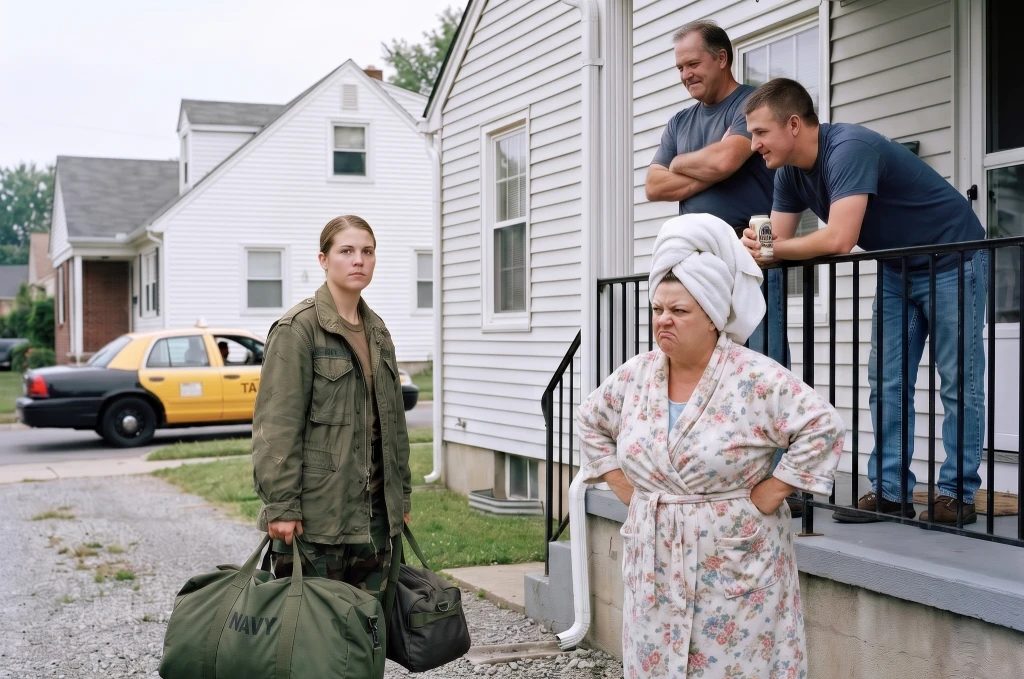
Someone moved behind the frosted glass. The door opened, and a woman I had never seen stood in my entryway holding my mother’s blue enamel bowl. It was full of cabinet screws. Mom used to mix biscuit dough in that bowl and tap the wooden spoon twice against its rim, the sound that brought Danny and me to the table on Sunday mornings.
“Can I help you?”
Behind her, the living room had been rearranged. My sofa was gone. A rolled rug leaned against the wall where my framed promotion warrant used to hang. Through the opening to the kitchen, I saw my father folding a moving blanket over my toolbox while my older brother, Danny, carried a box out of the hall.
My father looked up. His hands stopped, but the blanket kept sliding until one corner touched the floor.
“Rachel,” he said. “You’re early.”
I lowered my sea bag from my shoulder. “By four days.”
Danny set down the box. He had the same narrow face he’d had at nineteen, but now it looked used up around the eyes. “We thought you were coming Monday.”
“I was.” I looked at the stranger. “Then my flight changed.”
She shifted the bowl against her hip. “I’m Nora Ellis. I bought this house. Your father said they were clearing the last things from the garage.”
I had seen her name on the recorded deed. Until that moment, it had been ink on a county document, not a woman standing barefoot with my mother’s bowl.
The sentence was plain enough. My mind still tried to route around it, the way a convoy routes around a washed-out bridge before somebody admits the road is gone.
I looked at Dad. “Tell me she has the wrong address.”
He smoothed the moving blanket with both palms. He had always been good with his hands. He could splice a wire in a dark crawl space, square a door that had swollen in August, or catch a falling dish before it reached the floor. When I bought the house eight years earlier, he spent six Saturdays teaching me how to hang cabinets and never once made me feel foolish for holding the drill wrong.
It was the first address in my adult life that had lasted longer than a set of orders. I kept one closet empty when I deployed and left clean sheets on the bed, small preparations for the version of me who would return tired and need nothing explained. Dad knew what the place meant because he had helped me make every room usable.
Now he wouldn’t meet my eyes.
“We had to make a decision,” he said.
“About my house?”
“Danny was in trouble.”
Danny breathed out through his nose. “Don’t start like you already know everything.”
Nora’s fingers tightened around the rim of the bowl. She looked from one of us to the next. “Mr. Mercer said you had agreed to sell.”
“I did not.”
My father stepped toward the door. “Rae, put your bag in the garage. We can talk somewhere else.”
“The garage belongs to her too, apparently.”
Nora flinched, and I regretted the words as soon as they landed. She had not changed my locks or emptied my rooms to injure me. She was standing barefoot in a house she believed she owned, caught between three people who shared a history she had been sold along with the appliances.
I forced my voice down. “When did you close?”
“A week ago Tuesday,” she said. “I got the keys yesterday.”
Nine days. The county alert had reached me eight days ago while I was still in Okinawa, a subject line on my phone that read RECORDED INSTRUMENT NOTICE. I had spent the next three days getting a scanned copy of the deed, then taken it to the legal assistance office. I knew my father had signed something and Nora Ellis was the buyer. I had not known she had already taken possession.
Dad saw recognition move across my face.
“You knew,” he said.
“I knew there was a deed.”
“And you came here without calling?”
The accusation was thin, considering what he had done, but it found its mark. I had wanted to see his face before he could build another explanation. I had told myself that documents were safer than voices and that four days would not change anything already recorded.
Nora set the bowl on a small table just inside the door. “Does somebody want to tell me what’s happening?”
Dad rubbed the back of his neck. “There’s a misunderstanding over the power of attorney. That’s all.”
“There is no misunderstanding,” I said. “The power of attorney I gave you covered the insurance, utilities, and emergency repairs while I was overseas. It specifically excluded selling or borrowing against the property.”
Danny gave a short laugh. “You always talk like you’re reading people their rights.”
“And you always joke when the numbers are bad.”
His mouth closed. Dad stepped between us, not threatening, just placing his body where he had placed it since we were children.
“I kept this place standing every time you left,” he said. “Storm shutters, busted water heater, that leak over the laundry room. You trusted me then.”
“I trusted you to keep it standing.”
The words changed his face. For one second I saw the man who had waited outside the processing station when I first enlisted, holding two coffees long after his had gone cold. Then he looked toward Danny, and the softness disappeared behind the old reflex to protect him.
Nora picked up her phone from the table. “I have the closing packet.”
Dad turned. “You don’t need to show her anything until we speak to the closing office.”
“She says she owns the house.”
“I do own it,” I said.
“And I paid for it.” Nora’s voice had become quieter, not weaker. “So I’m going to look at the papers.”
She walked toward the kitchen. I stayed on the porch because she had not invited me in. That detail seemed absurd, but it mattered. Danny leaned against one of the porch posts Dad and I had replaced together. The screw heads were still flush and evenly spaced.
“How much?” I asked him.
“How much what?”
“How much trouble were you in?”
“Dad said we’d explain.”
“I’ve heard Dad explain you since I was a kid.”
His eyes sharpened. “You haven’t been here for most of those years.”
Before I could answer, Nora returned with a thick paper folder. She crouched by the table and spread the documents over its narrow top: purchase agreement, title commitment, settlement statement, recorded deed. My father moved closer, but Nora placed one hand flat on the papers.
“Please don’t touch these.”
He stopped.
I took the limited power of attorney from the document sleeve inside my sea bag. The base legal assistance office had prepared two originals before my rotation. Mine still carried the small crease where I had folded it around my passport, and the final paragraph was exactly as I remembered: no authority to sell, convey, pledge, or encumber real property.
Nora found the copy from her closing packet. Behind my genuine limited document was a separately notarized paper titled AMENDMENT TO POWER OF ATTORNEY.
It purported to supersede the real-property restriction and give my father broad authority to sell the house and receive the proceeds. At the bottom was a reproduction of my signature beside a notary acknowledgment dated three months after I had arrived in Okinawa.
I read it twice. Logistics had trained me to distrust the first count when the count mattered. The date remained the same. So did the false page.
“That isn’t mine,” I said.
Nora lowered herself onto the edge of a box. “What do you mean?”
“I never signed this amendment. I was on Camp Hansen that day. I have duty records, travel records, and the original document.”
Danny’s gaze went to the yard. My father stayed very still.
Farther down the packet, I found a certification bearing Dad’s signature. In it, he declared that the power remained valid, that I had approved the transaction, and that he knew of no restriction on his authority. His signature was not copied. I had watched him write that slanting T on birthday cards and school forms my entire life.
I placed the two versions side by side. “Dad.” He looked at the false amendment, then at me. “Did you know I had never signed this?”
To read the rest of the story – CLICK the NEXT button 👇👇👇