


The front door at Rowan’s Grill fought Eli Mercer all the way in. Its closer had been set too hard, and the rubber tip on his cane slipped when he leaned back to keep the glass from striking his shoulder. By the time he got inside, the ache where his left leg ended had sharpened from a warning to a pulse.
He could have told anyone within ten feet what was wrong with the door. For forty years, people had brought him engines that knocked, windows that would not rise, lawn mowers that coughed blue smoke. A quarter turn on the closer arm would have fixed this. Eli kept the thought to himself.
A paper sign inside the window read THANK YOU FOR 72 YEARS—FINAL DAY: SUNDAY. Beyond it, every red vinyl booth was occupied except the narrow one beside the front window. Eli recognized its brass-edged table from the old snapshot in his coat pocket. The vinyl had been green then, and the man who had written on the back had believed he would come home to sit there.
A young man in a black ball cap crossed outside the window with a stack of flattened boxes, briefly blocking the winter light. He carried them toward the covered patio while Eli watched the empty booth.
A young server came around the counter with three menus tucked against her apron. She had dark hair twisted up with a pencil and the quick, level gaze of someone keeping six unfinished tasks in order.
“Table for one, sir?”
“Two,” he said. “But I only need one menu.”
Her eyes moved to the line forming behind him, then back to his face. She checked the clock and turned the RESERVED card on the windowsill facedown. “The Hendersons aren’t due for forty minutes. The window booth all right?”
“That’s the one.”
Her name tag said MARA. She waited while he lowered himself onto the bench, pretending to straighten the sugar jar when his prosthetic caught under the table. Eli appreciated the pretense more than he would have appreciated pity.
“Coffee?” she asked.
“Two. And one Rowan burger with grilled onions. Mustard, no pickle.”
“You know the old order.”
“I was told.”
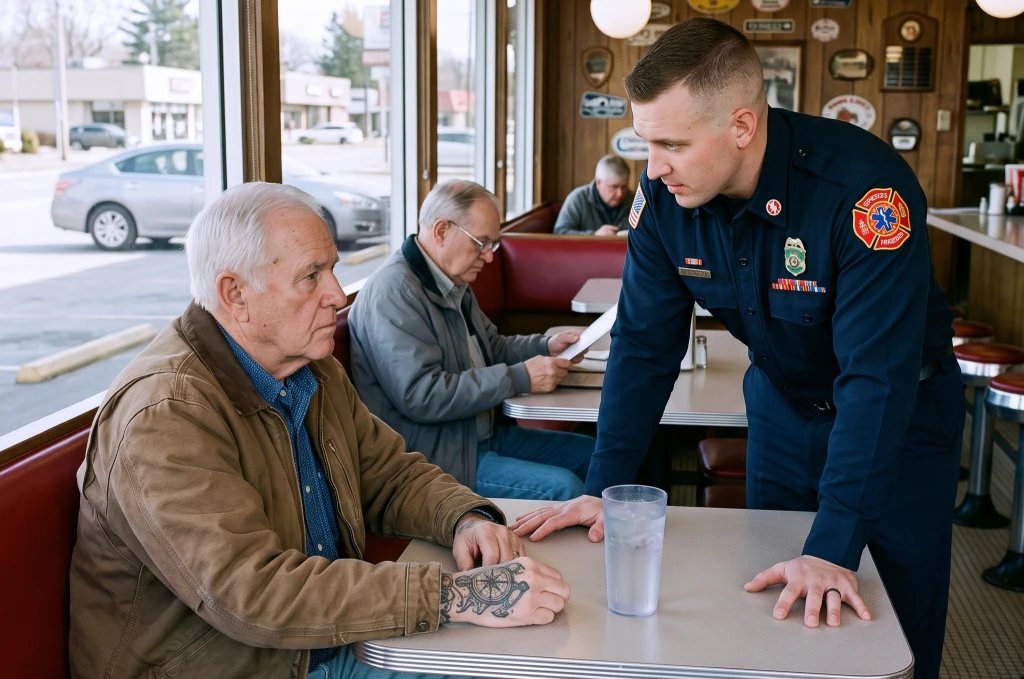
Mara set one thick white mug before Eli and the other at the place beside him, nearest the window. Eli placed two folded twenties beneath the sugar jar and rested his left forearm on the table. His cuff drew back, exposing the faded mark above his wrist: a narrow dagger laid across an anchor, one fluke deliberately unfinished.
At the large table behind him, a man in a reunion jacket noticed it.
“Navy?” the man asked.
Eli turned enough to be civil. “A long time ago.”
The man tipped his head for a better look. “That isn’t a Navy emblem.”
“No.”
“Special operations, then?”
Eli looked at the empty mug beside him. “I was attached to some men who did that work.”
The answer should have ended it. Instead, the man gave a short laugh and shared a glance with his companions.
“Attached,” he said. “That word does a lot of lifting.”
Eli could have supplied his rating, his unit, the hospital where he had awakened without a leg. He could have explained that the little mark had never been official and that none of the eight men who wore it had mistaken it for a medal. He moved the second mug half an inch until its handle pointed right, the way Owen had always turned a coffee cup before drinking.
The grill was closing because the highway had shifted traffic east and because seventy-two-year-old plumbing did not care about family history. People had come for one last meal, one last photograph beneath the old clock, one last chance to tell the owner how sorry they were while occupying tables he needed to turn. Eli had read about the closing in a four-inch newspaper notice. He had driven more than sixty miles that morning because “some other Sunday” had finally run out.
The owner emerged from the kitchen carrying a bus tub. He was in his early fifties, broad through the shoulders, with a flour mark along one sleeve and Owen’s deep-set eyes. Eli knew him before Mara called him Dad. Tom Rowan surveyed the room, counted the people waiting, and stopped at Eli’s table with its two coffees and one customer.
“Sir, I’m sorry,” he said. “The Hendersons came early. Would you mind taking a seat at the counter?”
Every counter stool was filled. Tom saw it at the same moment Eli did.
“There’s a table on the covered patio,” Tom added. “Mara can help you move.”
Mara had arrived with the burger. “Dad, it’s cold out there.”
“The heaters are on.”
“One of them is.”
Tom’s jaw tightened, not at her but at the room, the line, the fryer alarm sounding behind him. “I’ll bring him in as soon as something opens.”
Eli knew what it cost a small shop to let work pile up. Tom had not called him a fraud or asked him to leave. Still, Eli heard the easy yes come out of his own mouth and hated it; explaining why he needed this booth would have meant saying Owen’s name.
“Patio’s fine,” he said.
Mara reached for the tray, but a voice from the kitchen called her name twice. “I’ve got it,” Eli said, closing one hand around his cane and lifting the tray before she could object. The second mug rattled in its saucer as he crossed the room.
The laughter stopped. Chairs scraped inward to give him space, and several people looked down at their plates. Not one person reached for the tray.
The door closer shoved back at him. Eli caught the glass with his shoulder, but the tray tilted. Coffee climbed the rim of both cups, and the man in the black cap caught the tray from outside.
“Easy,” he said. “I’ve got the tray. You keep the door.”
He was perhaps thirty, in jeans and a dark windbreaker. The flattened boxes stood beneath the awning behind him. Mara saw him through the window and broke into a smile.
“Noah!”
“Hey, little sister.”
“We didn’t think the Navy would get you home in time for closing day.”
“Neither did I.”
Noah lifted the tray as though he had been carrying awkward loads through narrow places all his life. Eli shifted his cane and lowered himself into a metal chair. His cuff pulled back again.
Noah stopped. His attention fixed on the unfinished fluke of the anchor, and the ease left his face. He set the tray squarely on the patio table, took off his cap, and looked at Eli with a concentration that seemed to exclude the people gathering behind the glass.
“May I ask your name?”
“Eli Mercer.”
Noah looked from Eli’s face to the unfinished anchor. “That name is on the back of my grandmother’s photo of eight sailors. All eight names are listed beneath a drawing of this mark. My grandfather was Owen Rowan.”
Noah stepped closer. “Were you with Owen Rowan the night he died…”
To read the rest of the story – CLICK the NEXT button 👇👇👇