


The docking lock made the wrong sound and then gave Danny Reyes a green light. He heard it from beneath a Subaru on the other lift: three quick metallic knocks, a strained electric buzz, and finally the heavy clack the floor unit was supposed to make once. By the time he rolled out, the lowered-floor minivan in his second bay had gone still. A green lock symbol glowed on the dash.
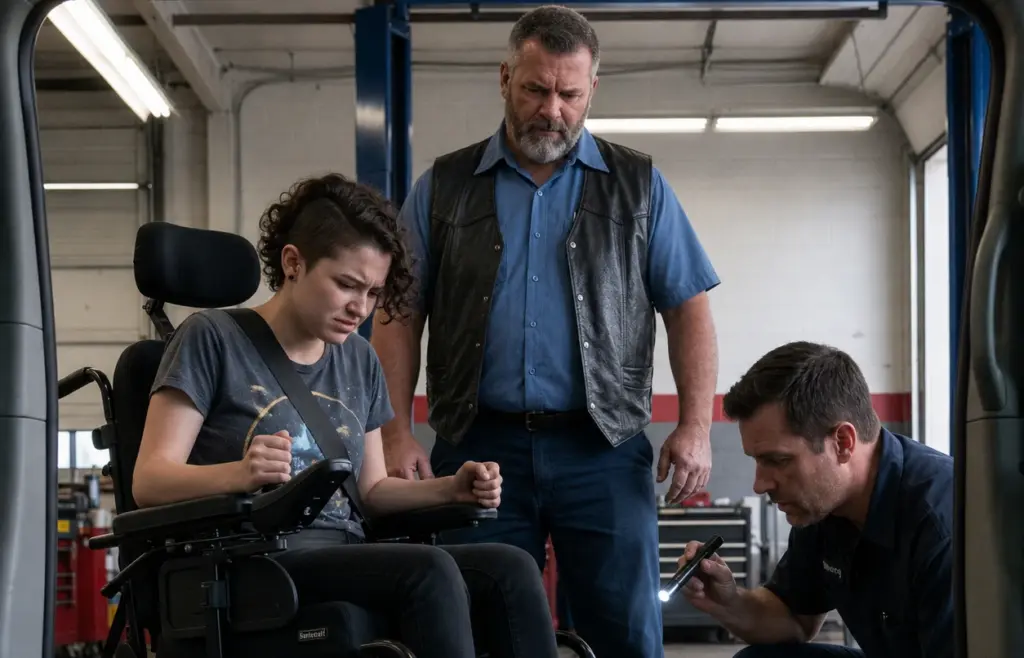
Nora Bell, nineteen according to the work order, looked down at it as if it had just lied under oath.
Danny pushed himself upright against the tire rack, waiting for the left leg to remember its job. “Don’t move yet.”
Her father, Wade Bell, turned beside the open sliding door. He was broad through the shoulders, with a gray-shot beard and a black leather vest over a clean blue work shirt. The patch across his chest said RED WASH VETERANS RIDERS, not the name of any club Danny knew. Even standing quietly, he took up enough room to make the bay seem poorly measured.
“Wasn’t planning to,” he said.
“I meant her.”
“Then you should probably look at her when you say it.”
Danny did. The driver had dark curls shaved close over one ear and a power chair fitted low beneath her. She had one hand on the joystick and the other resting near the van’s release switch. A faded astronomy T-shirt showed beneath the shoulder belt.
“I wasn’t planning to move either,” she said. “But it’s nice when the men establish jurisdiction.”
The big man closed his eyes briefly. “Nora.”
“Wade.”
The exchange had the smooth wear of a family joke used often enough to remain useful.
Danny crossed the bay without touching the van. At thirty-eight, he owned Reyes Automotive, two lifts, one employee who now came three afternoons a week, and an evaporative cooler that treated a Tucson July like a personal insult. The office window held two envelopes he had turned facedown so customers could not read FINAL NOTICE through the glass. The Subaru on the other lift was a cash brake job he needed to finish before noon, but the sound had already rearranged his day.
He crouched near the open door. Years earlier, after twelve years as an Army mechanic ended in medical retirement, he had spent six years installing and servicing lowered floors, ramps, hand controls, and docking systems at an adaptive-vehicle shop north of town. He had kept his vehicle-equipment training current after the company was bought and the service department moved to Phoenix; community transport vans still came through his garage for ramps, lifts, and floor locks. Danny had liked the work because every measurement ended somewhere human, and he had used most of his severance and too much credit to open this place.
These days he changed alternators and tried not to count empty hours.
“Can you tell me what you were doing when it made that noise?” he asked Nora.
“Docking.”
“I got that far.”
“Good. Your sign says diagnostics, so I wanted to establish a baseline.”
One corner of Wade’s mouth shifted. Danny suspected Nora had inherited her delivery from him and refined it for sport.
Nora looked down toward the floor unit. “Normal approach. Slow speed. It catches, argues with itself, then the light goes green.”
“How long since the replacement?”
“Three weeks,” Wade said. “The original quit releasing. The shop in Phoenix put in the same model. We went back once. They ran the electronic check and said it was secure.”
“It is secure,” Nora added. “According to the tiny green authority.”
Danny lay on his good side at the threshold, keeping both hands where she could see them. The wheelchair’s docking pin sat inside the vehicle-mounted receiver. From above, the engagement looked complete. Beneath it, however, fresh silver showed through black coating along only one edge of the receiver throat. The opposite side still held factory paint.
He moved his gaze outward. Nora’s front casters were turned slightly left. The right one sat flat on the lowered floor. Under the left wheel, a thin crescent of light showed.
“Did you stop with your casters like that?” he asked.
“They turn themselves when the dock pulls me the last inch.”
“Would you hold still while I use a light? I’m only looking.”
She nodded. “Looking is currently approved.”
Danny took a penlight from his pocket. The dock had been mounted square to the floor seams, which looked tidy and meant nothing. A wheelchair did not enter along a painted centerline; it followed the driver’s position, the hand-control clearance, and the path the front wheels could actually make through the cabin. The worn edge suggested the docking pin was arriving off-axis. The lifted caster suggested that, once engaged, the lock was forcing the chair to finish an alignment it had not chosen.
The indicator could still turn green. It reported that the locking mechanism had closed around the pin. It did not report what load the chair frame was carrying while it sat there.
Danny rose slowly. A hot cord pulled from his left hip to his calf, then eased. He no longer disguised that pause; hiding it only made people hurry him.
“I want to see the release,” he said. “Don’t hold the switch longer than you normally would. If it resists, stop.”
Nora pressed the dash button. The solenoid buzzed. The lock gave two dry taps but did not let go.
Her shoulders tightened before her face changed.
“Stop,” Danny said.
She released the button. Danny did not reach for the emergency lever. Instead, he asked, “Do you want your dad to operate the manual release, or do you want me to talk you through it?”
Nora studied him for a second. “Talk me through it.”
He stood outside the doorway and described the yellow handle beside her left knee. She found it, pulled, then backed her chair an inch after the latch opened. The docking pin climbed the worn side of the jaw before dropping free, and the left caster struck the floor with a small rubber slap.
Wade had heard it too. His hands closed once at his sides.
“That didn’t happen before the new unit,” he said.
“The caster lift?”
“Any of it.”
Danny put a strip of blue painter’s tape on the van floor without crossing into the wheelchair’s footprint. He marked the center of the receiver, then sighted along the scrape. The angle was small. In his old shop, a rushed installer might miss it during an empty-cycle test, especially if the diagnostic plug reported a clean lock.
He would not know the cause until the floor unit came up. A slotted base plate could have shifted during tightening. The guide could be seated wrong. The reinforcement beneath the lowered floor might be sound or might not. Each possibility led to a different repair, and none of them gave him permission to treat Nora’s chair as another assembly on his bench.
“Marcus said you worked on these,” Wade said.
“Marcus Cole?”
“You fixed the ramp motor in his van last winter.”
Danny remembered Marcus: close-cropped hair, a power chair with a scuffed left armrest, and a habit of labeling every loose fastener he brought in with orange tape. Danny had repaired a corroded connection and refused payment for the diagnostic hour. At the time, that had felt like decency. The unpaid hour looked different beside the final notices.
“Ramp motors, lifts, floor locks, hand controls,” Danny said. “Vehicle equipment. I don’t alter wheelchairs.”
Wade looked at the lifted caster, then at his daughter. “Can you fix this?”
“Maybe. First I need to know whether the misalignment is all on the van side. If it isn’t, we bring in somebody qualified for the chair side.”
“We already paid somebody qualified,” Wade said, not loudly. “Twice, if you count the trip back.”
Nora’s fingers rested against the edge of the joystick. “Dad.” He stepped away from the door at once. The movement told Danny more about him than the vest or the beard did. Danny looked at Nora. The pawl had reclosed after release, and the green symbol shone again. It reported the jaw’s position, not the presence of a chair. He pointed to the floor-mounted receiver. “Do you want me to take it apart?”…
To read the rest of the story – CLICK the NEXT button 👇👇👇