


The cold-room alarm began three minutes before Marian Holt told her children they would not inherit her company. It was a small alarm, no louder than a kitchen timer, but at sixty-four Marian had spent thirty-four years training her body to answer that particular pitch. She left her coffee on the orchard office desk and crossed the concrete floor with Kate close behind her. Beyond the insulated doors, twelve pallets of Anjou pears waited for a truck to Seattle, and the air had already climbed four degrees.
“Evaporator fan,” Kate said, listening with her head tilted.
Marian heard it then: the compressor running without the low, steady churn of moving air. Kate was already on the radio, sending Luis for the spare motor and calling a neighboring packer about temporary space. She rerouted the afternoon truck before Marian had finished checking the frost line.
It was clean work. Fast without being careless. Marian felt the old lift of pride and covered it, as she often did, with one more instruction.
“Move the Bartletts first,” she said. “They’ve been off the tree longer.”
Kate lowered the radio. “I know which pears we have, Mom.”
“Then we’re agreed.”
The look Kate gave her had been forming for years. At thirty-eight, she had Marian’s dark eyes and her father’s habit of pressing her tongue behind one cheek before saying something expensive. This time she said nothing. She turned back to Luis and repeated the plan exactly as she had made it before Marian changed the order.
Grant came through the packing-house door while the first pallet jack was rolling. He wore loafers on a floor slick with meltwater and carried a leather folder under one arm. He had driven up from Portland that morning in a car too low for the orchard road.
“Are we saving fruit or having the meeting?” he asked.
“Both,” Marian said.
Grant smiled at Luis, remembered to ask after his wife’s surgery, and stepped aside so the crew could work. That was part of what made him good. He could walk into a bank, a warehouse, or a grower’s kitchen and locate the person whose confidence mattered most. Five years earlier, when an early freeze stranded half the valley’s apple crop, he had persuaded a rail company to add refrigerated cars in forty-eight hours. Holt Harvest would have lost three of its largest growers without him.
He had also pledged one of the company’s distribution subsidiaries against a loan using a board consent that falsely recorded Marian’s approval.
Marian waited until the pears were moving toward the backup room. Then she led Kate and Grant into the old office that still held their father’s dented thermos on a shelf. Ben Holt had been dead twenty-one years. Marian had kept the thermos because throwing it out felt theatrical, and because its red plastic cup still bore two small tooth marks from when Grant had been a boy.
Grant put the folder on the desk. “Before you start, the Yakima project is not a loss. We need another quarter.”
“You needed board approval before you borrowed against Riverbend Storage.”
“The opportunity would have closed.”
“Then it should have closed.”
Kate stood by the window, arms folded. She had known about the guarantee for eleven days and had spent ten of them trying to refinance it before telling Marian. That concealment hurt more than Grant’s gamble. Kate knew where every hidden obligation ended: at a grower’s payment, a driver’s paycheck, a family waiting on money that had already been earned.
“Payroll was never at risk,” Kate said.
“You don’t get to decide what was at risk after you hid it from me.”
“There,” Kate said quietly. “That’s the whole company in one sentence.”
Marian looked from one child to the other. They were not the spoiled caricatures people sometimes imagined when they heard family business. Grant worked brutal hours. Kate had once slept four nights in a dispatch office during a highway closure, matching drivers to open routes by hand. They had helped build Holt Harvest. Marian had paid them well, trusted them with thousands of employees and millions of dollars, and still kept the final vote inside the revocable trust bearing her name.
For years she had called that caution. Lately, Dana Liu, her lawyer, had begun calling it a bottleneck.
“On Monday,” Marian said, “I will ask the board to place both of you on leave while the audit is completed. My voting shares will transfer to the stewardship trust at the same closing.”
Grant stopped smiling. Kate’s folded arms loosened as if something had struck them.
Marian continued before either could interrupt. “Employees and growers will hold four seats. Three will be independent. The family keeps its economic interest, but no one inherits control. Not you. Not Kate.”
“Not even you?” Kate asked.
“I will chair the transition for eighteen months. After that, the trustees choose the chair.”
Grant gave a short laugh. “So yes. You, until you decide you’ve finished teaching everybody how to breathe.”
“The documents are ready.”
“Ready isn’t signed,” he said.
Until Marian signed, the old family trust still divided her controlling shares between Grant and Kate at her death. Marian registered the sentence, the leather folder, the fact that he knew exactly how narrow the weekend had become. Dana had warned her not to discuss the transfer alone. Freeze their access, sign first, talk later, she had said. Marian had refused. She wanted her children to hear it from her. More than that, though she had not admitted it to Dana, she wanted them to understand and choose better while there was still time.
She had spent much of motherhood arranging choices and calling the arrangement freedom.
Kate turned to the window. Outside, the crew slid the last pallet into borrowed cold space. “You promised me the chief executive role if I could run operations through three seasons without a serious loss. I did four. Then the standard became board confidence. Then community confidence. Now it’s a trust with strangers on it.”
“You concealed an unauthorized guarantee.”
“Eleven days,” Kate said. “After twenty years of telling me I was almost ready.”
The words found their mark because they were partly true. Marian had brought Kate into the business at eighteen, praised her judgment in private, and corrected her in front of people whose respect she needed. She had put Grant in rooms where he could make deals, then kept authority close enough to snatch back. It had seemed safer than watching either child fail.
It had also kept both of them orbiting her.
“The trust is still the right decision,” Marian said.
“Of course it is,” Grant replied. “Because you made it.”
He opened the folder. Inside was a two-page agreement postponing Monday’s transfer and describing the Riverbend guarantee as an action taken with Marian’s knowledge. She read the first paragraph and closed it.
“No.”
“Take a walk before you decide,” Grant said. “You always think better where you can see the river.”
The invitation sounded ordinary. The three of them had walked the basalt rim above the orchard since the children were small. Ben used to carry Kate on his shoulders and let Grant run ahead until the path narrowed. After his death, Marian had kept bringing them there, as if repetition could turn a family of four back into one.
She should have called Dana. She should have asked Luis to join them or signed the transfer that morning. Instead, Grant paused beside Ben’s thermos and turned the red cup once in his hand. Kate waited at the door. Marian told herself ten minutes on the path Ben loved might spare all three of them the humiliation of Monday.
The path climbed through dry grass and white oak. Below, the Columbia moved west in a wide metallic sheet. Grant carried the leather folder under his arm. Kate left her phone on the office desk; Grant said his was charging in the car. Marian noticed both things and told herself they were trying, for once, to speak without interruption.
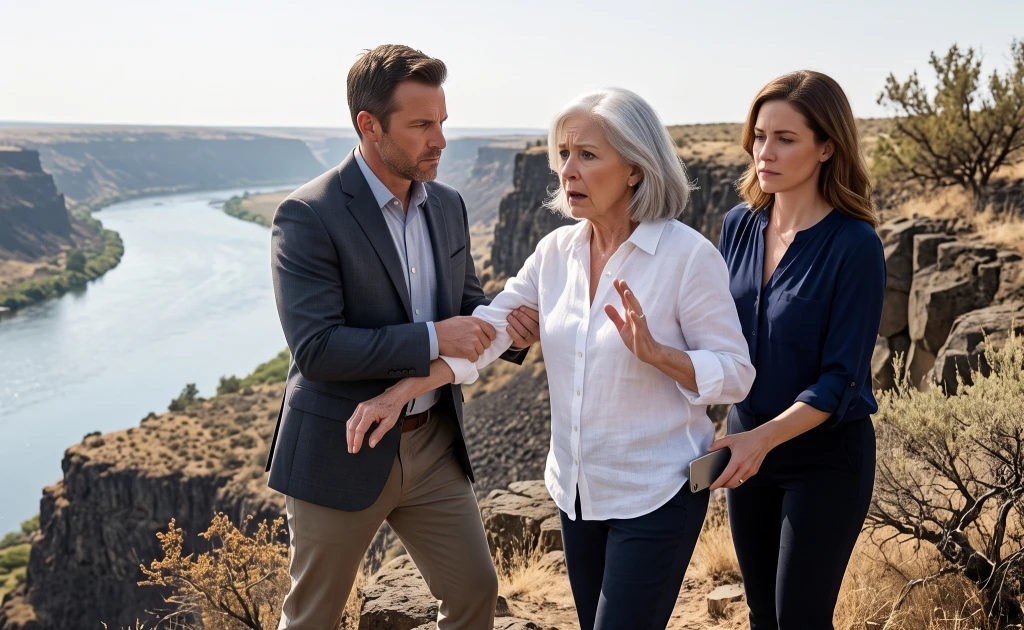
At the overlook, Grant moved between her and the path home.
“Sign the postponement,” he said.
“No.”
“Ninety days. We unwind the guarantee and no one loses anything.”
“People have already lost the right to know what was done with their company.”
Kate flinched at the phrase their company. “You mean your company. When it suits you, we’re family. When we disagree, we’re employees who should have known better.”
Marian held out her hand. “Come back with me. We can tell the board together. Cooperation will matter.”
Grant’s face changed, not into rage but into calculation stripped of charm. “And on Monday you make sure we can never lead it.”
“You made that decision before I did.”
He caught Marian above the elbow. His grip was hard enough to wrinkle her linen sleeve.
Kate said, “Grant, don’t.”
“Tell her to sign.”
Marian pulled once and felt the edge of rock beneath her heel. The drop was not a clean wall. Basalt shelves broke through scrub oak forty feet below, then fell again toward an old maintenance road. She had stood there a hundred times without imagining her children as part of the danger.
“Take your hand off me,” she said.
Kate stepped closer. For one hopeful second, Marian thought her daughter had chosen. Then Kate took the phone from Marian’s back pocket and held it against her own chest.
“Just give us the ninety days,” Kate said. “Please.”
Marian looked at the woman who had saved twelve pallets of pears that morning and saw how badly competence could serve fear. “Give me my phone.”
She moved toward Kate. Grant shoved her with both hands.
There was no darkness, no storm, nothing to make the moment look like fate. Marian saw Grant’s open palms and Kate’s mouth forming her name. Her wedding band caught once on the sunlight as it slipped over the knuckle of her reaching hand.
The first impact drove the air from her. A scrub oak turned her sideways; rock struck her hip, then her wrist. She slid through brittle branches and landed on a narrow shelf with the sky above her and no feeling in her left leg.
For several seconds she could hear only a thin mechanical whine. It reminded her absurdly of a cold-room fan running dry.
Then shadows moved at the rim. Marian tried to breathe deeply enough to shout and found she could not. She gathered what air she had and called the name she had used through fevers, school concerts, and the night Ben died.
“Kate.” Above her, a hand appeared against the sky and vanished. “Grant,” Kate said, “she’s still alive…”
To read the rest of the story – CLICK the NEXT button 👇👇👇