


On a hot July afternoon, Daniel Mercer was halfway through approving the demolition schedule for the Magnolia Motor Court when his daughter laughed. At first he mistook the sound for a cry. He pushed back from his desk so fast that his coffee tipped against the saucer, then heard it again—breathless, rusty from disuse, and unmistakably June. The tablet in front of him still showed a row of orange clearance boxes. Daniel ended the call without explaining and ran for the balcony.
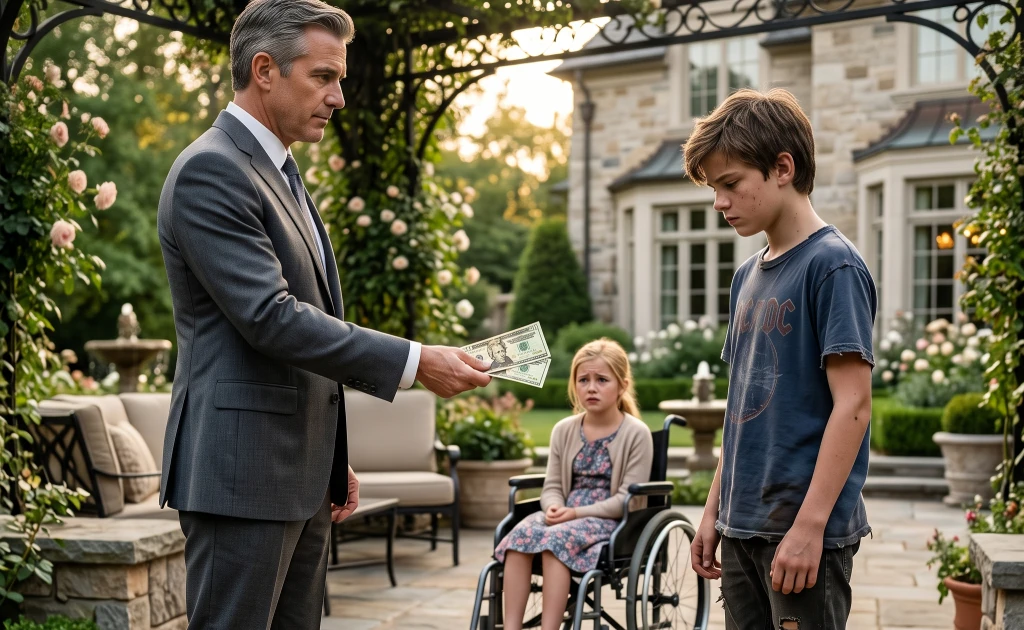
Below him, a barefoot boy was dancing in the south garden. He was all elbows and sharp knees, wearing a faded Hawks T-shirt and jeans rolled above his ankles. A pair of battered high-tops lay beneath the privet hedge; one sole gaped wide enough to catch in the grass. Free of them, the boy jerked across the lawn—robot, scarecrow, malfunctioning lawn sprinkler—while ten-year-old June watched from her wheelchair under the pergola.
“No, no,” she called. “The elevator one. Where it gets stuck.”
The boy went rigid. He rose by inches, shuddered between imaginary floors, then dropped into a squat with an expression of grave mechanical disappointment. June slapped both wheel rims and laughed so hard she folded over her lap.
Eleven months had passed since the wreck on I-85 killed Daniel’s wife, Mara, and left their daughter with an incomplete spinal cord injury. June could feel pressure in both legs and produce some movement on her left side, but she had not walked since. She had also stopped drawing, stopped answering friends from school, and stopped tolerating any sentence that began with when you get better.
Daniel had taken her to specialists in Boston, Baltimore, and Houston. He had installed a therapy room with parallel bars, suspension equipment, and a wall display that charted every repetition. When one doctor advised patience, Daniel found another; when June cried through an exercise, he counted louder.
Lena Ortiz, June’s physical therapist, had finally taken the stopwatch out of his hand. “Take this outside, Daniel. She can’t work with you grading every attempt.”
Daniel had heard an accusation of surrender. He canceled two weeks of sessions and paid for another round of consultations. June responded by refusing to enter the therapy room at all.
Now she was sitting straighter than she had in months, conducting a strange boy with the flat of her palm. At the edge of the lawn, Darius Grant appeared from the security office and started toward them. Daniel raised one hand from the balcony, and Darius stopped beside the rose arbor.
The boy launched into a turn, caught his heel in the grass, and windmilled so wildly that Daniel thought he was truly falling. At the last moment he recovered, looked offended by the ground, and bowed to it. June’s laughter broke into a cough, but she waved away the water bottle clipped to her chair.
“Again,” she said.
The boy checked her face before repeating the move. That small glance unsettled Daniel more than the trespass itself. The boy was not performing at June. He was watching her, adjusting the joke to the exact point where her guarded expression gave way.
Daniel went downstairs. By the time he stepped onto the terrace, the boy had seen Darius. His whole body changed. The loose comedy vanished; his shoulders drew in, and his eyes measured the hedge, the terrace steps, and the distance to the service gate.
June saw it too. “He didn’t take anything.”
“I didn’t say he did.” Daniel kept his voice level. “What’s your name?”
The boy bent to retrieve his shoes but did not put them on. “Isaiah.”
“Isaiah what?”
“Cole.” His gaze flicked toward Darius, then back. “I came off the greenway. Cutting through here saves ten minutes to Peachtree. I wasn’t going in the house.”
Darius touched the radio at his belt. “Irrigation crew left the lower latch loose. I’ve got it.”
Daniel nodded, though the failure irritated him. The property had cameras, motion sensors, and two people assigned to security that afternoon. Still, a thirteen-year-old in a torn shirt had crossed half the garden before anyone stopped him.
“Why did you stop?” Daniel asked.
Isaiah looked at June. “She was staring at the ants.”
“They had a better afternoon planned than I did,” June said.
Isaiah’s mouth twitched. “She looked bored in a serious way. I know some dances.”
“Those are not dances,” June said. “That last one was a medical emergency.”
He grinned, and for a second they seemed to forget Daniel was there.
Daniel reached for the habit that had solved most problems in his adult life. He took two twenties from his wallet and held them out.
Isaiah stared at the bills. “For what?”
“Your time.”
“I wasn’t busking.”
“You were performing.”
June’s smile disappeared. “Dad.”
Daniel felt both children turn away from him without moving. He put the money back in his wallet, annoyed by the sensation and not yet willing to name it.
“Then have something to eat,” he said. “That isn’t payment.”
Isaiah looked toward the hedge again. Hunger and caution moved plainly across his face. Hunger won by a narrow margin.
They ate grilled cheese and tomato soup at the small table off the kitchen. June stayed in her chair instead of asking to be helped onto a dining seat. Isaiah sat where he could see both doors. He finished the first sandwich quickly, slowed down for the second, then wrapped half of it in a paper napkin and slipped it into his backpack.
Daniel pretended not to notice. June did him the courtesy of pretending too.
Isaiah told them he had learned to dance at a neighborhood arts program and from videos he watched at the library. He could turn the hiss of an air brake or the squeal of a grocery cart into a rhythm. He described dances by their mistakes—the bad knee, the late shoulder, the foot that lied about where it was going.
He gave almost no answer about school. When Daniel asked where his parents were, Isaiah’s face closed; he said only that his sister knew where he was.
“Does she know you came through a stranger’s gate?”
“Probably not that part.” June hid a smile behind her spoon.
Daniel said Isaiah could return the next day through the side gate, after Darius had confirmed it with his sister. He set the hours without thinking—four to five-thirty, no wandering through the house, no photographs, and no leaving the grounds with June. Isaiah listened with the patient expression of someone waiting for an adult to finish arranging him.
“And I’ll pay you for—” Daniel began.
“No,” June said.
Isaiah pushed back his chair. “I should go.”
Daniel stopped him in the mudroom. “You can’t keep appearing here without some arrangement.”
Isaiah pulled on the broken high-tops. “Then ask me.”
“Ask you what?”
The boy tightened one frayed lace, keeping his head down. “If I want to come back.”
Daniel looked at him. “Do you?”
Isaiah glanced past him at June. “Tomorrow. If she has better material.”
“I’ll work on it,” June said.
After Isaiah left, Daniel told Darius to follow at a distance and find out where he lived. Darius did not reach for his keys. “He gave you a name. You could ask the sister tomorrow.”
“And if he doesn’t come tomorrow?”
“If I tail him tonight, he’ll spot me. Then he won’t come back.”
Daniel’s patience thinned. “I need to know whether my daughter is safe.”
Darius studied him for a moment, then nodded. He had worked for Daniel long enough to recognize when concern had hardened into an order.
Just before nine that night, Darius returned with three photographs. The first showed Isaiah boarding a city bus. The second caught him walking beside a young woman in scrubs, both carrying grocery bags. The last showed the woman unlocking Room 17 at the shuttered Magnolia Motor Court, less than a mile down the same greenway.
An orange Mercer demolition warning had been taped across the door. Daniel called the site superintendent and put the next morning’s work on hold, then reopened the pre-demolition occupancy report on his tablet.
On its final page was Daniel’s electronic signature…
To read the rest of the story – CLICK the NEXT button 👇👇👇