


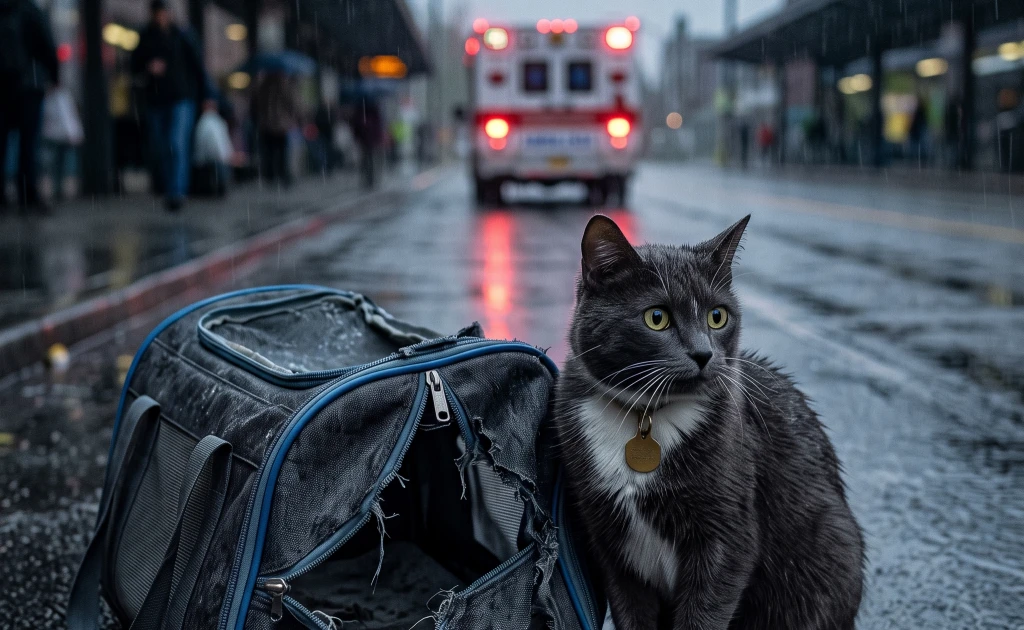
Six minutes before the first coach from Portland was due, Ben Calder noticed the cat sitting under the schedule board at Gate Two. The animal was too clean to belong to the Breakwater bus terminal. His coat was charcoal gray except for a white blaze that spread across his chest like the open collar of a sailor’s shirt, and an old brass tag hung from a worn leather band at his throat. He sat beyond the shelter of the awning, where April rain had darkened the concrete, watching amber letters assemble and vanish above him.
PORTLAND — ON TIME.
The cat rose.
Ben stopped halfway through checking the yellow safety line. Air brakes sighed beyond the gate, and the coach eased in with its running lights glowing in the wet dawn. The cat took three measured steps toward the curb. He did not look at the driver or the luggage bay. He watched the folding door.
Passengers came down one by one: a nurse in navy scrubs, two college students with headphones, a man carrying a sleeping toddler. The cat examined every face. When the driver shut the door and pulled away, the animal stayed at the curb until the red lights disappeared into the rain. Then he returned to the arrivals board and sat down.
Ben had spent fourteen years noticing what did not fit: a suitcase without a passenger, a driver too quiet after a mountain run, the shine of diesel where pavement should have been dry. Since his ten-year-old son had received a donor heart, that habit had followed him home. Morning temperature. Medication before breakfast. No grapefruit. Call the transplant team for a fever, vomiting, a missed dose, an exposure that might be nothing until it wasn’t.
His phone vibrated in his pocket. Claire had sent the same two words she sent every morning he opened the terminal.
Meds done.
Ben typed a thumbs-up, deleted it, and wrote, How’s Eli?
The answer came before he reached the dispatch office. Still asleep.
He should have felt relieved. Instead he looked back at the cat, who had resumed staring at the board as if ON TIME were a promise somebody had made him.
“He’s been doing that since Monday,” Rosa Delgado said.
The ticket agent stood behind Ben with a ring of keys and a paper cup that smelled scorched enough to strip paint. Rosa had worked mornings at the terminal longer than Ben had, and could retag a passenger’s bag while explaining, in two languages, why the bus they had missed was not technically still there.
“Three days?” Ben asked.
“He leaves to drink from the dish behind the coffee counter. He uses the flower bed by the employee lot. Then whenever a Portland coach pulls in, he takes his position.”
“Nobody called Animal Services?”
Rosa gave him a look over the rim of her cup. “Janine did. They were full Monday. Yesterday they couldn’t catch him. He went under Coach 218 and made fools of everybody.”
The cat turned his head when Rosa spoke, but only briefly. Ben saw the name on the tag when the brass caught the light: SKIPPER. A phone number had once been engraved beneath it. Years of rubbing against fur had worn the digits into shallow, useless marks.
“So where’s his person?”
Rosa’s mouth tightened. She set the coffee down on a bench.
“That’s the part I thought somebody told you. An older man collapsed right here before the Monday coach. Had one hand on that cat’s carrier and the other on his chest. When he went down, the carrier tipped and the zipper split. Cat shot under the bench. Paramedics couldn’t wait around for him.”
Ben looked from Gate Two to the lane used by ambulances. “Was the man conscious?”
“Not by the time they loaded him. His wallet went with him. His rolling bag too. I put the torn carrier in Lost and Found, but Skipper wouldn’t come near me.” Rosa rubbed at a brown ring on the bench with her thumbnail. “I keep thinking I should’ve grabbed him before the ambulance left.”
“You would’ve lost a finger.”
“Maybe. He still would’ve known somebody tried.”
Ben went into the office and pulled Monday’s incident report. Walter Pike, seventy-two, local address on Harbor Street. Rosa had copied the identifying details from his driver’s license while the paramedics worked. The ticket was for Portland, and in the notes she had written what Walter told her while buying it: valve appointment, Casco Regional.
Ben called the two hospitals that served Breakwater, then the patient-relations office at Casco Regional. At each one, a polite voice told him no patient information could be released. At Casco, an advocate agreed to take Walter’s name and Ben’s number in case a patient by that name could receive it.
“Please write that it’s about his cat,” Ben said. “The cat is safe for now.”
“I’ll attach your message if we have a patient by that name. That’s all I can promise.”
Ben understood rules. Most days he was grateful for them. Rules kept sleepy drivers off the road and children from wandering onto the loading apron. But after he hung up, the sentence all I can promise felt smaller than it had any right to.
He brought Skipper water in a clean takeout container and half a plain turkey sandwich from his lunch. The cat waited until Ben stepped back before eating. He did not rub Ben’s legs or ask for more. When the next Portland coach was announced, he left the turkey unfinished and went to the curb.
By noon, the rain had sharpened into sleet. Ben found a flattened produce box and wedged it beside the brick wall, out of the wind. Skipper ignored it. His post was six feet away, directly beneath the board.
“This can’t go through another night,” Janine Walsh said.
The terminal manager had come outside in a red rain shell, her silver hair tucked under the hood. She was not unkind. She had once driven a stranded mother and two children home after the last coach because the taxi company would not take their wet dog. She was also responsible for six bus bays, a public waiting room, and an animal that had already run beneath moving equipment.
“County Animal Services has a space opening tomorrow morning,” she said. “They’ll scan him, hold him, and call their foster list. That’s safer than this.”
“Their foster list is full. I called.”
Janine glanced at him. “Of course you did.”
“Give me until closing.”
“For what?”
Ben watched Skipper’s ears turn toward the loudspeaker at the first crackle. “For the man to call.”
“And if he doesn’t?”
Ben did not answer.
Janine pushed rain from her forehead with the heel of her hand. “Pickup is at eight tomorrow. I’m not punishing him, Ben. I can’t leave him beside buses because we’re all sad about why he’s there.”
That was exactly the kind of sentence Ben himself would have used two years ago. Before Eli’s heart had failed. Before he had learned that a reasonable rule could still land on one particular body with unbearable force.
“Eight tomorrow,” he said.
At home, animals had been a closed subject since the transplant. Claire had grown up with cats and still stopped to greet every dog on their street, but the transplant team had been clear about unknown animals, scratches, litter, fleas, and infections that healthy children shrugged off. An established, healthy indoor pet could sometimes be managed. A stray carried straight from a bus terminal was another matter.
Ben knew all of that. At four, he called three rescue groups anyway. At five, he called the clinic that had treated their old beagle years before. At six, he left a message with a woman who fostered senior cats. No one had room that night.
The final Portland coach arrived at 9:10. Skipper went to the curb once more, his damp fur rising in points along his spine. A woman in a green coat descended last. For a second the cat leaned so far forward that Ben thought he might run to her. Then she turned, and whatever he had found in the shape of her walk disappeared.
The driver closed the door. The board changed to NO MORE ARRIVALS.
Skipper returned to his place, but this time he did not sit. He lowered himself onto the wet concrete and tucked his paws beneath him.
Ben brought out the torn carrier from Lost and Found. Walter’s name was written on a masking-tape label inside. Ben had repaired the zipper with two small cable ties, enough to hold until morning, and lined the bottom with an old dispatch sweatshirt. He set it beside the cat with the door open.
“I can’t tell you he’s coming back,” Ben said. “I can’t tell you where you’re going either.”
Skipper looked at him with flat gold eyes. Ben waited without reaching. After a while, the cat stood, sniffed the sweatshirt, and stepped inside.
The zipper rasped shut more loudly than it should have.
Ben photographed the tag, called the county’s after-hours line, and logged himself as the temporary finder under Janine’s existing report. Then he texted Janine a picture of Skipper secured in the carrier so she could cancel the morning pickup.
On the drive home, Ben rehearsed the practical version. One night in the enclosed mudroom. Veterinary appointment first thing. Eli would not touch him. Claire would be angry, but anger was manageable. A cat beside a moving bus was not.
He had not called her because she would have said no. That fact sat in the passenger seat all the way across town.
The kitchen light was on when he pulled into the driveway. Claire opened the side door before he reached it, wearing gray sweatpants and the cardigan she used on nights when she expected bad news. Her gaze moved from Ben’s face to the battered carrier in his hand.
Behind its mesh panel, Skipper’s white chest showed like a scrap of clean cloth. “Ben,” Claire said. “Tell me you did not bring an unexamined stray into a house with a transplant patient…”
To read the rest of the story – CLICK the NEXT button 👇👇👇