


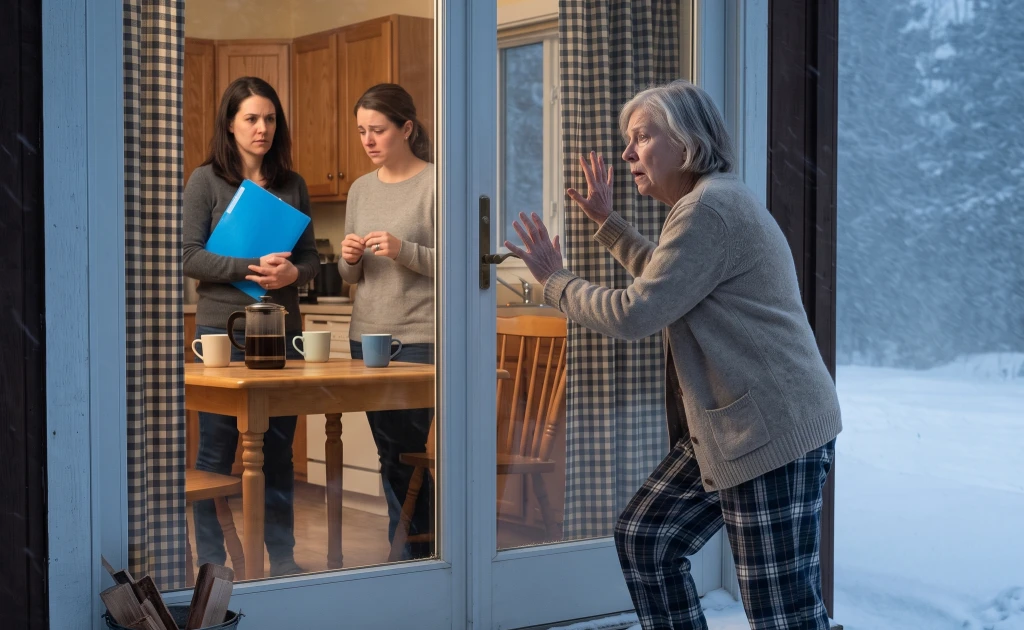
The dead bolt turned while Ruth Whitaker’s hand was still on the knob. She had stepped onto her own back porch for one armload of wood, wearing felt-lined clogs, a wool cardigan, and the flannel pants she wore to make coffee. Claire had pointed at the nearly empty wood box and said keeping it filled was one more job Ruth could no longer manage. Ruth, angry enough to prove otherwise, had expected to be outside for ten seconds.
Snow blew sideways across the porch and erased the shallow dents her heels had made. Beyond the woodpile, at the black edge of the spruce, a wolf called once—a low, carrying note that seemed to open more distance than the storm could hide.
“Claire.” Ruth struck the door with the flat of her hand. “Open this.”
Her older daughter answered from the other side, close enough that Ruth could hear how carefully she was breathing. “When you’re ready to be reasonable, knock.”
“I am knocking.”
There was a murmur behind Claire, then Jenna’s thinner voice. Ruth could not make out the words. The kitchen light remained on, warm behind the checked curtain she had sewn the year Tom died. On the table inside sat three mugs, the coffeepot, and the buyer-signed purchase offer Claire had brought up from Duluth in a blue legal folder.
Ruth hit the door again. “At least give me my coat.”
This time no one answered. At seventy-one, Ruth knew exactly how fast cold could take a person. She had carried mail on a hundred-mile rural route for thirty-two winters, back when a stalled truck meant waiting for a farmer to notice and cell service vanished between every two hills. The thermometer outside the kitchen had read three below before dark, with a wind chill near eighteen below.
She tried the mudroom window. Locked. The garage stood forty yards away, but Claire had changed that padlock in November after Ruth misplaced a key. The nearest occupied house belonged to Mavis and Ed Dwyer, nearly three-quarters of a mile down the county road. In clear weather Ruth could walk it with her cane. Tonight the road and the ditch were one white, moving surface.
The old line shack was closer—less than half a mile through the trees. Tom had kept dry wood there, along with blankets in a metal bin and a little cast-iron stove. Ruth had not been inside since the previous fall, but she knew the route: past the split cedar, along the low ridge, then downhill toward the creek.
She could also break the kitchen window.
The thought came cleanly, with the image of the iron boot scraper beside the step. She could smash the glass, trigger the alarm company Claire had insisted on using, and make the whole ugly thing public before midnight. Instead Ruth turned toward the woods.
She told herself the shack was closer. Beneath that sensible answer lay the old, hard knot that had governed too much of her life: nobody in Pine Crossing needed to see what her daughters had become, or what she had allowed.
She found a pair of thin knit gloves in her cardigan pockets and pulled them on. They were meant for carrying in firewood, not crossing open snow.
At the end of the porch, something had crossed the drift since dusk. Four deep prints led from the spruce toward the shed. Three were round and clean. The fourth scuffed outward, drawing a faint diagonal tail through the powder. It was the third time since Christmas Ruth had seen that spoiled rhythm near the lower field. She stopped with one hand on the railing.
Six years earlier, on the last February she had carried Route 4, she had found the same spoiled rhythm stamped beside Blackwater Road. She had followed it down an embankment and seen a young gray wolf caught by the hind leg in an illegal cable snare. The animal had twisted the wire deep before exhaustion stilled her. A blue research tag flashed in one ear whenever she lifted her head.
Ruth had done nothing foolish. Tom had taught her that pity did not make wild teeth less wild. She called conservation officer Ben Ortega, set orange mail crates along the shoulder to slow traffic, and waited forty yards away while sleet stiffened her uniform jacket. When two snowmobilers tried to come down for a look, she stood in the road and sent them on with the voice she used on loose dogs and men who parked across mailboxes.
Ben arrived with a wildlife biologist near dusk. They sedated the wolf, cut the cable, and carried her out on a tarp. The injury healed, Ben later told Ruth, but not straight. On a trail-camera picture he mailed her that spring, the young female stood lean and watchful under budding aspen, her right hind foot angled slightly away from the others.
Ruth had kept the picture with Tom’s old compass beneath her retired mail satchel. She had never fed the wolf, never seen her again, and never told herself the animal owed her anything.
Now the crooked track disappeared around the shed. Behind the kitchen glass, Jenna pulled the curtain back two inches. Her pale face appeared, then vanished. Ruth waited for the lock. She counted to ten, because Jenna had always needed time to oppose her sister. At twelve, the kitchen light went out.
Ruth stepped off the porch.
The first drift took her above the ankles. Snow packed into the open backs of her clogs, and within a dozen yards the wool at her heels was wet. She kept the fence on her left until the old gate, then found the narrow lane Tom once used for his snowmobile. The spruce caught some of the wind, but their branches dumped loose snow down her neck whenever she brushed them.
Claire’s words followed her into the trees, not the cruelest ones but the reasonable ones. The chimney mortar was failing. Ruth had left a burner on in October. She had driven to town with one cataract still clouding her right eye and clipped a grocery cart in the parking lot. Claire managed billing disputes for a home-health company; after Tom fell ill, she handled his insurance, then the taxes, then most of Ruth’s bills. She had driven three hours each way for appointments and labeled the pill organizer in block letters Ruth could read without her glasses.
You think staying in that house proves you’re still in charge, Claire had said at the kitchen table. It only proves somebody else has to keep catching what you drop.
That had been true enough to hurt. It did not make the blue folder honest.
The offer covered the house, the outbuildings, and thirty-eight acres for a vacation-rental company. Claire called it generous. Jenna stared into her coffee and worried the torn skin beside her thumbnail. In October she had asked Ruth for another bakery loan and, for the first time, Ruth had said no. When Ruth asked why they needed her answer before the end of the month, neither daughter gave the same explanation twice.
“The loan payment jumps next month,” Claire had finally said. “If we wait, you could lose more.”
“What home-equity payment?”
Claire’s face changed then—not much, just a stillness around the mouth. Jenna began to cry. Ruth said she would call the credit union before signing anything. Ten minutes later, when she stepped out for wood, Claire turned the dead bolt behind her.
The lane bent right at the cedar, but in the whiteout every trunk seemed split and every slope seemed to fall the wrong way. Ruth took off one glove to feel the bark. The glove slipped from her stiff fingers and vanished in the snow. When she bent to search, dizziness pressed the dark close around her.
She straightened too quickly and walked on. Her right clog came off in a drift. She found it by plunging her bare hand into the hole, but the effort left her panting. The cold had passed through pain into a padded heaviness that frightened her more. She began naming the mailboxes from her old route to keep her mind moving.
Anderson, blue box, porch dog. Blevins, broken flag. Cho, medical cooler on Thursdays.
At Dwyer she realized she no longer knew which way she faced. Something moved between the trees ahead. It was too tall for a fox and too silent for a deer pushing brush. Ruth saw a gray shoulder, the long line of a back, then the small flash of blue at one ear.
The wolf stood perhaps thirty yards away. Snow silvered her guard hairs. Her head was turned toward Ruth, but her body angled away, ready to leave. When she moved, the right hind foot swept a shallow crescent.
“I remember you,” Ruth said, though the wind took most of it.
The wolf did not come closer. She crossed the low ridge and vanished.
Ruth looked down. The animal’s prints ran along a trough protected by roots, where the snow was packed firmer than the open lane. She put one clog into the nearest print, then the other beyond it. She followed because the track went downhill, because the creek lay downhill from the shack, and because there was no better fact left to trust.
Twice she lost the trail. Twice she found the faint drag of the fourth foot where the wind had already softened the other marks. Then the trees opened enough for her to see a low roof hunched under snow.
Ruth reached the line shack on her hands and knees.
The key still hung inside a coffee can nailed beneath the eave. Her fingers could not close around it, so she held it between both palms and worked it into the lock. The door gave, and she fell across the threshold into darkness that smelled of iron, mouse nests, and old pine smoke.
For several seconds she lay without moving. Then Tom’s training, repeated through years of winter breakdowns, arranged itself in her head. Shelter first. Dry layers. Keep numb skin away from direct heat. Do not thaw it if it might freeze again.
She found the metal bin and pulled out a wool blanket. Kindling waited in a lidded bucket beside the stove. Her first match broke. The second went out in her shaking hand. The third caught the curl of birch bark, and a small orange flame began to work through the twigs.
She pulled off both soaked clogs and set them well back from the stove.
Outside the single window, the wolf passed once through the reach of the firelight. She did not approach the door. At the far edge of the clearing, the gray shape slipped over the ridge and disappeared into the storm.
Ruth wrapped the blanket around herself and listened to the stove tick as it warmed. The feeling returning to her fingers was sharp enough to make her gasp, but the sound came out almost like a laugh. She was alive. Whatever happened to the house, whatever Claire had hidden in that folder, Ruth had reached a place where the next choice was hers.
Then someone struck the door with both fists.
“Mom!” Jenna’s voice broke on the word. “Mom, let me in.”
Ruth lifted the stove poker and forced herself upright. “Where’s Claire?”
“At the house. I took the spare truck key.” Jenna hit the door again. “Please. I brought your boots and your phone. And you can’t sign that offer, do you hear me? Claire already took eighty-six thousand dollars from the house…”
To read the rest of the story – CLICK the NEXT button 👇👇👇