


The bear’s track lay inside Mara Vance’s boot print. She stopped with one foot raised above the soaked wiregrass. Her own print had filled with tea-colored water since she passed this way before dawn. The bear had come behind her, broad pad centered over her heel, five toes pressed into the black peat as neatly as a hand laid over a smaller hand.
Mara looked toward the wall of pond pine on the far side of Cypress Cut. Nothing moved there. Rain clicked on palmetto fans and whispered through the dead reeds, soft enough that the whole pocosin seemed to be listening.
She shouldered the aluminum-frame pack higher. The pint jar inside held the last of the anise-and-molasses lure Wade had given her, and its sweetness pushed through two plastic bags. She had come to remove it, along with the cable set fifty yards ahead, before Evie’s field crew reached this section of the lease.
That was the version Mara had settled on during the drive out: she was removing the set. It did not change the fact that she had put it there three nights earlier.
Mara was Calder Blackwater’s senior guide and its only employee with a current wildlife-control license. Wade put her name on the removal paperwork. The license made the cable no less illegal.
Her radio hissed against her collar. Wade’s voice did not come through, only a loose scatter of static. She had promised a check-in at seven. She still had twenty minutes, enough time to spring the cable, carry out the lure, and be back on the old fire road before her daughter knew she had detoured from the marked survey route.
The next print showed the bear’s right forepaw. Two outer toes landed crooked and shallow, as if they could no longer open all the way. Mara forgot the radio.
Six years earlier, she had knelt in summer mud beside a yearling black bear whose paw had been cinched nearly to the bone. She remembered the animal’s breath coming in hard, wet bursts beneath the canvas coat she had thrown over its head. She remembered cutting Wade’s cable and watching the paw open with the slow uncertainty of a cramped fist.
She had never reported the set. She had never told Wade she destroyed it. One decent act, buried under six years of useful silence.
Now the track angled toward Cypress Cut. The cut was not a creek, though newcomers mistook it for one. Timber crews had dug hundreds like it across eastern North Carolina to move water off the peat, leaving narrow black trenches hidden beneath mats of sedge and floating moss.
Mara knew where the ground held. She had guided hunters across it in darkness, carried injured hounds out during hurricanes, and once found an elderly man alive after two nights by noticing where spiders had been brushed from the switch cane. She tested the next hummock with the heel of her boot, felt it hold, and brought down her weight.
The peat shelf folded under her without warning.
Cold water struck beneath her ribs and stopped her breath. The pack frame caught on the edge, twisting her backward, while her right ankle drove between two submerged roots. She heard a small, dense crack that seemed to happen somewhere outside her body. Then the pain arrived.
Mara grabbed at the sedge. It came away in wet ropes. When she tried to lift her leg, the root held and the peat around her chest sagged another inch.
“Easy,” she told herself, but the word shook apart in her teeth.
The radio had slipped beneath her shoulder. She reached for it and pushed herself lower. Black water touched her chin, carrying the mineral smell of iron and dead leaves.
For one instant she was twelve again, lying flat at the edge of another drainage cut, reaching for Danny’s yellow rain hood as it moved away from her. Her brother had gone through where the surface looked solid. Mara had known better than to follow. She had also known he could not swim.
The hood had vanished without a splash. For forty-four years she had remembered the way her own hand stayed on the safe side.
“Not now.” She dug her fingers into the mat and pulled until her shoulders burned. The trapped ankle did not move.
Something broke a branch behind her. Mara turned her head and at first saw only rain hanging pale between the trees. Then a black bear stepped out of the pond pines, so large its wet back seemed to carry the dim morning with it.
The rifle on her shoulder was pinned beneath the pack. She could not reach it, and the movement would have been useless anyway. The bear came along her trail with its head low, testing the air. It stopped at the broken edge of peat.
The right forepaw landed first, two toes curled inward above a pale band of scar tissue. Mara’s mind offered no sensible place to put that fact. The bear was close enough that she could hear rain tapping its coat and the damp working of its nostrils.
Its muzzle turned toward the bait in her pack.
“That’s all you smell,” she whispered. “Good. Take it.”
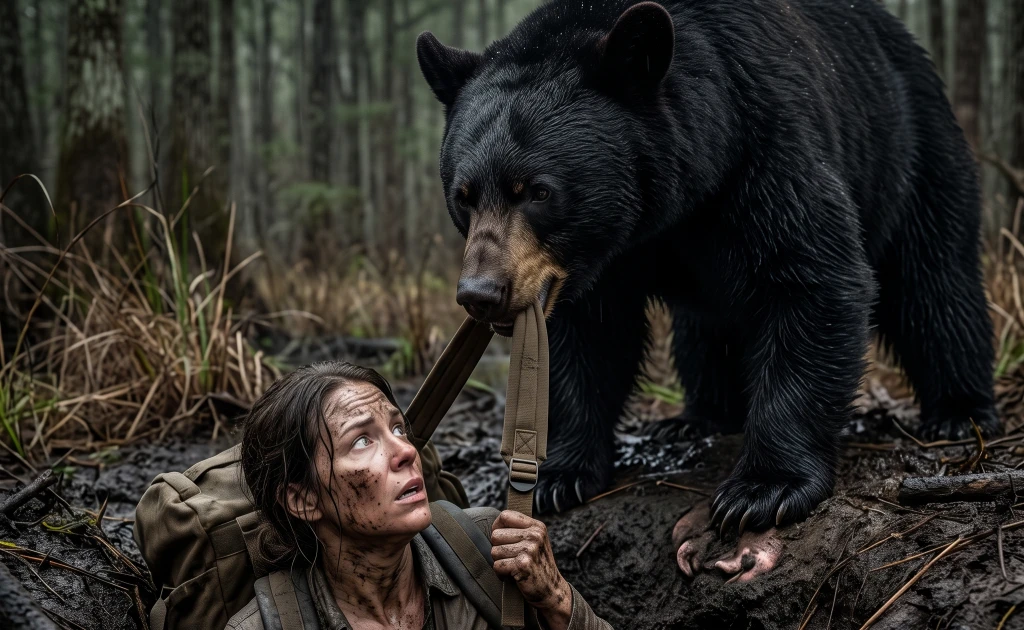
The bear stepped onto the peat. The mat dipped beneath its weight, but it knew how to spread itself over the ground. It reached past Mara’s shoulder and closed its jaws around the canvas haul loop at the top of the pack frame.
The bear backed away with the sweet-smelling pack in its teeth. The shoulder straps held. The frame struck the back of Mara’s skull, the jar shattered, and her trapped leg wrenched free with a burst of white pain.
She slid across the lip of the cut while the animal continued hauling at the loop. By the time the pack twisted loose from one shoulder, her hips had cleared the collapsing edge and her hands had found the roots of a wax myrtle on firmer ground.
Mara lay facedown in the reeds, coughing black water. The pack had twisted half off her body. The jar inside had broken; molasses seeped through the canvas in a dark, sweet stain.
The bear nosed the torn outer bag and licked once at the molasses on the frame. Then Mara’s radio crackled beneath her, sharp with an approaching human voice. The animal lifted its head and stepped back, the damaged paw resting lightly on the ground.
Mara did not call it by any name. She had learned too much about wild animals to mistake familiarity for ownership. Still, when the bear turned into the rain and the crooked paw came down once more, she knew which yearling had lived.
Her radio began calling from beneath her.
“Mom? Mom, answer me.”
Evie’s voice carried the tight, controlled pitch Mara had heard only twice before. Mara rolled onto one elbow, found the radio clipped under the pack strap, and pressed the transmit button with fingers that barely worked.
“Cypress Cut,” she managed. “East side. I’m out of the water. My ankle’s bad.”
There was a pause, then Evie said, “Stay where you are.”
Mara almost laughed. For once, it was an order she had no trouble obeying.
Evie reached her with two volunteer rescuers forty minutes later. Her brown braid had come loose under her rain shell, and one cheek was striped with mud. She dropped beside Mara, checked her breathing, and wrapped her in a foil blanket with quick field-trained hands.
“You didn’t eat,” Mara said. Evie’s hands always shook when she skipped breakfast.
“I had a granola bar. You can argue with me after we get you warm.”
Evie pulled the foil blanket tighter. “Who pulled you up here?”
Mara saw that the rescuers had found the groove in the peat. Beside it, the bear’s tracks ran backward for several yards, pressed deep where the animal had braced.
“A bear.”
One of the men looked toward the trees. Evie did not. She crouched over the clearest print and touched the air above it without disturbing the edges.
“Right front,” she said. “Two damaged toes.”
Mara closed her eyes. Evie had spent three summers running cameras and hair stations for a university bear study on Wade’s timber leases. She knew individual males by chest blazes, torn ears, and the small deformities their tracks carried from one season to the next.
“Male Eighteen,” Evie said. “The one from the Juniper block.”
Wade Calder arrived in his truck before the rescue UTV had cleared the fire road. He took control the way he always did: called the county clinic, sent a guide ahead to open the gate, and stripped the wet pack from Mara so the rescuers could lift her. His hand paused on the sticky black stain where the bait jar had broken.
Their eyes met. He said nothing in front of Evie and put the pack in the locked toolbox of his truck.
At Morrow County Medical Center, the doctor called Mara’s injury a nondisplaced fracture near the ankle and the cold exposure moderate, words that sounded mild beside the way her body shook. They kept her overnight, fitted her with a boot, and warned her that the joint would punish every shortcut she tried to take.
Evie stayed until nearly midnight. She asked about the bear three times. Mara answered only what could be seen in the tracks: it had taken the pack loop, it had pulled, it had left.
After Evie went downstairs for coffee, Wade entered carrying Mara’s dry jacket and the dented thermos that had belonged to her father. At sixty-one, he still moved with the balance of a man who had spent his life in boats and tree stands. His hair had gone silver, but his face looked much as it had when he gave twenty-five-year-old Mara her first steady guiding job and the keys to the cottage where she raised Evie.
“Your deductible’s handled,” he said. “Payroll too, until you’re back.”
He set the thermos on the bedside table, then laid a single sheet of paper across Mara’s blanket. It described an unprovoked charge by a large male black bear and an attack in which the animal had seized her clothing. At the bottom, a blank line waited above her printed name.
If state wildlife officers accepted that account, it would be logged as an aggressive encounter and give Wade the paper trail to seek lethal removal of Male Eighteen.
Wade placed a pen beside her hand. “Sign it, Mara…”
To read the rest of the story – CLICK the NEXT button 👇👇👇