


The gray-and-white cat moved before the coach had finished pulling into Bay Three. At 6:42 on a cold April morning, while the driver was still easing the brakes and a cloud of diesel hung beneath the terminal canopy, the cat left his place under the arrivals board and walked to the yellow safety line. He did not beg. He did not meow. He simply braced his front paws on the wet concrete and watched the folding door open.
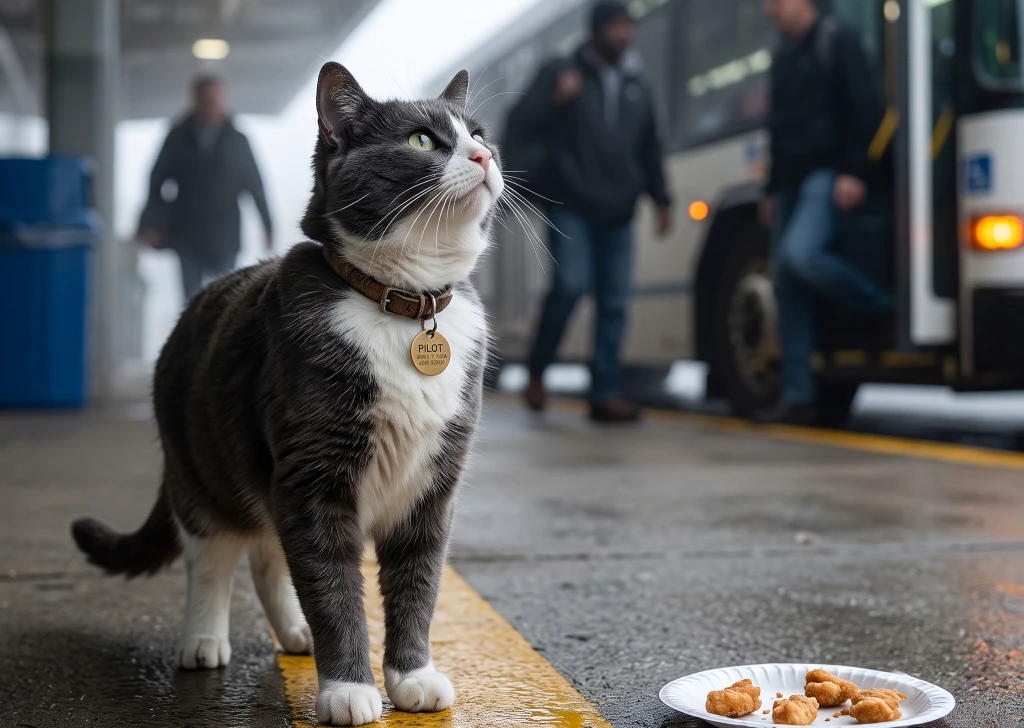
Dan Mercer was supposed to be watching the coach. Instead, he watched the cat inspect every person who stepped down: a nurse in blue scrubs, a college kid dragging a duffel, an older couple arguing quietly about a missing suitcase. The cat leaned forward for each face, then held still as the passenger passed him. When the driver finally closed the door, the animal remained by the curb until the coach disappeared behind the maintenance garage, then returned to the exact square of concrete beneath the glowing orange board.
“Third morning,” said Marlene from the coffee counter behind Dan. “Same thing every time a Portland bus comes in.”
Dan had spent Monday and Tuesday taking his son Eli to medical appointments in Portland. This was the first time he had seen the cat.
Dan checked his watch. The coach was forty seconds early, which meant the driver had probably rushed the last stretch of Route 1 again. Normally, that would have irritated him enough to make a note in the log. This morning he barely registered it as the cat sat with his tail wrapped neatly around his front paws, staring up at the next arrival time.
Port Alder Bus Terminal was not a place where anything stayed. Coaches rolled in from Portland and Bangor, passengers crossed the lobby with their heads down, and lost gloves collected in a plastic bin until someone threw them away. Dan liked the terminal for exactly that reason. Every departure had a number. Every delay had a cause. Even bad news could be entered in a box and stamped with a time.
For the past two years, he had tried to run his home the same way. Immune-mediated myocarditis had left nine-year-old Eli with cardiomyopathy and an unpredictable rhythm, while the medication controlling the inflammation also made infections harder for him to fight. His first heart medication came at 7:00 a.m.; Rachel logged his resting pulse and symptoms at 9:30 and checked his oxygen whenever he felt unwell. Meals, rest, remote-school lessons, and clinic calls all went onto the dry-erase calendar in their kitchen.
Dan’s phone vibrated against his belt. Rachel had sent the same message she sent every workday morning.
7:00 meds done. Pulse okay. Still sleeping.
He read it twice before putting the phone away. “Okay” had become the most beautiful word in his life, and the least trustworthy. The cat turned one ear toward him.
Up close, he looked too well cared for to be feral. His coat was thick charcoal gray, with a white bib that rose beneath his chin like the front of an old sailor’s uniform. A worn leather collar circled his neck. When Dan crouched, the brass tag swung forward.
PILOT.
There was a phone number on the back, but years of rubbing against the collar had erased three of the digits.
“You have terrible timing, Pilot,” Dan said.
The cat did not look at him. The board clicked over from 7:15 to 7:22, announcing a delay on the next Portland coach, and Pilot’s gaze followed the changing numbers.
Marlene came out carrying a paper saucer with plain chicken and a cup of water. She was in her sixties, with a permanent coffee stain on the cuff of her uniform and no patience for sentiment before sunrise.
“He’ll eat if you leave it beside him,” she said. “Not much. Just enough to keep going.”
“How long has everyone been feeding him?”
“Since Monday. Janice bought him cat food yesterday. Some woman offered to take him home, but he clawed out of her arms and ran straight back to the board.” Marlene set down the food. “People keep filming him. They think he’s the terminal mascot.”
As if summoned by the word, a young woman near the vending machines raised her phone. “There he is,” she whispered to her companion. “That’s the bus-station cat.”
Pilot glanced at the chicken, ate four measured bites, drank, and resumed his watch.
Dan felt an unreasonable flash of anger at the passengers recording him. They saw a charming animal with a good story for social media. They did not seem to notice the tension in his shoulders each time air brakes sounded beyond the bays, or the way his body loosened after another door closed without the person he wanted.
Dan knew that kind of waiting. He had done it beneath fluorescent lights outside pediatric procedure rooms, staring at doors that opened for other families. He had sat beside Eli’s bed listening to a monitor count seconds that did not belong to any schedule Dan could control.
He stood too quickly. Sympathy was a dangerous habit; once it got into a life, it made demands. They could not have a pet. Rachel wiped grocery containers before putting them away. Visitors canceled if they had so much as a scratchy throat. A cat that had slept on a public platform did not belong anywhere near Eli.
“Call the shelter,” Dan told Marlene. “They can scan him for a chip.”
“Ray already called somebody.”
Something in her voice made him look at her. Before he could ask, the speaker above Bay Three crackled.
“Portland service arriving in approximately two minutes.”
Pilot rose at once.
The change in him was so complete that two waiting passengers stepped aside. He went from a tired animal beside a food dish to a sentry taking his post. His ears tipped forward; his tail lowered; every part of him aimed toward the lane.
The coach arrived late and nearly full. Pilot searched thirty-one faces. Dan knew the number because he counted them without meaning to.
A little girl noticed the cat and reached down, but Pilot moved around her. A man wearing a canvas coat stopped as if he might recognize him. Pilot took two fast steps toward the man, sniffed once, and backed away. By the time the luggage compartment slammed shut, hope had drained from his posture so visibly that Dan had to turn toward the dispatch window.
“Mercer.” Ray Keating, the terminal manager, stood inside the office and crooked a finger. “I need you in here.”
Ray waited until Dan closed the door. He had the careful expression he wore when a conversation had already been decided by someone above him.
“That animal can’t stay on the platform,” he said. “We serve food. We’ve had two complaints, and one driver says the cat crossed the lane while he was backing in.”
“He stays under the board unless a Portland coach arrives.”
“That doesn’t make him an employee.” Ray rubbed both hands over his face. “The county officer is coming tomorrow morning. They’ll scan him, hold him, try to locate an owner. It’s what they’re supposed to do.”
It was not a cruel plan. Dan knew that. The county shelter was crowded but professionally run, and Pilot had a better chance there than on a bus platform. Still, the thought of the cat being coaxed into an unfamiliar carrier, placed in a stainless-steel kennel, and separated from the only place linking him to his owner made Dan’s stomach tighten.
“Give me today,” he said. “Let me find out who belongs to him.”
Ray studied him. “Since when do you bring home strays?”
“I’m not bringing him home.”
“Good. Because I know what you’ve got going on with Eli.” Ray slid a printed county pickup request across the desk. “You have until closing. After that, this is out of our hands.”
At the bottom of the page, beside the words scheduled arrival, someone had typed 8:00 a.m.
Dan returned to the lobby and found Janice Cole watching him from behind the ticket counter. She was a quiet woman who kept peppermint candies beside the register and remembered which passengers needed help with the steps. When Dan held up Pilot’s tag, she took off her glasses.
“Marlene said you were asking about him,” she said.
“You know him?”
“I know who he came with.” Janice glanced toward the platform. “Monday’s first Portland run. An older man bought a ticket and paid the pet fee in cash. Gray raincoat, overnight bag, looked like he hadn’t slept. Pilot was in a soft carrier at his feet.”
“Did the man board?”
Janice’s mouth tightened. “He never made it to the coach.”
She told Dan in pieces. The man had sat on the bench at Bay Three and pressed a fist to the center of his chest. When she asked if he needed help, he said he only needed a minute. Then his overnight bag slipped from his hand, and he folded to the ground without calling out.
Janice had dialed 911. Paramedics arrived while passengers were boarding, and the platform became a confusion of boots, equipment cases, and shouted questions. The carrier tipped during the rush, its zipper pulling partly open. Pilot forced his way out and darted beneath the bench when they lifted the man onto the stretcher. No one could coax him out. The ambulance left in one direction, the Portland coach in another.
“By the time he came out,” Janice said, “the bus was gone.”
Dan looked through the glass. Pilot was sitting beneath the board again, facing the lane from which the Portland coaches returned.
“His bag?” Dan asked.
“Locked in lost property with the damaged carrier. There’s no luggage tag. The ambulance crew took his wallet with him, and the ticket only says Portland. I called the local hospital Monday evening, but they wouldn’t tell me anything.” Janice put her glasses back on. “I think Pilot saw the coach leave. Maybe he believes the man was on it. Every time one comes back, he checks.”
The arrivals board clicked. Pilot stood.
Dan looked down at the county form in his hand, at the neat black type fixing the cat’s future to a specific hour. Eight in the morning was usually the quiet space after Eli’s first medication, when Dan waited for Rachel’s message that the dose was down and his son was steady. Now the same hour had become a deadline for another creature who did not know his life was being scheduled for him.
“One night,” Dan said. He laid the county form on Ray’s desk and kept his palm over the scheduled pickup time. “Delay them until nine. I’ll make calls, search the incident report, whatever it takes. Just give me until tomorrow.”
Ray leaned back in his chair. “I can’t release a patient’s information, Dan, and neither can the hospital. You know that.”
“Then don’t release anything. Help me get a message to him.”
The manager looked through the office window at Pilot, who had resumed his place beneath the board. “Closing time,” he said at last. “After that, the cat can’t be on company property. If he’s still here at eight tomorrow, the county takes him.”
Dan began with the ambulance service. A supervisor confirmed that a crew had responded Monday morning but would not identify the patient or his destination. The local emergency room offered to accept a message if Dan could provide a name. He had none. The police desk officer took a description, promised to check the incident number, and called back twenty minutes later to explain that medical details were protected.
Each answer was reasonable. Together, they formed a wall.
At noon, Dan unlocked the lost-property room with Ray beside him. The older man’s canvas overnight bag sat on the second shelf, still damp along one seam; the torn soft carrier had been folded beneath it. They did not search the closed compartments, but a paperback was visible through an outer pocket, along with a folded appointment sheet. Most of the print was hidden. Dan could make out only a Portland address and the words cardiac imaging.
“So he knew his heart was bad,” Dan said.
“Or he was going to find out,” Ray replied. “Either way, you can’t open his bag.”
Dan shut the door. Rules mattered most when breaking them would be convenient. He had built his life around that belief, and now it felt less like principle than helplessness.
The afternoon arrivals came through cold rain. Pilot checked every Portland coach, even one that arrived empty except for the driver. Between buses, Dan sat a few feet away and repaired the latch on an old plastic carrier Marlene had found in the maintenance closet. He left the wire door open beside the cat, but Pilot ignored both the carrier and the food inside it.
The terminal closed to passengers at 10:00. Ray went home at eight, Marlene at nine, and Janice left after the final ticket count. Dan stayed. He called Rachel and said there was a problem at work, which was true, and that he would explain when he got home, which was less honest than it sounded.
The last Portland arrival was due at 9:35. At 9:51, an engine turned into the terminal drive, and Pilot rose for the final coach that would reach Port Alder before the county officer arrived at eight…
To read the rest of the story – CLICK the NEXT button 👇👇👇