


“Don’t say my name, Dad. I’m in the closet.” Eight-year-old Mason Hart was whispering so softly that Captain Caleb Hart had to press the phone against his ear. Behind his son’s breathing came the crash of something heavy downstairs, then a woman’s cry cut short. “Derek hurt Mom,” Mason said. “I think he’s coming back up.”
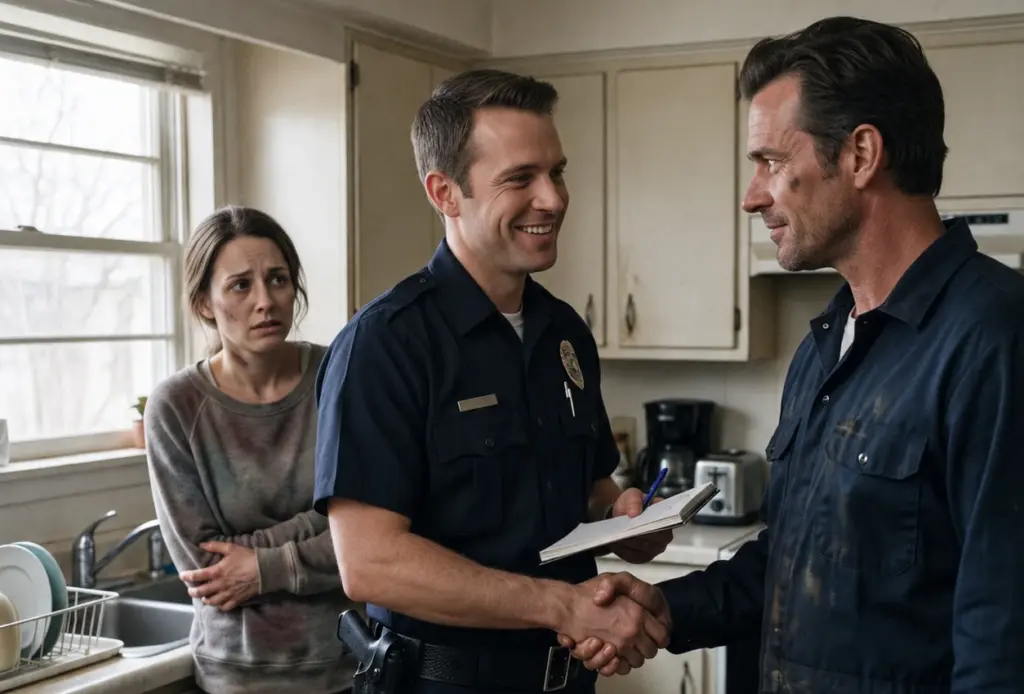
Caleb stood under a bare bulb in the operations room of a remote Army outpost, thousands of miles from Ashford, Missouri. A route map lay open beneath his free hand, marked for a patrol due outside the wire before sunrise. One moment he had been discussing a washed-out bridge with Devin Cross and Aaron Cho; the next, every line on that map had become a measure of how far he was from his child.
“I’m here,” Caleb said. He kept his voice low and level, the same way he spoke when panic could make a dangerous situation worse. “Is the closet door closed?”
“Yes.”
“Are you hurt badly enough that you can’t move?”
Mason drew in a shaky breath. “My mouth hurts. He grabbed me when I tried to get between them. Mom hit the table, and she didn’t get up right away.”
Caleb’s fingers tightened around the edge of the plywood table. He did not ask Mason to repeat the worst part, and he did not make a promise distance might prevent him from keeping. “Stay where you are. Put your phone on silent, but don’t hang up. I’m getting help to the house now.”
Devin had already moved closer. Caleb wrote Natalie’s address on the margin of the map and slid it toward him: 814 Cedar Lane, Ashford, Stonebridge County. Aaron opened a laptop, found the county’s direct dispatch number, and reached for the secure voice line that could place a civilian call to the United States.
“Child reporting an assault in progress,” Aaron told the dispatcher when she answered. “The child’s father is on a live call from an overseas military post. Adult male suspect is still inside the residence, and the child’s mother may be injured.”
The dispatcher began asking questions. Aaron answered what he could and looked to Caleb for the rest, while Devin started a written timeline with the local and Missouri times side by side. None of them spoke about what Caleb could do to Derek Vale if he were home. Men who knew him well understood that the thought existed; they also understood why he would not give it words.
“Mason,” Caleb said, “can you hear your mom?”
For several seconds, only the faint hum of the house came through. Then Mason whispered, “She’s crying. Derek keeps asking who she thinks she can call.”
Caleb looked at Aaron. Aaron covered the receiver and said, “Deputy is being sent. Cody Haines. Dispatcher says he’s six minutes out.”
Six minutes was an ordinary distance in Stonebridge County. In the operations room, it felt long enough for a life to split in two.
“Put your palm on the floor,” Caleb told Mason. “Feel the carpet under your hand. Keep breathing quietly, and tell me if the footsteps come upstairs.”
“Are you coming home?”
The question reached a place Caleb had kept defended since the divorce. Natalie Brooks had never tried to turn Mason against him, but she had stopped pretending that a video call could replace a father at the kitchen table. Their marriage had ended without a courtroom battle, leaving them joint custody on paper and long absences in practice.
“I’m working on it,” he said. “Right now, I need you to let the deputy come to you. Don’t come out for Derek. If the officer calls your name, answer him.”
Derek had entered Natalie’s life less than a year earlier. He ran Vale Recovery and Towing, spoke easily around adults, and had first presented himself as the kind of man who noticed a loose porch rail and repaired it without being asked. During recent calls, however, Mason had begun keeping his camera angled toward the wall. Natalie had dismissed Caleb’s concern twice, then apologized so quickly that he wondered who might be listening.
He had told himself not to turn a deployed father’s guilt into an accusation. Now his son was hiding among winter coats while Natalie lay hurt downstairs.
A floorboard creaked on Mason’s end of the call. The boy stopped breathing.
Caleb lifted one finger. Devin stopped writing, Aaron muted the open dispatch line, and even the radio operator at the far desk turned his volume down.
Footsteps crossed the hallway outside the closet. A door opened, then slammed hard enough to make Mason’s phone scrape against the floor.
“Where is it?” Derek shouted from farther down the hall. “I know she gave you a phone.”
Mason made a frightened sound in his throat.
“He doesn’t know where you are yet,” Caleb said. “Stay small. Don’t answer him.”
There was no tactical skill in those words, only a father trying to reduce the size of a child’s fear. Caleb had spent years learning how to move people through danger, but every lesson assumed he could see the ground and reach the person he was guiding. Tonight, he had nothing but a dim voice traveling across an ocean.
Aaron pointed to his headset. “Unit just turned onto Cedar Lane.”
Blue and red light soon flickered through the closet slats. Mason saw it too. “The police are here.”
Relief tried to enter Caleb’s chest, but training held it outside until the facts changed. “Stay on the phone. Let me hear what happens.”
The pounding at the front door carried clearly through the house. Derek’s footsteps moved downstairs, and after a pause Caleb heard the door open.
“Cody,” Derek said, sounding irritated rather than afraid. “What are you doing here?”
“Got a welfare call.” Deputy Haines spoke with the weary familiarity of a man stopping by a friend’s business after closing. “Somebody reported a woman and a kid getting knocked around.”
Natalie said something Caleb could not make out. Haines did not ask Derek to step outside, and he did not separate Natalie from him. Instead, there was a short silence followed by the deputy’s voice, closer now.
“Ms. Brooks, look at me. Did Derek hit you tonight?”
“I fell against the table.” Her words were thin and careful. “We argued. That’s all.”
“And the boy?”
Derek answered for her. “At a friend’s.”
Inside the closet, Mason whispered, “I’m right here.”
Caleb closed his eyes for half a second. “I know, buddy.”
Aaron repeated the child’s presence to dispatch and asked that Haines be told to locate Mason before clearing the residence. The dispatcher transmitted the request. A moment later, the deputy’s radio crackled downstairs.
Haines gave a brief laugh. “The father isn’t even in the country. This sounds like a custody complaint dressed up as an emergency.”
“My dad heard him,” Mason breathed.
“So did three other people,” Caleb said. “Keep listening.”
Haines moved through the downstairs rooms slowly enough to make his boots audible, but he never came near the stairs. Caleb heard a cabinet close, running water, and Derek speaking in a lower voice. The deputy’s answer came back more clearly.
“Dale put Vale Recovery back on the county rotation,” Haines said. “Sheriff doesn’t need another domestic call with your address on it, especially after he stuck his neck out on that contract.”
“Then don’t put it on paper,” Derek replied.
“That depends on whether this house stays quiet after I leave.”
The exchange lasted only seconds. It was not a confession delivered for an audience; it was routine, which made it worse. Caleb looked at Devin, who wrote the words as closely as he could remember them and underlined the sheriff’s name once: Dale Pritchard.
Natalie tried to speak again. “Cody, Mason was here when—”
“You told me he was at a friend’s,” Haines interrupted. “If you want to change your story, you can come to the office tomorrow. Right now, I see a couple who argued, no complainant willing to allege an assault, and no child in distress.”
Mason pressed a hand over his mouth, but Caleb heard the small break in his breathing. The deputy was standing one floor below a terrified child and declaring him absent.
“Ask dispatch for a supervisor,” Caleb told Aaron.
Aaron did. The dispatcher put him on hold, returned, and said the shift supervisor was handling a crash on the state highway. Haines had marked himself on scene, so no second unit would be sent unless he requested one.
Downstairs, the front door opened. Haines’s last words carried up the stairwell.
“Keep Natalie off the phone tonight. I don’t want the captain calling the state and turning this into something it isn’t.”
The door shut. An engine started outside, and the colored light vanished from the closet slats.
Caleb felt the shape of the situation change. The deputy had not merely failed to find Mason; he had warned Derek who made the call and how to prevent another one.
“Dad,” Mason whispered, “he’s coming upstairs.”
Caleb heard each step. Derek was no longer shouting. His calm approach was more frightening because it carried the confidence of a man who had just watched the law walk away.
“Can you get to the window without him seeing you?” Caleb asked.
“No. It’s across my room.”
“Then stay where you are. Keep the phone low.” Caleb looked at Devin. “Get me the Missouri child-abuse hotline and the state patrol contact. Aaron, do not let dispatch close that event without giving you the incident number.”
The bedroom door opened. Derek crossed the room and stopped close enough that Mason’s breathing vanished from the call.
“I can hear the phone,” Derek said.
The closet handle turned. Mason gasped, fabric rustled, and the door struck the wall.
“There you are.” Derek’s voice came nearer as he picked up the phone. “Captain Hart, Deputy Haines just told me exactly who called. You think being in the Army makes your word count more than mine?”
Caleb forced every answer through control. “Put Mason on the line and step away from him.”
“Sheriff Pritchard decides what gets written down in Stonebridge County. By the time you get home, there’ll be a file saying you’re an unstable ex-husband who uses his kid to harass Natalie.” Derek paused, letting Caleb hear Mason crying beside him. “This county will make sure you don’t get near your son again.”
The call cut out. Aaron turned his laptop toward Caleb. The dispatch event had already been closed: no assault observed, no injured party, child not present, civil custody dispute, no report required. Beside the final entry were Deputy Cody Haines’s badge number and a time stamp less than one minute old. Caleb stared at the words CHILD NOT PRESENT while Mason’s name remained on the dead call screen in his hand…
To read the rest of the story – CLICK the NEXT button 👇👇👇