


The red mitten appeared at Walt Mercer’s storm door at 1:16 in the morning, held against the glass by the animal he had once cut out of a poacher’s snare. Walt woke to the scrape of claws and lifted his head from the kitchen table, where he had fallen asleep over a mug of coffee gone cold. The motion light burned above the porch. Beneath it stood a huge gray shape with snow on his shoulders and a child’s mitten clamped carefully between his teeth.
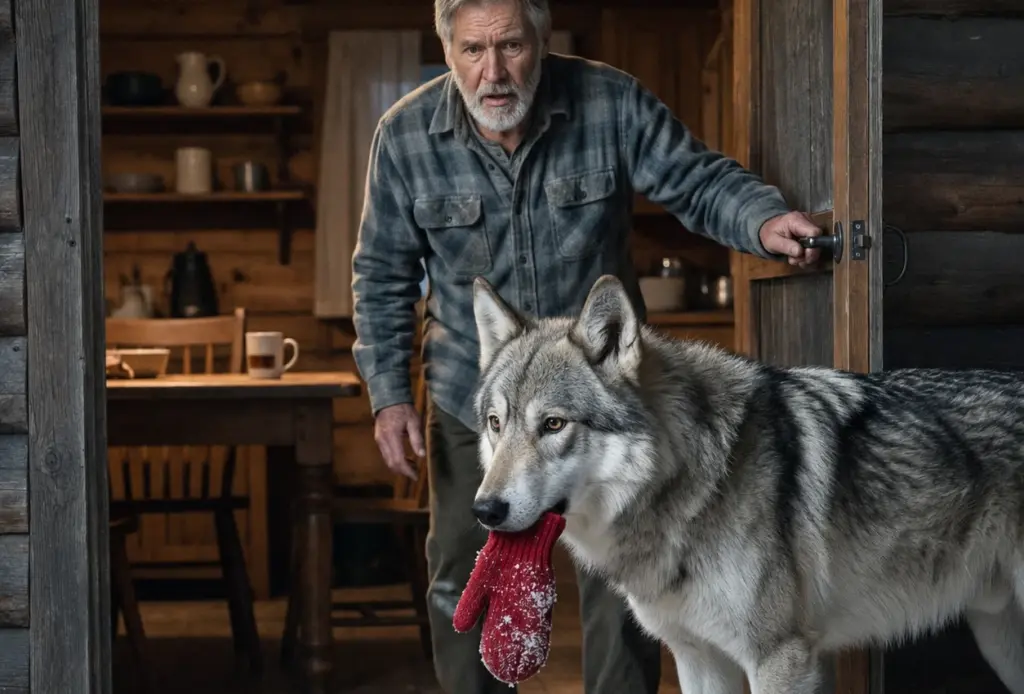
“Rook?”
The name sounded too loud in the cabin. Since Anne died, most words did. Walt crossed the kitchen in his socks and stopped at the inner door.
Rook usually waited by the woodpile. In two years, he had never come onto the porch and never asked to be let inside.
Tonight he had brought something. A child’s red mitten lay between his front paws.
Walt opened the inner door but kept the storm door latched. Wind drove snow against the glass in sheets, erasing the spruce trees twenty yards beyond the porch. Rook stared through it with pale amber eyes, then lowered his muzzle, picked up the mitten, and pressed it against the bottom of the door.
“Where did you get that?” Walt asked.
Rook dropped it again and looked toward the woods. Walt slid the storm door open a few inches. The cold came through like a blade. He reached down and lifted the mitten by its cuff. It was small enough to fit a kindergartner, bright red beneath a crust of ice, with a strip of silver medical tape stuck across the palm. Inside, the fleece was damp and faintly warm.
He looked past Rook into the white dark. No porch light shone through the trees. No snowmobile engine rose above the wind. The nearest year-round neighbor lived almost four miles away, and nobody with sense would have brought a child onto Lost Lake Road during a blizzard warning.
Walt checked his phone. NO SERVICE glowed where the carrier name should have been. He switched on the old rescue radio and called Pinewater dispatch twice, but the former county frequency returned only static; the consolidated repeater on Bear Ridge had been failing all winter, and tonight even the weather channel came and went.
Rook seized the sleeve of Walt’s flannel shirt and pulled.
The animal had never touched him that way. Even after Walt freed him from the illegal cable snare near Black Spruce Creek, Rook had kept the distance of something that remembered pain better than kindness. Walt reported the snare, but Rook vanished before the conservation officer arrived. After that he would take meat from the snow beside Walt’s boot, sometimes sleep under the spruce at the edge of the yard, and disappear for weeks without explanation. Gratitude was a word humans liked to put on wild things. Walt had never required it.
But this was not gratitude. This was urgency.
“Give me a minute,” Walt said.
Rook released him and backed off the porch, but he did not leave.
Walt dressed with the practiced speed of a man answering an old call. Wool layers. Insulated bibs. The knee brace he disliked. Headlamp, spare batteries, water, chemical warmers, emergency blanket, and the red trauma pack that had sat beneath Anne’s raincoat since Walt retired from Pinewater County Rescue four years earlier.
His hand paused on the pack’s handle. The last time he carried it, Anne had still been alive. She had stood in this kitchen and complained that retirement would kill him faster than thirty years of night calls. Six months later, a blood clot had done what wrecked cars, bad ice, and exhausted drivers never managed. Since then, Walt had stopped volunteering, stopped answering the rescue radio, and gradually stopped believing anybody would notice.
Rook struck the porch rail with his shoulder. At seventy-one, Walt knew exactly what the cold could take from him, but he also knew what delay could take from a child. He took the pack, a compact pry bar, his old rescue radio, and the satellite distress beacon from the hall cabinet. The shotgun stayed where it was. He needed both hands free, and a gun would not help a lost child survive the cold.
“All right,” he said as he stepped into the storm. “Show me.”
Rook ran north, though not at full speed. He bounded ahead until the beam of Walt’s headlamp nearly lost him, then returned, circling behind whenever Walt sank through a drift or stopped to catch his breath. Snow filled their tracks within minutes. The air had fallen to twelve below, and the wind off Lost Lake made the trees crack like distant rifle fire.
Walt kept the red mitten tucked inside his coat. Every few hundred yards he touched it through the fabric, as if its small shape could tell him whether he was moving fast enough.
The route climbed away from the lake and entered county timberland. Walt recognized the old fire road only when his boot struck the rusted edge of a culvert. Beyond it lay Camp Bracken, a fire-crew station built in the 1960s and abandoned after mold was found in the dormitory walls. During Walt’s rescue years, the bunkhouse had been used for winter drills. Now the county maps marked the place unsafe, and the road was supposed to be chained from November through April.
Rook turned onto it without hesitation, and Walt felt the first real stir of dread.
“There’s nothing up there,” Walt called.
The animal stopped, looked back once, and continued up the fire road.
There should have been no recent tracks, but under the fresh snow Walt found two compressed lines where a utility vehicle had climbed the grade earlier that night. Farther up, he saw the narrow chevrons of a snowmobile. The storm had softened both, though not enough to hide them.
That changed the cold inside him. Camp Bracken appeared through the trees after another half mile: a long, low bunkhouse, an equipment shed with one door hanging loose, and a cinder-block infirmary attached to the rear. The roof carried a heavy white burden. Every window was dark.
Rook ignored the main building. He ran straight to the infirmary and began tearing at a metal vent near the foundation. Red wool fibers clung to one sharp corner of the grille, and the snow below it had been dug away in frantic grooves. Someone inside had pushed the mitten through; Rook had pulled until it came free.
Walt swept his light over the paired metal doors. A new steel chain looped through their pull handles, secured by a brass padlock that still shone beneath the ice. Someone had placed a folded tarp over the threshold to block the draft from entering underneath. Beside the steps sat a red plastic fuel can, nearly full.
He climbed onto the landing and pressed his ear to the door. At first he heard only wind working around the eaves. Then something tapped from inside—three faint knocks, a pause, and one more.
“Pinewater Rescue,” Walt called. His voice came back to him from the dark building. “If you can hear me, move away from the door.”
No answer followed, but the tapping stopped. The chain was too tight for bolt cutters he had not brought. Walt fed the pry bar between the handles and pulled. Pain flared from his wrist to his shoulder. The right-hand door flexed but held.
Rook paced at the bottom of the steps, making a low sound Walt had heard only once before, when the cable snare had tightened around the animal’s hind leg.
“I know,” Walt said. “I’m working.”
He shifted his grip and leaned his weight into the bar. One handle tore partly free with a shriek of screws. Walt forced the gap wider, braced a boot against the wall, and pulled until the chain slipped through.
The smell inside stopped him for half a second. It was not the stale odor of an abandoned room. It was disinfectant, damp wool, spoiled milk, and the sour human smell of fear.
He switched on his headlamp and entered. An electric heater stood beside the wall, its power light dark. A heavy extension cord ran to a portable generator outside, but the cord had been severed cleanly near the window. On a folding table sat paper bowls, children’s pain reliever, sealed nutrition drinks, and a clipboard. A locked storage tote held more food and bottled water. Whoever supplied the room had kept everything organized and almost everything out of a child’s reach.
“Hello?” Walt said more softly.
The tapping came from behind a vinyl privacy screen. He moved it aside and found a narrow hospital cot pushed against the wall. Beneath it, wrapped in a gray wool blanket, lay a little girl.
She could not have been more than six. Pale hair clung to her forehead, and an adult parka had been draped over moon-print pajamas that were too thin for January. One bare foot showed beneath the blanket. Her heel was bruised, her toes colorless with cold.
Walt went to his knees.
“My name is Walt. I used to be a paramedic. I’m going to touch your neck, okay?”
Her eyes opened but did not settle on him. They moved past his shoulder, searching the room.
Rook stood in the broken doorway. The girl made a rough, breathy sound and tried to crawl out. Walt moved aside at once. Rook came forward slowly, belly low, ears turned back. He stopped an arm’s length from the cot and lowered himself to the floor.
Her hand found the fur along his neck.
“Rook,” she whispered.
Walt looked from the child to the animal. She had not guessed that name. Someone had told it to her, or Rook had been here with someone who knew him.
“You know each other,” Walt said.
The girl closed her eyes. Her fingers stayed in Rook’s coat.
Walt checked her breathing and pulse, then worked without asking questions she could not answer. He wrapped her in the emergency blanket beneath the wool one, covered her head, and moved the chemical warmers near her body without placing them against her skin. Her breathing sounded strained but steady. A pale surgical scar curved under her left ear and disappeared beneath the collar of her pajamas.
He pulled out the satellite distress beacon and pressed the emergency switch. The indicator kept flashing without returning a confirmation. Whether the alert had reached a satellite or not, the girl could not wait for help to find them.
“We’re not waiting on that,” he murmured.
As he lifted the parka, a torn hospital wristband slipped from the pocket. The printing had smeared, but the essential lines remained legible: JUNE E. VALE, a date of birth six years earlier, and AIRWAY ALERT. At one end was an emblem Walt recognized—three white pines inside a circle—the mark used by the Vale Pediatric Recovery Center outside Red Pine.
The center belonged to the Vale Family Initiative. Graham Vale, wealthy developer and chair of the Pinewater County Board, had built his state senate campaign around the line No Child Left Unheard.
Walt read the child’s last name again.
Vale.
The girl’s eyes opened when he said it under his breath. Terror tightened her grip on Rook’s fur. Her other hand flew to the scar at her throat.
“I’m not calling him,” Walt said. He did not yet know who him was, but he knew what her face had asked. “I’m getting you somewhere warm.”
He slid one arm behind her shoulders and another under her knees. She weighed far too little. Rook rose with her and moved so close that his shoulder brushed Walt’s leg.
Before Walt could reach the door, a white beam passed across the frosted window. He turned off his headlamp.
An engine idled beyond the building, and a truck door opened. A man came near the steps, speaking into a radio.
“The chain’s down,” he said.
The radio answered through a wash of static. “Then the wolf brought somebody. Hold there. Pike’s two minutes out.”
Rook stepped in front of Walt and the child. His body stiffened, but he did not growl.
A figure filled the broken doorway, rifle angled toward the floor. Snow covered the man’s hood and shoulders. He pulled the fabric from his face, revealing hollow cheeks, a week’s beard, and eyes fixed on the girl in Walt’s arms. Walt tightened his hold and reached for the pry bar at his belt.
The child raised her head. Her voice came through the scar as a frightened scrape. “Uncle Dean…”
To read the rest of the story – CLICK the NEXT button 👇👇👇