


At 4:17 on an August afternoon, the westbound lanes of Interstate 40 shimmered like black water. The temperature display outside Granite Ridge Estates read 101 degrees. Heat rolled off the pavement in visible waves, bending the new stone entrance sign and the unfinished houses beyond it. Tractor-trailers came down the grade in a steady metallic rush, their tires striking the seams in the road hard enough to make the shoulder tremble.
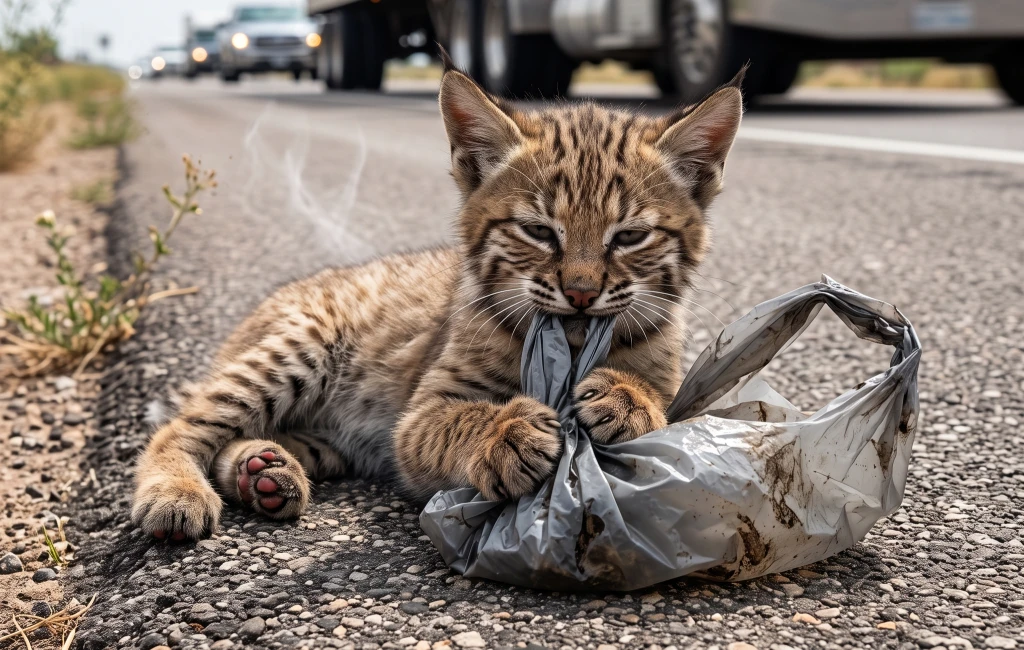
The bobcat kitten lay less than a foot from the white line. He was small enough that several drivers had mistaken him for a wad of blown insulation. His sandy coat was dark with road grime, and one black-tipped ear lay flattened against his skull. Each breath lifted his ribs sharply beneath the skin.
The pads of his feet were raw, but he would not release the bag. It was an ordinary plastic grocery bag, gray with dirt and twisted almost into a rope. The kitten had the handle between his teeth and both front paws wrapped around the crumpled middle. Whenever a truck passed, the draft pulled at the plastic, and each time he tightened his grip.
Another tractor-trailer swept by close enough to snap the bag like a flag. The kitten slid several inches across the gritty shoulder. He did not try to save himself. He used what little strength remained to drag the plastic back under his chest.
Cars had begun stopping along the shoulder. A man in golf clothes stood behind his open SUV door, filming. A woman kept saying someone ought to call animal control, though three people already had. Near the guardrail, a lanky teenager in a faded black hoodie held his phone at arm’s length.
“He’s still here,” Dylan Cole told the people watching his livestream. “Nobody’s doing anything. I swear that truck almost hit him.”
A horn bellowed from the backed-up right lane. The kitten flinched so hard that his body rolled, but his teeth remained locked on the bag.
“Get that cat out of the road!” a driver shouted through his window.
No one moved toward it. Six miles away, Noah Mercer was sitting at his kitchen table with one work boot on when his phone rang.
He looked at the screen but let it ring twice. The house was quiet enough for the refrigerator relay to sound loud. Three years after buying the small place and hauling Boone’s empty doghouse into the backyard, half his belongings remained in taped cartons along the living-room wall. He had hung no pictures. The previous owner’s faded curtains were still at the windows.
In the center of the table lay Boone’s collar. The leather had gone nearly black where rain and sweat had worked into it. The brass ID plate was scratched, and one edge bore the shallow marks Boone had made as a young dog, before he learned that equipment was not a chew toy. Noah kept the collar on a folded white dish towel, the one orderly object in a room he barely used.
The phone stopped, then began again. This time he answered. “Mercer.”
“It’s Frank.”
Frank Delaney directed Piedmont Wildlife Recovery, a low collection of cinder-block buildings outside Clayton. Noah held a current state wildlife rehabilitation license with the rabies-species category, listed Piedmont as his facility, and kept his pre-exposure vaccination current. Since Boone’s death, however, he had limited himself mostly to maintenance and transport shifts. Frank’s voice usually carried the exhausted patience of a man solving five problems with money for two. Now it was clipped.
“State Highway Patrol has a juvenile bobcat on the shoulder near the Granite Ridge exit. Wildlife Resources just called us because their field officer is forty minutes out. They’re asking for emergency containment and transport.”
Noah was already reaching for his other boot. “How young?”
“The videos make him look ten or twelve weeks. Maybe older, but he’s in bad shape. Trooper has traffic slowed, not stopped. I’ve got the duty officer on another line verifying your credentials and logging the response. Leah says if you’re going, bring him straight to intake. Don’t offer water on scene, don’t handle him, and don’t let anybody take that bag away from him.”
Noah’s hand stopped on the laces. “What bag?”
“You’ll see.”
Frank sent the location and a link. Noah watched three seconds of shaky video: white line, small spotted body, plastic clenched in its mouth. The sound was mostly traffic, but beneath it came a thin, rasping cry.
For one instant the kitchen smelled of smoke—not real smoke, but the memory of it. An evacuation tone sounded somewhere behind his eyes, followed by the crack of a floor giving way and the sensation of a leather collar sliding beneath his glove.
Three years had passed since the collapse. Every official review had cleared him, and Boone’s collar still waited on the table each morning as if the report had settled nothing.
Noah closed the video. He picked up his keys, then looked at the collar on the table.
“Send the case number to my phone,” he told Frank. “I’m leaving now.”
His old Ford Explorer already held the equipment Piedmont required for wildlife calls: a hard-sided transfer crate, a hoop net, a catch board, heavy gloves, towels, and a reflective vest. Noah checked the crate latch twice before backing out.
By the time he reached I-40, a state trooper had angled his cruiser across the outside lane. Traffic crawled past in the left lane while the stopped motorists clustered behind the guardrail. Noah parked beyond the cruiser, put on his vest, and showed the trooper the case number and credential confirmation from the duty officer.
“You’re the wildlife guy?” the trooper asked.
“Licensed wildlife rehabilitator. Veterinarian is waiting.”
The trooper glanced toward the shoulder. “Little thing’s got teeth.”
“That’s why everybody needs to stay behind the rail.”
Noah took the crate and catch board first. Dylan swung his phone toward him.
“Are you going to save him?”
Noah set the crate down well outside striking distance. “I’m going to try. Back up with everyone else.”
“I’m not close.”
“You’re close enough to make him watch you instead of me.”
Something in Noah’s voice made the teenager lower the phone and step away.
From ten feet out, Noah assessed the animal. Juvenile male, probably three months. No visible fracture. No active bleeding beyond the feet. Rapid open-mouth breathing, glazed eyes, poor balance. Heat stress, dehydration, and exhaustion were more immediate threats than aggression, but a frightened bobcat could still open a hand to the tendon.
The kitten watched him through half-lowered lids. Noah crouched sideways rather than facing him head-on. “Easy, little man.”
The kitten responded by pulling the grocery bag tighter beneath his chest.
That movement struck Noah more deeply than the crying had. He knew the logic of it. When the world had narrowed to one surviving object, the object was no longer leather or plastic. It was proof that before this moment there had been warmth, a known voice, a place where sleep had been safe.
A truck changed gears in the open lane. The kitten tried to rise, fell against the bag, and gave a dry, broken snarl.
Noah looked at the trooper. “I need a full stop for ninety seconds.”
The trooper studied the traffic, spoke into his radio, then stepped into the lane. The sound of engines thinned. For the first time, there was space around the animal.
Noah positioned the crate with its door open and a towel covering three sides. He laid the catch board as a low wall between the kitten and the roadway, then approached with the hoop net close to the ground. No lunging, no chase. He waited until the kitten’s head sagged and made one controlled movement.
The net came down over the kitten and the bag together. The animal found one last reserve of strength. He twisted, struck the mesh, and screamed. Several people behind the guardrail gasped, while Dylan’s phone came up by reflex and then stopped halfway.
“Quiet,” Noah said, though he did not know whether he meant the crowd or himself.
Using the catch board, he guided the netted kitten backward into the crate without putting his hands near the animal. The bag went with him. When the kitten cleared the threshold, Noah withdrew the net and shut both latches.
The entire transfer took less than a minute. Noah covered the crate, leaving the vents open, and secured it in the Explorer’s cargo area. He set the air-conditioning to cool the vehicle gradually, not shock an overheated animal with cold air. Then he called Leah through the hands-free system.
“Male juvenile contained. Conscious, minimally responsive. Respirations fast. Pads look burned. No obvious fracture.”
“How long to me?” Dr. Leah Bennett asked.
“Twelve minutes.”
“Keep the cabin quiet. Nothing by mouth. If he goes flat, call before you move him.”
From the covered crate came a faint rustle of plastic. Noah drove.
Piedmont Wildlife Recovery occupied what had once been a county maintenance depot at the edge of the forest. Leah was waiting under the intake awning with a rolling cart, oxygen, and two technicians. Frank stood behind her holding a clipboard and his phone.
“Wildlife Resources logged the intake under our rabies-species permit,” Frank said as Noah opened the rear hatch. “Highway Patrol recorded the pickup. Maya will inspect the repaired long-term pen tomorrow.”
Leah leaned toward the crate without blocking its vents. She was thirty-eight, composed even after a sixteen-hour day, with brown hair coming loose from its knot and a dark iodine mark on one sleeve of her scrub top.
“Bring the whole crate,” she said. “Low lights. No audience.”
Inside intake, they transferred the crate onto the exam platform and closed the room. Leah watched the kitten for a full thirty seconds before touching a latch. His chest fluttered. His muzzle remained pressed to the grocery bag.
“We document before we separate anything,” she said.
Noah held a clear evidence tray beneath the crate door while Leah used long forceps to lift one torn corner of the plastic. The kitten made a weak sound but could no longer pull back. Something caught in the folds and fell into the tray.
A small clump of coarse tawny guard hair—not food—lay tangled with pine needles. Wound through both was a strip of orange construction ribbon, its color faded by dirt and weather.
Leah stared at the guard hairs, then at the kitten’s paws locked around the bag. “We can’t know whose scent is on it,” she said quietly. “But this came out of a den. It may be the only familiar thing he has left…”
To read the rest of the story – CLICK the NEXT button 👇👇👇