


Dean Mercer heard the flies when he lifted the mower blade from the bench grinder. At first he blamed a bad bearing. But the wheel wound cleanly to a stop, and the dense, uneven buzzing continued beyond the open garage door. Saturday heat had already settled over Merritt, Ohio. It pressed the smell of cut grass and motor oil into the garage and silvered the weeds along Dean’s back fence. Beyond them stood the abandoned seed mill, its loading shed collapsed on one side and its concrete footings half buried beside the old rail spur.
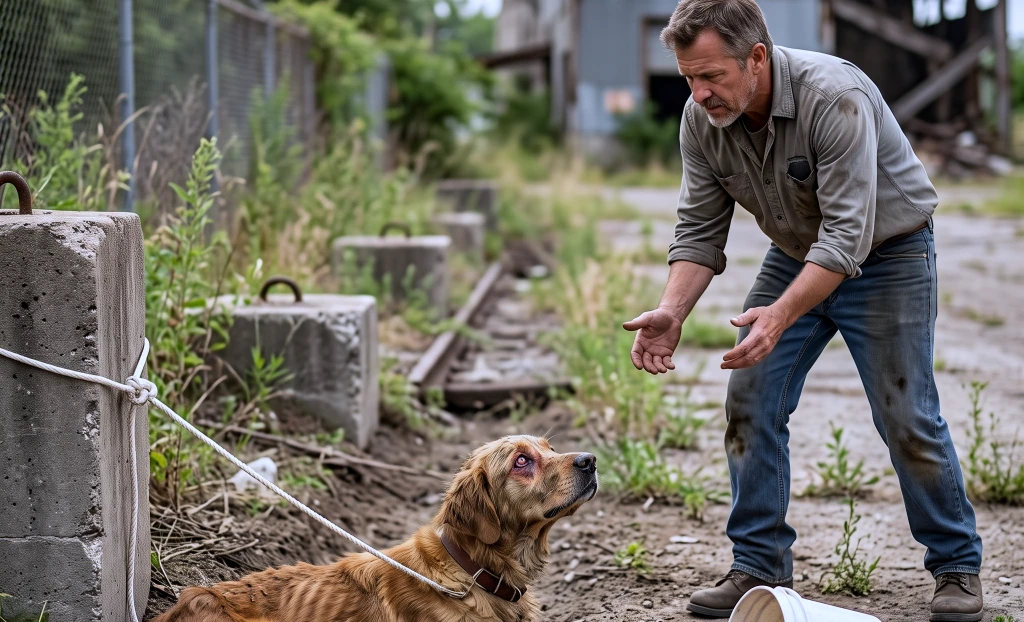
Nobody had worked there in six years. County crews mowed the service lane when somebody complained, which meant twice each summer if the town was lucky.
Dean took off his safety glasses. Under the flies, he caught a thinner sound, so slight that the fan in the corner nearly covered it.
A dog, trying not to cry out anymore.
He shut off the fan and crossed the yard. The back gate dragged through crabgrass before giving way, and burrs fastened to his jeans as he pushed toward the nearest concrete pier. The buzzing thickened until he could feel it around his face.
The dog lay motionless in the drainage cut on the other side.
She was a large, golden-red mix with a white blaze down her chest and an old tear in one ear. Dirt had dulled her coat, and her ribs showed beneath the mats along her sides. A white nylon line ran from the concrete pier to her neck. The ground around her had been worn into a hard circle, with claw marks at its outer edge.
An overturned plastic bucket lay just beyond that circle. A dark patch beneath it had dried to mud.
Dean stopped several feet away and let her see his hands. The dog’s eyes opened, cloudy with heat and exhaustion. Her tail pressed once against the dirt, too weak to lift. Dean’s hand closed around his own knee.
“Easy,” he said. “I’m coming closer.”
She did not growl. That worried him more than if she had.
The line had been looped twice through a cracked leather collar and pulled tight enough to disappear into the fur at the side of her throat. Flies clustered there. Dean could smell infection beneath hot dust and old water, and when the dog tried to raise her head, the line drew tighter.
He backed away slowly. “I’ll be right back.”
In the garage he grabbed a clean moving blanket, bottled water, a shallow parts tray, work gloves, his folding knife, and the thin paint scraper he used to shield hoses when cutting old insulation. His phone was already in his hand before he reached the gate again. The veterinary clinic in town answered on the third ring.
The receptionist listened without interrupting. She told him to offer only small amounts of water, cut the restraint if he could do it without touching the wound, and bring the dog straight to the side entrance. If she became unresponsive, he was to call back from the yard.
Dean slid the parts tray beneath her muzzle and poured in less water than he wanted to give. The dog smelled it, licked twice, then tried to pull the dish closer with one paw. He held it where she could reach without tightening the line.
“There’s more,” he told her. “You don’t have to finish it now.”
Her dry tongue rasped the metal. When she stopped, Dean eased the paint scraper beneath the outer loop of nylon, using its dull blade as a guard between the knife and her skin. The line was swollen with dirt and body heat. He sawed a few fibers at a time while the dog trembled under his wrist.
He fixed machinery for a living. He knew what tension could hide, how a belt could look slack until the load shifted and took a finger with it. He kept one hand on the line, felt each strand surrender, and made sure the released end could not whip back against her neck.
The first loop parted. The dog flinched, pressed her muzzle into the dirt, and held herself rigid.
“Almost,” he said. “Stay with me.”
When the second loop gave, the line dropped into the dirt. The dog drew a breath that moved along her whole body, then lowered her head against Dean’s boot. He laid the clean edge of the blanket beside her, rolled rather than lifted her onto it, and dragged the corners together into a stretcher.
She was lighter than her frame promised. He carried her through the weeds in short steps, the blanket pulling at his shoulders, and laid her across the back seat of his truck. Before closing the door, he returned for the severed loops that had fallen beside her and put them in an empty storage tote. He left the bucket and the length still knotted to the pier where they lay; the way he had found her might matter later.
The clinic stood between a laundromat and a tax office that had never reopened after the pandemic. A technician rolled a gurney through the side door while Dean was still setting the parking brake. Dr. Lena Ortiz followed, tying back the sleeves of her blue scrub jacket.
“How long was she down?” she asked.
“I don’t know. I heard her twenty minutes ago.”
“Did she drink?”
“A little. I didn’t let her gulp.”
Dr. Ortiz nodded and began examining the dog before the gurney cleared the doorway. Dean followed until a technician asked him to wait beside the treatment-room wall, then stood there with the stained line in its tote and dried blood in the half-moons of his nails.
They cut away fur, started fluids, took blood, and cleaned enough of the neck to see the wound. Dr. Ortiz spoke in short instructions that made no promises. The dog’s temperature was too high. Her weight was too low. The wound needed debridement, antibiotics, and observation, and dehydration was only the first thing they could correct.
When the technician passed a scanner over her shoulder, it beeped.
“Chip,” she said.
The number brought up the name June and an owner, Lydia Hayes, at an address on Sycamore Road. Dr. Ortiz searched the clinic’s own records and found that June had been a patient there. A note added after Lydia’s death listed an estate contact, Derek Hayes.
At the sound of June’s name, one ear moved. Dr. Ortiz said it again more softly, and the dog opened her eyes.
“There you are, June,” Dean said.
She found him against the wall. Her tail shifted once on the towel.
Dean’s shoulders loosened before he knew enough to trust the feeling. She had a name. Someone had once registered her, vaccinated her, and taken enough care to make sure she could be returned.
Dr. Ortiz removed her gloves. “She needs to stay with us at least twenty-four hours, probably forty-eight. I also have to report the condition she arrived in.”
“To animal control?”
“Yes. They determine protective custody and any foster placement. I can recommend a medical foster, but I can’t send a disputed animal home with whoever asks first.”
Dean looked through the glass panel in the treatment-room door. June lay under a light blanket with a fluid line taped to one foreleg. “What would they need from me?”
“A safe place, a fenced or controlled outdoor plan that doesn’t put pressure on her neck, transport for rechecks, and the willingness to follow instructions when she doesn’t make it easy. Officer Kline is on call today. She’ll speak to you.”
“Tell her I’m willing.”
Dr. Ortiz studied him, not unkindly. “She’s going to be frightened after the medicine wears off. She may guard food, panic at ordinary things, or refuse you after trusting you today.”
“Tell her anyway.”
In the waiting room, Dean remembered the message on his phone. Owen was supposed to come at noon so they could finish rebuilding the front hub on an old BMX bike they had started two Saturdays earlier. The visits had become like that: a job named in advance, a start time, an object between them so neither had to decide what else to say.
He typed, Found an injured dog. At Merritt Vet. Bike won’t happen today. You don’t have to come.
Owen answered with a single word: Okay.
Dean set the phone facedown. He gave Beth Kline, the county humane officer, a factual account when she arrived, then walked her to his truck and showed her the tote. She photographed the severed loops, sealed them in a bag, and had Dean mark the concrete pier on a map before she left to document the remaining line and bucket. Beth formally placed June in protective impoundment and authorized the clinic to continue emergency care. Derek would receive written notice that day; unless the estate surrendered its claim first, a court would review the seizure the following week.
“If she can be released in a day or two,” Dean said, “I want to foster her.”
Beth looked past him at the truck, the grease under his nails, and the garage receipts scattered on the passenger floor. “I’ll inspect your house, yard, and work plan before I approve anything.”
“When?”
“Tomorrow morning. Don’t clean up on my account.”
By late afternoon, June’s temperature had begun to fall. Dr. Ortiz allowed Dean into the treatment room for five minutes, warning him not to ask the dog to move. He stood beside the low recovery kennel and rested two fingers on the towel near her front paw.
A technician opened the treatment-room door and led Owen in. He wore a faded black T-shirt and carried the red shop rag Dean had left on the grinder bench.
“Mom drove me,” he said. “We stopped at your place first. You left the garage open.”
At sixteen, Owen had grown taller without Dean being present for the daily increments. His dark hair fell into his eyes, and there was a fresh scrape along one knuckle, probably from the bike chain. He looked through the kennel door at June, then at the wide bandage around her neck.
“Is she going to live?”
“Dr. Ortiz says she has a chance.”
Owen crouched but did not put his fingers through the bars. June opened her eyes and watched him. He turned one hand palm up on the floor, far enough away that she would have to choose even the idea of contact.
“What’s her name?” he asked.
“June. Her owner died. The county’s trying to find out who had her.”
“What happens when she leaves here?”
Dean heard the caution in the question. “I asked to foster her. Officer Kline has to approve it.”
Owen looked at him then. “You asked?”
“Yes.”
“And if they say no?”
“I’ll ask what I have to change.”
June moved her paw until one nail touched Owen’s open hand. He stayed perfectly still, but his face tightened in a way Dean recognized from the morning Rachel had carried the last suitcase to her car. “You asked the county to let you keep her after one hour,” Owen said. “Why didn’t you ever ask me to stay…”
To read the rest of the story – CLICK the NEXT button 👇👇👇