


At forty-two, Kate Bell had fourteen minutes to catch her bus when a paper bag split open beside the peach stall. Six peaches rolled across the polished concrete of Reedy Mill Market, scattering between stroller wheels and the legs of café tables. The man who had been holding them stood perfectly still, tall but stooped, dressed too warmly for an August morning, and staring at the fruit as though it had landed in a place he did not recognize.
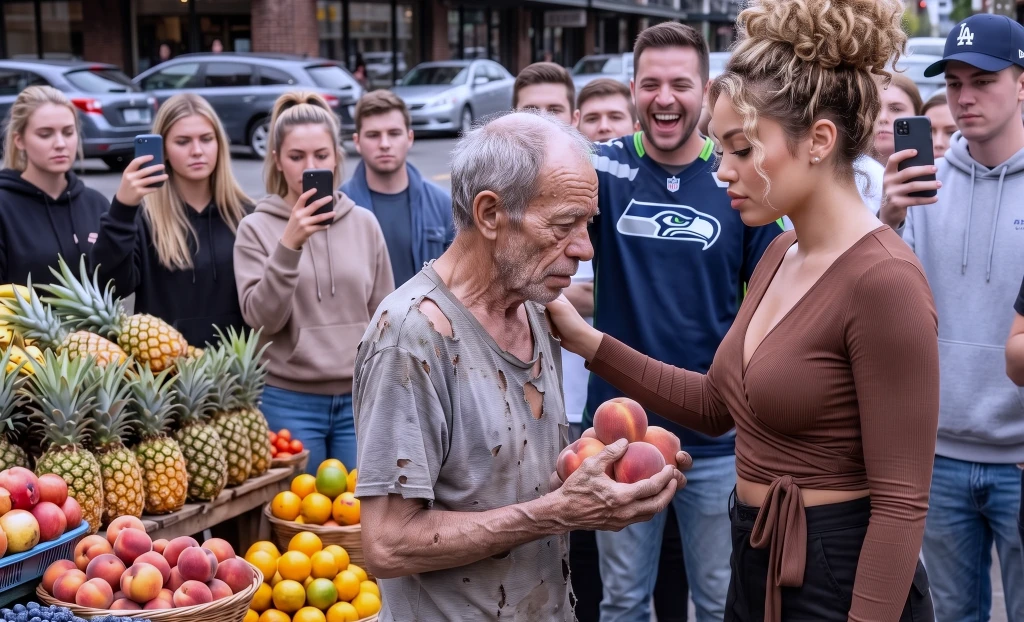
Kate checked the clock above the old mill doors. The next bus would put her at Upstate Table after the panel had started, and panels rarely waited for contract workers with explanations.
One peach stopped against her shoe.
She crouched without picking it up. “Sir, would you like some help?”
His eyes moved to her face, pale blue and frightened. “I had a route sheet.”
“Okay. Do you know where you are?”
He looked up at the iron beams and the hanging signs. Around them, Saturday shoppers kept moving. “This used to be a weaving room.”
“It did. Now it’s Reedy Mill Market.” Kate pointed toward the peach at her foot. “May I gather these for you?”
After a moment, he nodded. She retrieved five, and a boy found the sixth, bruised beneath a table. The vendor brought a fresh bag, but the older man kept checking the same empty pocket.
“My wallet should be there,” he said. “Nathan told me not to take it out on the floor.”
The vendor recognized him. “Mr. Harlan, do you want me to call your son?”
The name seemed to settle him. “Nathan is at the south warehouse.”
The total on the scale was $8.67. Kate paid before she could calculate what that left for lunch, then asked the vendor to point her toward the market office. She did not take the man’s arm until he said she could.
From the office doorway, Kate watched her bus pull away from the curb.
The market manager found an emergency card in his shirt pocket: Walter Harlan, seventy-eight, mild cognitive impairment; call Nathan Harlan. While the manager called, Kate left Priya Shah at Upstate Table a message saying an emergency had delayed her.
Walter sat in a vinyl chair with the new bag of peaches in his lap. “I know you missed something.”
“A bus.”
“It mattered.”
“Yes.” Kate sat across from him. “So does getting you where you meant to go.”
He rubbed one thumb across the folded top of the bag. “I was the night dispatcher for Blue Ridge Produce Cooperative. Retired after forty-one years. I could tell you where every truck was between here and Asheville.”
“I believe you.”
“This morning I couldn’t tell which door I came through.”
Kate resisted the urge to promise it was nothing. Her own life had been built around people deciding which truths she could handle.
“Your son is on his way,” she said.
Nathan arrived a little over twenty minutes later in a navy cooperative shirt, gray at the temples. He knelt in front of Walter instead of speaking over him.
“Hey, Dad. Do you know who I am?”
Walter gave him an offended look. “You’re the boy who schedules refrigerated trucks as if weather accepts appointments.”
Nathan’s shoulders loosened. He asked two more quiet questions, then turned to Kate. “The manager said you stayed with him.”
“He told us who to call and let me stay with him.”
Walter lifted the peaches. “She paid for these, too.”
Nathan reached for his wallet, but Kate shook her head. “Get him home. He can repay me when the morning feels less crowded.” She left her number because Walter insisted on exact accounts, then hurried to another stop.
Kate reached Upstate Table thirty-eight minutes late. The conference-room door stood open and the panel was gone.
Priya Shah met her in the hall. She was compact, brisk, and kind enough not to soften the truth. “The county representative had another meeting. I couldn’t hold the panel.”
“I understand.”
“Human resources will let you know if we can reschedule.”
Kate knew what that meant. She also knew that pleading would turn Walter into a story she had purchased for sympathy.
“Would you read this before you close my file?” She took a stapled memo from her portfolio. “Your posting mentioned the new neighborhood grocery program. The current plan measures distance from a distribution point, but not the trip home for residents without cars.” Priya glanced at the title: Bus-Route Gaps in the Neighborhood Grocery Pilot.
Kate had spent three weeks mapping bus transfers, sidewalk gaps, package weights, and the hours when routes thinned, after long shifts cleaning customer data for a pharmacy contractor. The Upstate Table job connected to a problem she understood, not merely a bill she had to pay.
Priya accepted the memo. “I’ll read it.”
That was all Kate had left to ask for.
The small brick house in Sans Souci was quiet when she returned, but Ruth and Evan were waiting at the kitchen table. Ruth had left a plate covered in foil beside the stove, the way she had whenever Kate came home late since childhood. A loan packet sat between them with orange stickers marking the signature lines.
Evan tapped the top page. “Forty-six thousand clears the vendor accounts, the truck note, and the cards. One payment instead of six.”
His mobile repair business had closed after eighteen months of borrowed parts and promises that one fleet contract would change everything. Kate had already covered two electric bills and three mortgage payments while Evan “restructured.”
“Whose name is on the new loan?” Kate asked. Neither answered.
She turned to the borrower page. Her own name had been typed beneath Evan’s.
“No.”
Ruth folded her hands. “Your credit is the only reason the bank will consider it.”
“That is not a reason to use it.”
“Use it?” Evan’s chair scraped back. “I’m asking you to stand behind me.”
“I paid the van note, the electric bills, and the mortgage. I’m not signing this.”
Ruth’s expression changed, grief arranging itself into accusation. “When the county brought you here, you didn’t have a name that belonged to anybody. We gave you ours.”
Kate felt the old debt open beneath the words. Ruth had invoked it for Evan’s tuition, the roof, his first van, every holiday when Kate’s overtime mattered more than her presence. Harold Bell, who had sat beside Kate through night terrors, had never presented love as an invoice. Since his death, Ruth had kept accounts for both of them.
“I have paid for the name,” Kate said. “More than once.”
Ruth flinched. Evan did not. “If you walk away from this, don’t expect Mom to keep a room for you.”
Kate looked toward the narrow hallway. Until that moment, she had thought of the room at the end as hers, although its closet still held Evan’s old trophies and Ruth entered without knocking.
“You should use it for storage,” she said.
She packed one canvas bag: clothes, her laptop, Harold’s blue sweater, and the records that began after the missing part of her life. Ruth watched without asking her to stay. Evan remained with the pen.
At a budget motel on Wade Hampton, Kate paid for one night, set the chain, and ate vending-machine crackers while traffic hissed over wet pavement.
Shortly after eight the next morning, Nathan Harlan called. “My father has been asking about you since six,” he said. “He wants to repay eight dollars and sixty-seven cents. I can send it electronically, or you can stop at the cooperative office. Whichever is easier.”
Kate had nowhere she needed to be until the motel made her leave at eleven. “I’ll stop by.”
Blue Ridge Produce Cooperative operated from a low complex west of downtown where forklifts moved pallets of late-summer fruit beneath white loading canopies. Nathan met her at reception and led her to a glass-walled office overlooking the dispatch floor.
Walter was waiting with an envelope. Inside were eight one-dollar bills, two quarters, a dime, a nickel, and two pennies.
“Accounts settled,” he said.
“Exactly settled.” Kate poured the coins into her palm.
One penny slipped. When she bent to catch it, the chain beneath her blouse slid free. The brass token at its end struck the desk with a small, hard click.
Walter stopped smiling. The token was dark with age, stamped ROUTE 17, with a crescent-shaped notch cut into one edge. Kate covered it instinctively, but Walter had already leaned forward. Nathan moved beside him, one hand hovering near his shoulder.
“Where did you get that?” Walter asked. “I’ve always had it.” “No.” His voice shook, but his gaze was clear. “I clipped that edge myself. The girl wearing it disappeared thirty-four years ago…”
To read the rest of the story – CLICK the NEXT button 👇👇👇