


The crosshairs rested just behind the mountain lion’s shoulder. Nathan Mercer had made that shot before. At forty-eight, after six years in the field with Montana Fish, Wildlife & Parks, he knew exactly what an official removal order required—and what one rifle report would end.
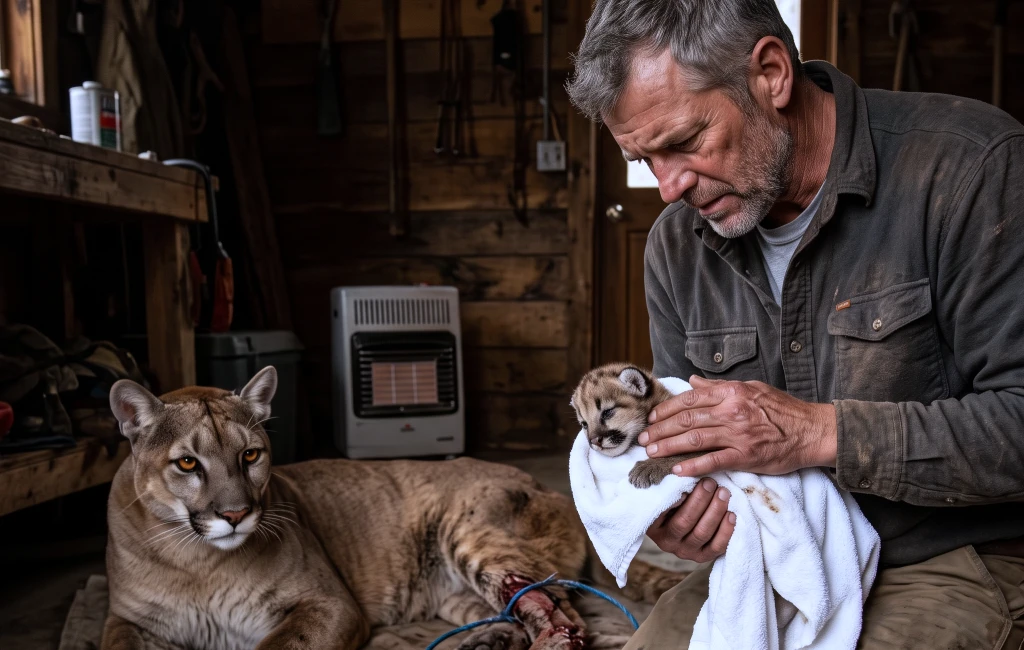
Below him, the lion stood beside a wind-thrown ponderosa, half concealed by a screen of young firs. Late-afternoon light washed the Bitterroot Mountains in the flat silver that came before a late-January snow squall. There was no wind at ground level. No branch moved. Even the ravens circling farther down the drainage seemed to be waiting.
Nate kept his cheek against the stock.
“Mercer,” Cal Brennan had said over the radio twenty minutes earlier, his voice breaking through static from the trailhead. “If the identification holds and you have a safe backstop, the authorization stands.”
Cal was a game warden, not a man who enjoyed killing. Neither was Nate. But three ranch families along Lost Horse Creek had been warned to keep children and pets close after a calf carcass was found beneath a cottonwood, with lion tracks circling the blood. Someone had photographed a tawny cat on the ridge the following night. By noon, a USDA Wildlife Services specialist had classified the loss as probable lion depredation and initiated a targeted-removal response, with Cal serving as FWP’s enforcement liaison. An agitated county commissioner was demanding action before fear produced a dozen armed volunteers.
Nate had followed the tracks for most of three days. They ended here.
Through the scope, he saw the notch in the lion’s left ear that appeared in the rancher’s trail-camera image. Same cat. Same long body. Same dark tip on the tail.
He eased the safety forward. The lion shifted, and her right hind leg nearly folded beneath her.
Nate stopped breathing.
At first he thought the shadow above her hock was mud. Then she turned enough for the light to catch a raw, narrow groove cut all the way around the leg. The fur had been rubbed away. A short twist of frayed steel cable still clung to it, blackened with blood and dirt.
Not a ranch fence. Not an old injury.
An illegal snare, recent enough that the wound was still wet.
The lion took one uneven step and pressed her flank against the fallen tree. Her ribs moved too quickly. Nate adjusted the focus, following the line of her body, and only then understood what the fir branches had hidden.
Her abdomen hung low and full beneath her.
Very full.
He had seen pregnant lions on remote cameras and once from a helicopter during a winter survey. This was different. Her flank tightened with a visible contraction. Her back arched. The muscles in her hindquarters shuddered, and a dark thread stained the snow beneath her tail.
Nate’s finger came off the trigger.
For one disorienting second the circular field of the scope turned blue-white, the color of a phone screen in a dark truck cab.
At the gate now. Ellie has the hiccups again. She must know she’s going home. Love you.
Laura’s last text had arrived eleven years earlier while Nate sat in a truck stop west of Missoula, waiting for sleet to ease over Lookout Pass. She had spent a week with her mother in Seattle. Nate had promised to drive out and bring her home, then accepted one more freight run because they needed money before the baby came. Laura told him not to be foolish. The regional flight was short. He could meet her at Missoula before dinner.
He had read the message and smiled at the name they had chosen for their daughter. Ellie Mercer. He had meant to answer after he paid for fuel. Seven minutes later, a voice message arrived. He tapped it and heard Laura say, “Hey. We’re boarding in a few minutes.”
Instead, men in wet work jackets began gathering beneath the television bolted above the counter. A reporter stood in wind-driven snow outside Missoula International. Behind her, emergency lights pulsed red against the low clouds. NorthSound Regional Flight 417, Seattle to Missoula, had gone down during its approach.
No confirmed survivors.
Nate had looked at Laura’s text again because the flight number was not in it. Some irrational part of him believed that omission could save her. Then the passenger route appeared across the bottom of the screen, and the coffee cup slipped from his hand.
For years afterward, he remembered small things with brutal clarity: coffee spreading between the black-and-white floor tiles; the cashier saying, “Sir, are you all right?”; his own phone still open to a message he had never answered.
He did not remember driving to the airport. He remembered being told there was nothing to identify.
In the first year after the crash, people tried to explain that his presence would not have changed weather, machinery, or gravity. Nate knew that. Guilt did not care what a man knew. It cared that Laura had been afraid of flying, that he had promised to bring her home, and that he had chosen another load instead.
Eventually he sold the truck and went north. For four seasons he worked Bering Sea boats where the hours were savage, the decks dangerous, and nobody asked why a man volunteered for every miserable watch. Exhaustion gave him stretches of sleep without dreams. It did not give him a life.
That came more slowly. Twice, injured wildlife crossed his path—a storm-beaten seabird on deck and a seal dragging plastic line beyond the harbor. In both cases, the crew called authorized responders and kept the animal safe or in sight until trained help arrived. The moments were small, almost private, but they showed Nate something grief had hidden: being unable to save the people he loved did not excuse him from helping whatever was still alive in front of him.
When he returned to Montana, he trained in wildlife management, conflict response, remote rescue, and evidence handling. He started as a seasonal field technician and stayed. By the time his hair had gone iron gray at the temples, he was the senior backcountry wildlife conflict technician people called when livestock, predators, public fear, and bad terrain collided.
He had built a second life around arriving before it was too late.
Now the rifle trembled against his shoulder.
Nate lowered it.
The lion raised her head at the movement. Her ears flattened, and her lips drew back just enough to show the points of her canines. There was no plea in her face, no human understanding. There was pain, exhaustion, and the last defensive warning of a wild animal that had nowhere left to go.
Nate backed away one measured step at a time until the firs blocked her view of him. Then he crouched behind a boulder and keyed his radio.
“Cal, hold the removal order. Female is pregnant and in active distress. She has a fresh cable injury on the right rear leg. Possible illegal set.”
Static hissed.
“Cal, copy?”
Nothing.
He tried the direct channel for Dr. Maya Torres, the wildlife veterinarian stationed in Hamilton. The radio gave him one clipped syllable that might have been his name, then went dead again.
Nate looked downslope. The mountain lion had sunk onto her side. Her head remained up, but only barely.
The calf carcass returned to him in pieces: too much blood in one place, almost none along the supposed kill path; the hide was cut more cleanly than feeding damage could explain; snowmobile tread, ski marks, and sled-runner tracks blurred beneath fresh snow fifty yards from the cottonwood. He had photographed everything and told Cal the scene bothered him. They had agreed to treat it as suspicious while Nate found the cat.
Now steel cable was embedded in her leg.
Someone had wanted lion tracks around that calf. Someone had wanted a depredation order in place, ready to explain a dead cat that should never have been hunted.
That question would have to wait.
Nate slipped the rifle over his shoulder and moved toward the gear cache he had left below the ridge. The orange bundle strapped to his pack was a collapsible recovery sled, required equipment on a lethal backcountry response. It was meant to bring a carcass out for examination.
He unfolded it in the snow.
The danger of the plan did not escape him. Nate’s large-carnivore capture training assumed a team, a transport crate, and chemical restraint—not one man beside a conscious mountain lion. If she had still been able to stand, he would have backed off. She could not. Every condition that weakened her also made her less predictable.
But the nearest service road was miles away. Maya could not reach the ridge before dark even if Nate found a signal. Leaving the cat where she lay meant exposing her and the kittens to falling temperatures, blood loss, and whoever had set the snare.
His remote field station was less than two miles downhill.
Nate packed snow beneath the sled runners, attached the hauling lines, and took an insulated canvas cover from his emergency kit. He approached from behind the fallen tree, keeping the sled between himself and the lion.
She saw him at twenty feet.
Her head came up. A hoarse snarl rolled out of her chest, and one forepaw struck the edge of the sled hard enough to jerk it sideways. Nate froze. She tried to rise, but the injured leg failed. Her body tightened with another contraction, longer than the first, and she dropped heavily against the snow.
“Easy,” he said, though the word was mostly for himself.
He waited until her breathing slowed. Then he advanced by inches, using the rigid sled as a barrier and the slope to do what strength alone could not. He never tried to lift her. He eased the sled beneath her as she shifted, moving only when another contraction spent what little strength she had. Snow collapsed beneath his knees. The lion twisted once with terrifying speed, claws scraping across the sled, and Nate felt the wind of her paw against his sleeve.
Then the effort went out of her.
He drew the canvas around her without covering her head and secured her only enough to keep her from sliding during the descent. Up close, he could smell blood beneath the musky heat of her coat. He could also see the tremors moving through her abdomen.
Nate gathered the hauling straps and looked west. The sun had already dropped behind the Bitterroot crest. Blue shadow climbed the drainage toward them, and the first grains of snow ticked softly against the canvas. The lion’s body clenched again. This time fluid spread dark and unmistakable beneath her. Delivery was close, and daylight was going…
To read the rest of the story – CLICK the NEXT button 👇👇👇