


The night the bobcat appeared at the outer gate of the old wildlife enclosure, rain was running off her whiskers. It looked close to dark, though the clock above my workbench said ten past five. On the last Thursday in April, a thunderstorm had lowered itself over the Blue Ridge outside Saluda, on the Polk County side, and stayed there, turning the yard behind my shop into brown water and beating on the metal roof hard enough to cover ordinary sounds. What reached me wasn’t ordinary. Three quick strikes against chain link, a pause, then three more.
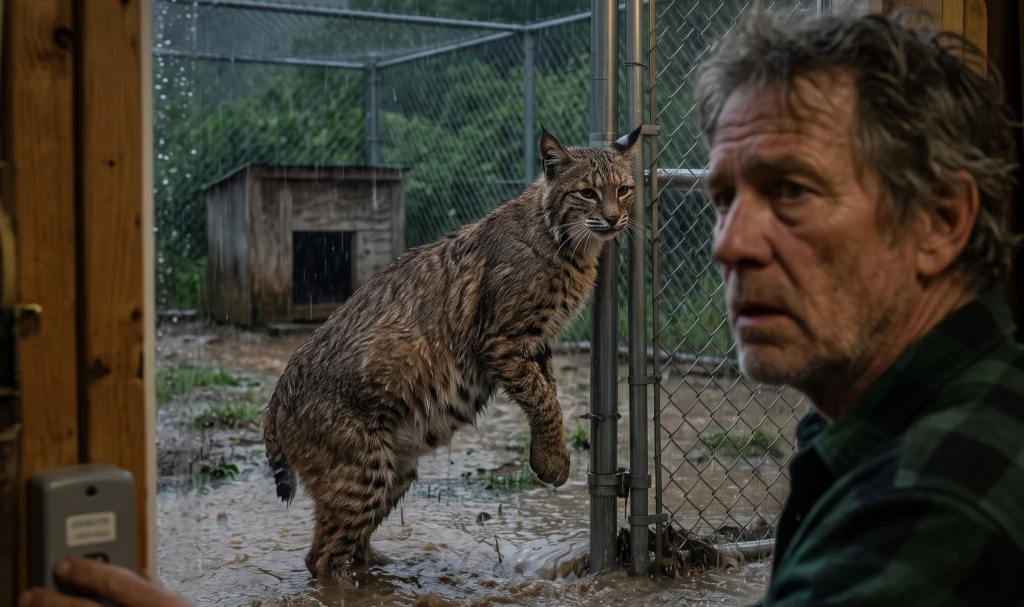
I set down the cabinet door I was fitting and went to the window. The security light showed a blunt, tawny shape beyond the fence, backed against the gate as runoff streamed around her paws. Her ears were black-tipped. Her tail ended after a few inches in a dark bar. She was no soaked barn cat, though at first some stubborn part of my mind had wanted her to be.
She hit the mesh once more, not lunging at me but trying to stay upright. Then she turned sideways, and I saw the weight low in her belly.
“All right,” I said, too softly for her to hear through the rain. “Don’t go anywhere.”
The enclosure had stood empty for fourteen months. My wife, Sarah, had used it as a satellite rehabilitation site under her state license, mostly for foxes and bobcats preparing for release. After she died, Claire—by then holding her own state authorization to rehabilitate bobcats—had it inspected and approved as her Polk County site while she worked with Foothills Wildlife Recovery Center. I remained on Claire’s volunteer roster for maintenance and concealed feeding under her direction, never independent animal care. I kept the bolts sound, the perimeter skirt clear, and the shift doors working. I had not agreed to put an animal in it again.
That distinction seemed less sturdy with a pregnant bobcat collapsing against the gate.
I locked the shop door between us and called the center’s emergency number. Dr. Maya Ruiz answered on the second ring over a roar of voices and weather radio.
“Noah, tell me you aren’t outside with it.”
“I’m inside the shop. She’s outside the air lock.”
“Species?”
“Bobcat. Adult female. Looks pregnant. Favoring the right front foot.”
Maya asked for video, so I sent twelve seconds through the enclosure app. While she watched, I checked the road camera. Water had covered the low bridge at the bottom of my gravel lane. A county alert arrived before she called back: a tulip poplar had fallen across the main road and brought utility lines down with it, closing both approaches.
“We can’t get a team to you until the water drops,” she said. “The game warden is tied up on the other side of the closure. Is the remote gate functional?”
I looked toward the control box Sarah and I had mounted in the protected service passage. “I tested it Monday.”
“If she enters on her own, you can secure the exterior gate. Do not draw her with food. Do not enter any shared space, and don’t try to examine her. The den box is dry?”
“Dry as my kitchen.”
“Your kitchen roof leaks by the chimney.”
Maya had known Sarah too long. “Drier than my kitchen.”
The outer air lock had two gates and a solid wall on the shop side. From the service passage, I could raise or lower the exterior drop gate without showing myself. I switched on the infrared cameras, opened the interior gate into the run, raised the exterior gate, and backed away from the narrow window.
For almost a minute, nothing happened. I watched on the monitor as the bobcat held her head low and tested the opening with her nose. Her shoulders remained outside. She looked past the gate, toward the laurel thicket and the flooded dark, and I kept my hand off the close switch while she decided whether to leave.
Then her injured paw folded under her.
She recovered, crossed the air lock in two quick bounds, and disappeared into the run. I lowered the exterior gate; its latch caught when it settled into the floor channel. She spun at the metallic sound, teeth showing, but there were two fences and twelve feet between us. I shut the service-passage door and took my first full breath since seeing her.
“She’s contained,” I told Maya.
“Good. Now leave her alone. We’ll watch remotely.”
The den box was a cedar chamber at the rear of the run, raised above ground and packed with clean straw. Sarah had made me rebuild its first roof because the overhang was two inches shorter than she wanted. On camera, the bobcat circled it, entered, came out, and scraped at the bedding. She turned three times before settling with her back to the wall.
“Whoa,” I murmured at the screen. “You made yourself a little spot, huh?”
Maya heard me through the phone. “No microphone, Noah.”
“It’s off.”
“Keep it that way.”
I knew the rules. Minimal sight, minimal sound, no chance for a wild animal to connect human presence with food or shelter. Sarah had written those three instructions in block letters on every mammal log. The oldest copy still hung inside the service cupboard, nineteen months after we buried her.
I set a basin of water into the covered feeder drawer, slid it through without entering the run, then switched off the passage light. On the monitor, the bobcat did not move for twelve minutes. When she finally lifted her head, her sides tightened in a way that made me lean closer.
“Maya.”
“I see it.”
The center’s camera system sent alerts to designated staff. Maya added a veterinarian from her team and told me again to stay out. There was nothing useful I could do, which has always been the instruction I follow worst.
I pulled a stool to the monitor. The storm shook the gutters and found the old leak beside the chimney, tapping into a coffee can on the shop floor. The bobcat panted, rose, and changed position. Her claws worked at the straw. Once she stared directly into the camera, her pale eyes reflecting white, and I felt the old unreasonable sensation that an animal had asked me a question.
My phone showed a name I had not called in eight months.
Claire had installed the newer cameras for the center two summers before Sarah got sick. My daughter could read wildlife footage better than I could read a board’s grain, and she volunteered on mammal surveys when her job with a regional land trust allowed. Maya must have alerted her.
I pressed her name before I had time to decide not to.
She did not answer. A minute later, a message appeared.
I’M ON THE CAMERA. DON’T GO IN.
Even her texts sounded like her mother when she was frightened.
The first kitten arrived at 7:42, dark and slick against the straw. The mother bent over it at once. For a few seconds all I could see was the curve of her shoulder; then a tiny paw moved beneath her chin.
The second came twelve minutes later, louder than the first. The third was smaller. It lay still long enough for Maya to say my name in warning, because I had stood without knowing it.
“I know,” I said. “I know I can’t help.”
The mother licked the small body with hard, efficient strokes. She nudged it, turned it, and bent again. On the enlarged screen, one foreleg jerked. A mouth opened. The sound that followed was too faint for the camera to catch, but the mother’s ear moved toward it.
“Hi, bud,” I whispered from behind two closed doors. “Yeah. You made it. Good job.”
Three kittens worked their way against her belly. The mother curved around them, rainwater still darkening the fur along her spine. She looked exhausted and entirely alert.
My phone rang.
Claire’s face appeared first, washed blue by whatever screen she was using. Her brown hair was tied back, and she wore the green rain shell I had given her three Christmases ago, the last present from me she had kept. She did not say hello.
“Move camera three to the left,” she said.
I used the controls. “You’ll lose the kittens.”
“I need her head. Closer.”
The bobcat lowered her chin to the straw. On the screen, her left ear filled the frame. A narrow V was missing from its outside edge, with a second, shallower tear below it. Claire went still.
“What?” She leaned toward her camera as if the distance between Asheville and my shop could be shortened by will. “Dad,” she said. “Look at her left ear. That’s Juniper…”
To read the rest of the story – CLICK the NEXT button 👇👇👇