


Penny stopped so abruptly that Rachel nearly walked into her. The first-graders had already passed the puppies, the calico kittens, and a beagle who could make his ears slap the glass by shaking his head. Their voices filled the cinder-block corridor despite three reminders from Mrs. Bell to use indoor voices. Penny had walked through all of it with one hand closed around the hem of her oversized school T-shirt, folding the cotton into a square no larger than a postage stamp.
At the last kennel, she let go.
The dog inside lay with his back to them and his long gray face turned toward the wall. He was a Weimaraner, though Rachel recognized the breed only from the card clipped to the gate. Beneath his name, a red strip read MEDICAL HOLD — STAFF CONTACT ONLY. His spine showed beneath a coat the color of rainwater. A stainless-steel bowl sat several feet behind him with three small mounds of wet food arranged inside it, each one untouched.
In the kennel next door, a little fawn-and-white dog spun in frantic circles. He barked whenever a child moved and barked harder when no one did.
“Penny,” Rachel said. “Your class is going.”
Her daughter did not seem to hear. She watched the gray dog without leaning toward the wire or making the kissing noises the other children had tried with every animal in the building.
Rachel glanced after the group. She had volunteered for the shelter visit because Mrs. Bell had asked for one more chaperone, and because the teacher had used the phrase hard to draw out at their conference the week before. Rachel had spent the rest of that meeting explaining that Penny talked at home, that she read above grade level, that she simply needed time. Then she had answered two questions Mrs. Bell had directed to Penny.
“We really do have to—”
“Give her a second.”
The man approaching from the service door wore navy coveralls with one knee patched in darker blue. A ring of kennel keys rested against his hip, but he did not touch the latch. His name tag read SILAS DORSEY, SENIOR ANIMAL CARE TECHNICIAN.
“She’s not bothering him,” he said.
“I’m supposed to keep her with the group.”
“And you have.” Silas nodded toward the glass door at the end of the corridor. Mrs. Bell and the other chaperones were gathering the children in the education room twenty feet away. “You can see them. They can see you.”
The small dog flung himself against his gate again. The Weimaraner did not move.
“What’s wrong with him?” Rachel asked.
Silas studied the animal before answering. “His dehydration is improving. The eating isn’t.”
He explained that animal control had found the two dogs nine days earlier near an abandoned service station off Route 18. The little one had been barking beside a drainage ditch. The Weimaraner had been down in the weeds, too weak to climb out.
“They came in together?”
“Their chip registrations list the same owner and address. The number’s disconnected, and the owner appears to have died. Our reunification coordinator is trying to find family.” He pointed to the small dog. “That’s Jasper. The big fellow is Dexter.”
The names made Penny look up.
“The veterinary team treated the dehydration and placed a temporary feeding tube,” Silas continued. “His tests haven’t given us one clean answer for why he still won’t eat enough on his own. Pain can do it. Nausea can do it. Fear and stress can, too. We’re working through the list.”
Rachel looked at the three untouched portions. “How long can he keep refusing?”
Silas’s thumb moved over a worn spot on his key ring. “We’re covering what he doesn’t take by mouth. We keep offering the bowl so we can track what he’ll eat on his own.” Penny crouched, still several feet from the gate.
“Sweetheart, don’t get too close.”
“I’m not.”
It was the first thing she had said since the bus arrived. Dexter’s right ear lifted from his skull. It rose no more than an inch, turned toward her, and held there. Silas went very still.
Jasper barked twice, spun once more, then stood with his narrow chest heaving. Dexter’s ear remained pointed toward Penny.
“Does he like it better if nobody looks at him?” she asked.
Silas lowered himself to one knee beside Rachel, moving slowly enough that the keys at his hip did not sound. “He might.”
Penny turned her body sideways to the kennel. She sat on the floor, crossed her legs, and looked down at her own hands.
Rachel checked the doorway again. Mrs. Bell caught her eye through the glass and raised a questioning palm. Rachel held up one finger, asking for a minute. It was the sort of decision she usually made quickly, then defended afterward.
This time she looked at Penny first.
“One minute,” Rachel said.
Silas did not call Dexter’s name. He did not tap the gate. The corridor changed as the class moved into the next room and the door swung shut behind them. Without the children’s voices, Rachel could hear the ventilation fan, Jasper’s quick breathing, and rain ticking against the high windows.
Dexter turned his head.
His eyes found Penny, shifted to Silas, then returned to the wall. But he had looked. Silas slowly released the breath he had been holding.
“That’s new,” he said.
Penny looked at him. “What is?”
“He checked.”
The school visit ended with a photograph beside the shelter’s donation bins. On the bus, the children argued over whether the beagle or the orange kitten had been funniest. Penny sat by the window with her backpack on her lap and did not mention Dexter. Rachel decided not to ask until they were halfway home.
“You stayed very calm with him,” she said.
Penny traced a finger through the fog at the bottom of the glass. “Everybody kept telling him what to do.”
“They were trying to help.”
“I know.”
There was something in the way she said it that made Rachel leave the next sentence alone.
The shelter called late that afternoon.
Silas had spoken with Dr. Patel, the veterinarian overseeing Dexter’s care. The dog had completed two handling assessments and a separate food-response observation without showing aggression or guarding. His medical condition was stable enough for a brief, controlled observation in the quiet room.
It would not be a contact visit, Silas said. Penny would sit at a safe distance and would neither touch Dexter nor handle his food. Silas would hold the leash, Dr. Patel would manage the meal, and Rachel would remain beside her. If either the dog or the child showed discomfort, they would stop.
“Why are you asking us?” Rachel said.
“Because he noticed how still she was. Dr. Patel wants to see whether the same quiet changes anything.”
Penny stood at the kitchen counter listening, the hem of her shirt twisted around one finger. Rachel covered the phone. “Do you want to go back?” Penny nodded once.
They returned after the shelter closed to the public. The rain had left black leaves pasted across the parking lot. Behind the building, a crow with one crooked leg waited on the chain-link fence. Silas touched two fingers to the bill of his cap and went inside.
Dr. Patel met them in a room with two doors, a rubber floor, and no furniture except three plastic chairs pushed against the wall. She was small, brisk, and careful not to make the visit sound like a cure.
“Dexter is receiving most of his calories through a temporary feeding tube,” she told Rachel, “but voluntary eating matters. One bite would be information. It would not mean the problem is solved.” Then she looked at Penny. “Your only job is to sit where I show you. Whether he eats is our job.”
Penny listened without folding her shirt.
Silas brought Dexter through the inner door in a padded harness. Up close, the hollows around his hips looked deeper. His legs seemed too long for the rest of him, and a soft wrap protected the tube at his neck. His nails made uncertain taps against the rubber. Jasper began barking somewhere beyond the wall.
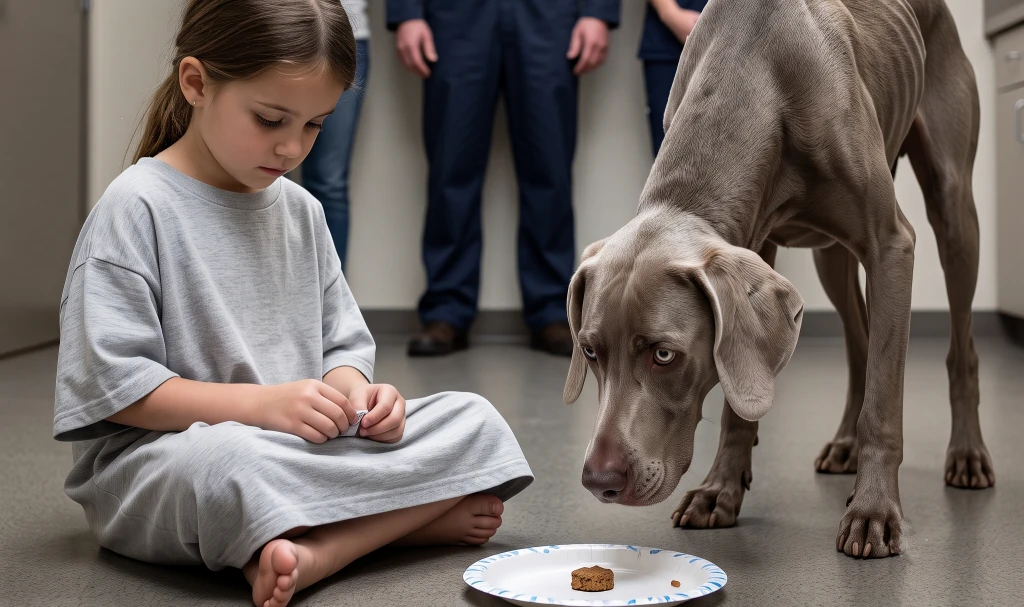
Dexter stopped at the threshold. Penny sat down beside Rachel, not in front of him but at an angle. Silas shortened the leash enough to keep control without pulling it tight and rested one hand near the handle on Dexter’s harness. Dr. Patel placed one piece of the prescribed food on a paper plate and slid it across the floor. For nearly a minute, Dexter did nothing.
Rachel became aware of every sound she made. The scrape of her sleeve. The shift of her shoe. The small click in her throat when she swallowed. She wanted to whisper encouragement to Penny. She wanted Silas to try the dog’s name. She wanted someone to do something that would make the waiting end.
Penny rested both hands on her knees.
Dexter lowered his nose. He took one step, then another. He sniffed the food and backed away. No one spoke.
The barking beyond the wall stopped. In the sudden quiet, Dexter looked toward the sound, then at Penny. At Dr. Patel’s nod, Penny turned a little farther sideways and lowered her gaze. The veterinarian used a long-handled feeding spoon to move the morsel several inches closer to Penny, still well beyond the child’s reach, then withdrew the spoon.
Dexter stretched his neck. He drew back, looked at Silas, and leaned forward again. This time his lips closed around the food. Penny did not move.
He swallowed.
Rachel felt Penny’s shoulder touch hers. Silas’s grip shifted on the leash, but his hand stayed low. Dr. Patel wrote something on the sheet clipped to her board.
Dr. Patel tipped a second morsel from the spoon onto the same place. Dexter waited until Penny lowered her eyes again. Then he ate that one, too. “That’s enough,” Dr. Patel said gently. “We stop while it’s still his choice.” As Silas led Dexter toward the inner door, the dog paused and looked back. Not at the plate. At Penny. Silas waited until the door had closed before speaking. “Could she come back tomorrow…”
To read the rest of the story – CLICK the NEXT button 👇👇👇