


The food went into Kennel Eighteen warm and came out twenty minutes later with the spoon groove still across the top. Silas Reed lifted the stainless-steel bowl without letting it scrape. Sound carried too well through the old cinder-block building. A dropped latch could set off forty dogs at once, and the dog in Eighteen had learned to make himself smaller whenever the row erupted.
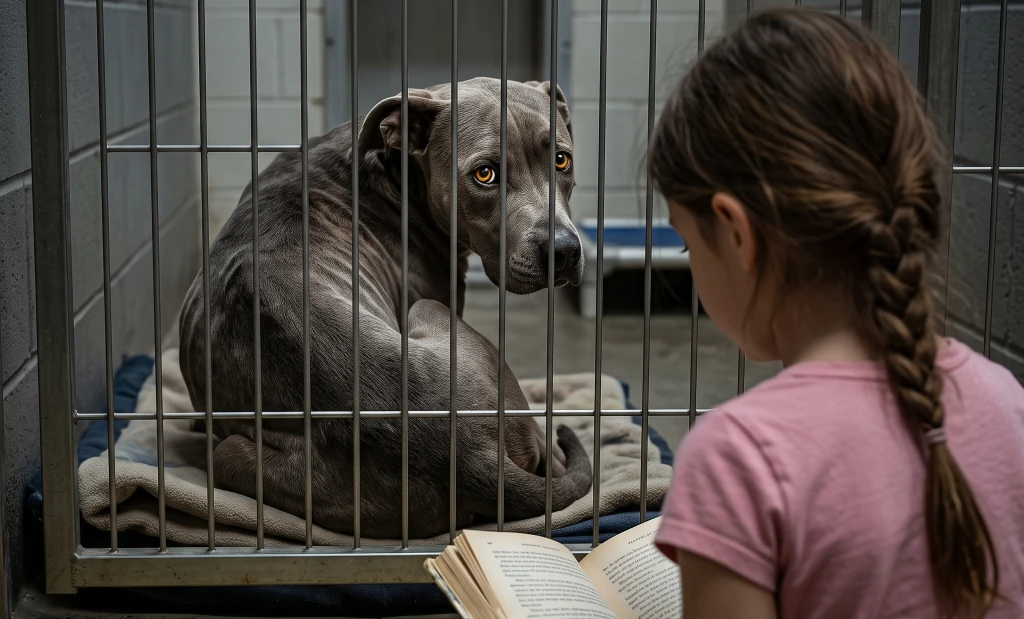
Dexter lay on a folded fleece pad with his back to the aisle and his narrow gray face angled toward the wall. His hips stood too sharply beneath his coat. Pale squares on his front legs showed where the veterinary clinic had shaved him for an IV. When Silas opened the hatch to remove the bowl, one ear moved. The rest of him did not.
Silas marked another zero in the voluntary-intake column.
“All right,” he said quietly. “Not this one.”
He no longer told Dexter that the next meal would be different.
In the adjoining kennel, Jasper sprang against his gate. The little fawn-and-white Italian Greyhound mix spun once, sneezed, and thrust both front feet through the lower bars.
“Feet inside.”
Jasper withdrew them, trembling so hard that his ID tag clicked against the gate. Yet when Silas moved past with the untouched bowl, Jasper stopped spinning. For two breaths, perhaps three, he stood with his flank pressed to the partition between the kennels. Then a dog farther up the row barked, and Jasper began again.
Leah Moreno, the shelter’s behavior and foster coordinator, was waiting at the prep counter with Dexter’s chart open.
“Nothing?” she asked.
Silas showed her the bowl. Dexter had arrived twelve days earlier, dehydrated, exhausted, and so thin that the county officer who found him beside a service road had carried him to the van. The veterinary team had treated his raw paw pads, corrected the dehydration, and ruled out an obstruction, severe infection, and organ failure. Carefully measured assisted feedings were keeping his body stable while the team continued to offer food by mouth. So far, he had taken none voluntarily.
“Dr. Maya Chen wants him back at the clinic if he still takes nothing voluntarily today,” Leah said. “She won’t let this drift.”
“I know.”
“And no more trying six different foods. Every new bowl and every extra person in his space adds pressure.”
Silas looked at the neat spoon mark. He had warmed the food, changed the dish, sat outside the gate, turned his back, talked, stayed silent, and once brought in a radio because the intake notes said Dexter had lived with an older man. He had kept the volume low on a baseball game until Leah made him turn it off.
“I know that too,” he said.
By ten, the public corridor outside the shelter’s kennel rows had filled with the Saturday group from the public library. The program was called Pages for Paws. Children sat outside selected kennels and read for twenty minutes while their parents remained beside them. The confident readers chose puppies. Two boys tried to make a hound howl until a program volunteer separated them and reminded the room to use library voices. A girl in purple boots read a dragon story to a beagle that slept through every page. Silas was replacing a loose clip on a kennel card when he noticed the child at the end of the row.
She was small for seven, with brown hair escaping from a braid and her own battered paperback held against her chest. Her mother, Claire Bennett, stood beside her in a raincoat, glancing between the clock and the other families. The child had stopped at the yellow line outside Dexter’s kennel.
“That one isn’t part of the reading list,” Silas said. “You can look, but the gate stays closed.”
The mother nodded quickly. “Of course. Penny, there’s a spaniel open near the front.”
Penny did not move. Dexter had turned his face toward the wall before she arrived. His bowl had already been removed, and there was nothing in the kennel except water, bedding, and the long gray shape of him.
“He’s recovering,” Silas explained.
“From what?” Penny asked.
The word came out softly but cleanly. Her mother looked relieved by it.
“Several things,” Silas said. “Mostly from too much change in too little time.”
“We don’t know that for certain,” Leah said behind him.
“We know he’s been through a severe physical stress,” she continued. “We know his medical tests are improving. The rest is our best reading of his behavior.”
Penny lowered herself to the floor outside the yellow line. Her mother touched her shoulder.
“You’ll get dirty.”
Penny opened the book across her knees. “That’s okay.”
“Use your reading voice, then. Start with the t—”
The girl’s mouth tightened. Her finger remained beneath the first line, but no sound came.
Her mother stopped. “Sorry. Take your time.”
Penny looked not at her mother but at the dog. She turned slightly sideways, making her body narrower, and began to read in a voice that barely reached the gate.
The story was about a mouse searching for the moon. Penny paused before words beginning with hard consonants. Her mother’s lips sometimes moved, but she did not supply them. Silas pretended to work on the kennel card.
Halfway down the page, Dexter’s left ear lifted. Penny kept reading.
His ear turned toward the aisle. A minute later his head shifted far enough that one amber eye appeared beyond the ridge of his shoulder. Silas felt Leah’s hand close around his sleeve before he could step nearer.
“Don’t change anything,” she murmured.
They did not. Penny reached the end of the page, then started the next. Dexter watched her until a metal pan clattered in the washroom. His eye vanished. His muzzle returned to the wall.
The reading period ended. Chairs folded, children collected stickers, and dogs barked at the sudden movement. Penny remained seated.
“We need to let the staff work,” her mother said.
Penny closed the book. “Can I come back?”
Leah crouched on the public side of the yellow line.
“Maybe. But you couldn’t go in there, and you couldn’t touch him. Do you understand?”
Penny nodded.
Leah asked, “Why didn’t you call his name?”
Penny ran her thumb along the book’s bent corner.
“When people keep saying my name, it gets harder.”
Her mother looked down.
Leah stood. “Give me twenty minutes to speak with our vet.”
Twenty minutes later, after the reading group had cleared the corridor, Silas brought Dexter into the shelter’s quiet meeting room on a harness, with a loose safety lead. A portable exercise pen divided the room. Penny and Claire sat on one side; Dexter had the other half, with his fleece pad and an open route back to the door.
Leah explained every rule before they began. Penny would stay seated. She would not reach through the pen or look directly into Dexter’s face. If he moved away, she would let him. If Leah said stop, they stopped. Penny listened without interrupting.
Dexter stood beside the door. Without the wall, he seemed uncertain where to put his face. His ribs moved beneath his dull coat. Silas sat near the handle of the safety lead without shortening it. Leah handed Penny a small ball of the soft food approved by the vet.
“Set it on the floor,” she said. “Then roll it gently. Not at him. Just where he can see it.”
The morsel stopped several feet from Dexter. Nothing happened.
Penny placed her hands back on her book. Her mother’s knee bounced once, then stilled beneath her palm. Silas heard Jasper barking in the distant kennel row, a cart squeaking in laundry, rain ticking against the high window.
Dexter’s nose moved. He lowered his head, then raised it again. One front paw came forward. He looked toward Silas, toward the door, and finally toward Penny, who had opened her book but was not reading.
Dexter crossed the space in three careful steps. He stretched his neck, sniffed the food, and drew back. Penny did not move. After several seconds, he leaned forward again and took the morsel from the floor.
No one cheered.
Silas looked down at his hands. Leah exhaled through her nose. Penny turned one page, slowly enough that the paper made almost no sound.
Dexter remained where he was. For the first time since Silas had met him, the dog had chosen a place that was neither a wall nor an exit.
They ended the session after that single bite. Leah would not risk turning a success into another demand, and Dr. Chen kept the assisted-feeding schedule in place; one voluntary morsel did not change Dexter’s medical needs. While Silas led him back to the recovery row, the dog looked once over his shoulder at the child seated behind the pen. In the hallway, Penny’s mother pressed both palms around the strap of her purse.
“So she can visit again?” she asked.
“Yes,” Leah said. “Carefully. But I need you to understand the risk.”
Penny was several feet away, showing Silas the picture of the moon at the end of her book. Leah lowered her voice.
“If Penny becomes the only person he’ll eat around, we’ve created a new dependency—and put it on a seven-year-old…”
To read the rest of the story – CLICK the NEXT button 👇👇👇