


The notice of nonrenewal had been taped to the wall above the graduation certificates, as if the planned demolition described in its second paragraph could cancel every name below it. Naomi Brooks found it at 5:12 on a Thursday evening, eight minutes before Second Bell’s summer ceremony. Behind her, forty folding chairs faced a plywood stage Marcus had built from salvaged classroom doors. In the old kindergarten room, Leon Turner was practicing his signature for the last time. Naomi’s seven-year-old triplets were tying blue ribbons around rolled certificates and arguing over which knots looked most official.
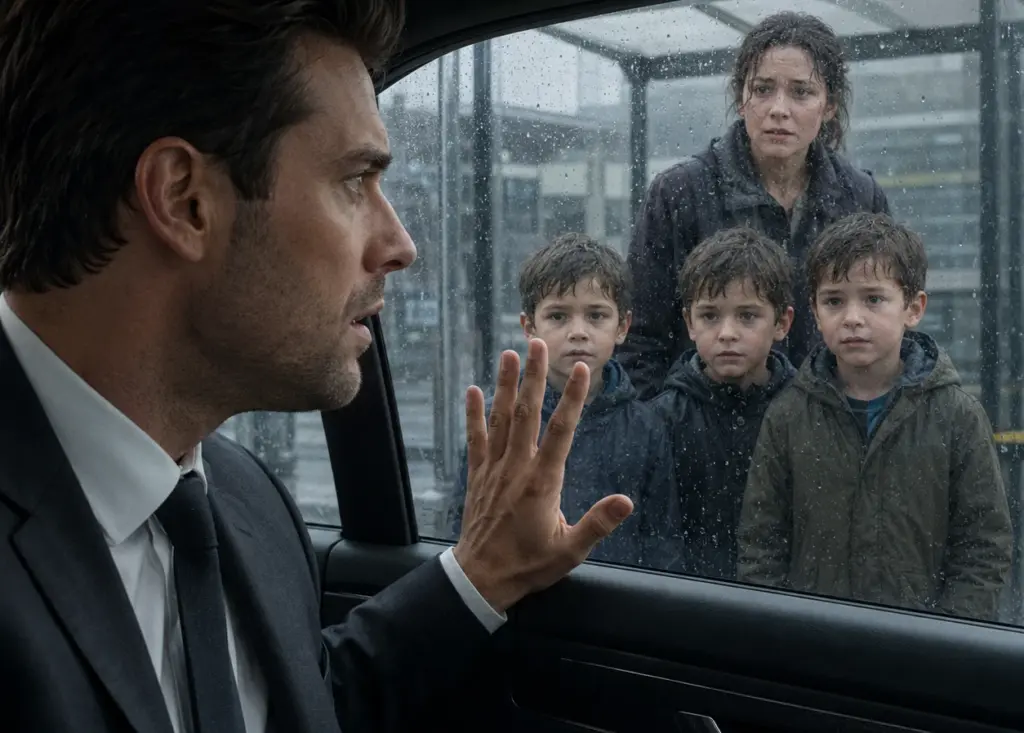
Ruby read the developer’s name aloud from the notice. “Mercer Urban Development.”
Miles stopped winding ribbon. Theo looked first at Naomi, then at the paper.
“Mercer,” Ruby said. “Is that the same Mercer as Grant Mercer?”
Naomi had given them their father’s name four weeks earlier. She had not yet given them an explanation for why she had waited so long.
“We’re doing graduation now,” she said. “We’ll talk at home.”
Ruby’s mouth tightened. She had Naomi’s habit of hearing the sentence underneath the one that was spoken. Miles went back to his ribbon, but more slowly. Theo slipped one finished roll beneath his arm as if the notice might take that too.
Marcus Hale, Second Bell’s co-founder, came through the side door carrying two sheet cakes and saw Naomi’s face. He set the boxes down without asking what was wrong. A construction estimator by trade, he read documents from the numbers outward: purchase price, deadlines, contingencies, then nouns.
“Thirty days,” he said. “The owner issued the nonrenewal yesterday. Mercer’s notice of intent is attached.”
Second Bell leased the ground floor of the old Dunley Street School from a neighborhood nonprofit that had owned the property for years and could no longer afford it. Naomi had known the roof account was nearly empty. She knew the ancient alarm panel was living on borrowed time and that every adult learner who used a wheelchair had to enter through the cafeteria loading ramp. Marcus had spent two years telling her that love for a building did not pay for its bones.
She had answered with grant applications, small repairs, and the conviction that one more semester would give her room to solve the rest.
“They can’t post this on graduation night,” she said.
“Apparently they can.” Marcus looked at the learners beginning to arrive in their good shirts and summer dresses. “Do you want me to take it down?”
Naomi thought of how many of them had spent their lives being handed bad news after everyone else had discussed it. “No. After the ceremony, we tell them what we know. Not what we’re afraid of. What we know.”
Leon came out holding a practice sheet. At sixty-two, he could set a course of brick straight enough to satisfy a laser level, but he still pressed too hard with a pencil. Three versions of his name showed on the page. The first leaned downhill. The second crowded the margin. The third had room between the letters.
“Which one?” he asked.
Naomi pointed to the third. “That’s the one you sign.”
He glanced toward the notice, then folded his practice sheet until the words disappeared. “We still doing this?”
“We are.”
During the ceremony, the window units rattled against the Georgia heat. One by one, eleven adults crossed the old classroom doors and accepted Second Bell completion certificates for high-school-equivalency preparation, English-language study, or beginning literacy. Leon went last. When Naomi placed the pen in front of him, he did not ask her to point to the line.
He signed, lifted the certificate, and found his daughter in the second row. Her cheer rose above the window units and brought everyone else to their feet.
Only after the photographs and cake did Naomi stand beneath the notice and explain that Second Bell had thirty days. She did not say the building would be saved. She said classes would continue on Monday, that records were secure, and that nobody would lose work already completed. When people began asking where they would go, she had no honest answer.
Grant Mercer’s name waited at the bottom of the page in dark blue ink.
Naomi had once watched that hand cover a blank statistics exam. She had pushed a yellow pencil across a library table and said, “Start with the thing you know.” He had turned the pencil between his fingers until she thought he might leave. Then he wrote the first equation.
That had been twelve years ago. Seven years ago, the same hand had rested on a windowsill while she carried her suitcase down the steps of their apartment building.
By 9:00 the next morning, Naomi was in the reception area on the fourteenth floor of Mercer Urban’s offices. Marcus had taken the children to Second Bell. He had offered to come with her. She had said no because she was no longer sure whether she wanted a witness or a shield.
The conference room overlooked cranes, roofs, and the green seam of the BeltLine. A model of the Dunley Street project stood on a side table: two new apartment buildings, young trees no wider than pipe cleaners, cars arranged in obedient rows. The old school was absent.
Grant entered carrying a folder and speaking to someone behind him. “Give me fifteen minutes, then bring in the finance—”
He saw Naomi and stopped.
Age had pared away the softness in his face. There was gray near one temple and a pale line across his thumb she did not remember. He still held a pencil when he was thinking, though now it was a carpenter’s pencil, flat and red, tucked against the folder.
“Naomi.”
He said her name and stopped inside the doorway. The receptionist had warned him; his body had not believed her.
“Mr. Mercer,” she said.
His eyes moved to the photocopy of the notice she had laid beside the project model. “You run Second Bell.”
“I founded it.”
He pulled out the chair across from her but did not sit. “I didn’t know.”
“You signed the acquisition.”
“Under the property owner’s name. The tenant schedule lists a nonprofit.” He opened the folder, scanned a page, and looked up. “It lists Second Bell Education Initiative. It doesn’t list you.”
“Would it have changed anything?”
“I don’t know.”
It was the first useful answer he gave her.
Grant sat and explained the project without hiding behind euphemisms. The school needed more work than the current owner could fund. The lease expired in thirty days. Mercer Urban planned seventy-two apartments, eighteen of them income-restricted, two blocks from a bus transfer point. The company had already spent money on surveys, design, and the purchase option.
“People need housing,” he said. “I’m not going to pretend they don’t.”
“People in our classrooms need housing too. They also need a place they can reach after a shift ends at six.”
“The building isn’t safe for indefinite occupancy.”
“Then you repair it.”
“With what money?”
The question landed because Marcus had asked it before, without Grant’s polished table between them.
Naomi opened her own folder. She showed him enrollment numbers, bus routes, employer partnerships, and a letter from a community land trust willing to consider an adaptive-reuse proposal if Second Bell could produce a viable construction budget. Grant read more carefully than she expected. Once, he reached for the red pencil, then left it where it was.
“This letter isn’t financing,” he said.
“No. It’s a way to get to financing.”
“In thirty days?”
“Ninety. Assign your purchase option to the land trust at Mercer Urban’s documented cost and give us ninety days to close.”
Grant checked the acquisition calendar. “Our option expires in eleven days, Tuesday at five. If we neither exercise nor assign it, the seller can move on.”
“Then you have time to enter the building.”
He leaned back. “You came prepared.”
“I came late.”
That was also true. Naomi had known the owner was considering a sale. She had spent months trying to keep learners calm while telling herself a capital campaign could wait until the next grant cycle. Only the date on the notice was new.
Grant closed the land-trust letter. “I’ll review this with the investment committee. I can’t promise an assignment.”
“I’m not asking for a promise.”
His gaze settled on her face. For a moment the conference room gave way to the college library, the yellow pencil, his head bent close to hers. He looked away first.
“Why did you ask for me specifically?” he said. “You could have met with acquisitions.”
Naomi had planned two conversations: first the building, then the children, with enough time between them that neither could be mistaken for leverage. But Grant’s company had entered their classroom, and the children had read his name from the notice.
She took a photograph from the back of her folder and placed it beside the model.
Ruby stood in the middle, grinning with one front tooth only halfway grown. Miles held a cardboard bridge he had built at Second Bell. Theo leaned into his brother but watched the camera with Naomi’s wary eyes. All three had Grant’s deep-set dimple on the left side, visible only when they smiled.
He did not touch the picture.
“Who are they?”
“Ruby, Miles, and Theo.”
Grant looked at Naomi, then back at the three faces. His attention moved among them with the helpless precision of a man checking the same calculation because he did not trust its answer.
“How old?” he asked.
“Seven.”
The color left his face. He sat very still, one hand flat beside the photograph.
“Naomi,” he said. “Are they mine?”
To read the rest of the story – CLICK the NEXT button 👇👇👇