


Nora Hale knew something was wrong because the hens had stopped complaining. Every morning, the twelve red hens met her at the coop door as if they had retained counsel overnight. On that cold October morning, they stood beneath their roost instead, necks stretched toward the lambing barn across the yard. Even June Bug, the speckled hen that pecked Nora’s boots for sport, made no sound.
Nora set down the egg basket. The barn’s north door stood open by six inches. Her father had closed it after evening chores; she remembered because he had made her go back and check the latch herself.
Then something breathed on the other side of the wood. It was not the snuffling breath of a ewe or the impatient blast of a horse. This was slower and lower, followed by the faint scrape of a claw across concrete. Nora’s first impulse was to run for the house. Her second was to prove that nine was not, as her father sometimes seemed to believe, practically the same as four.
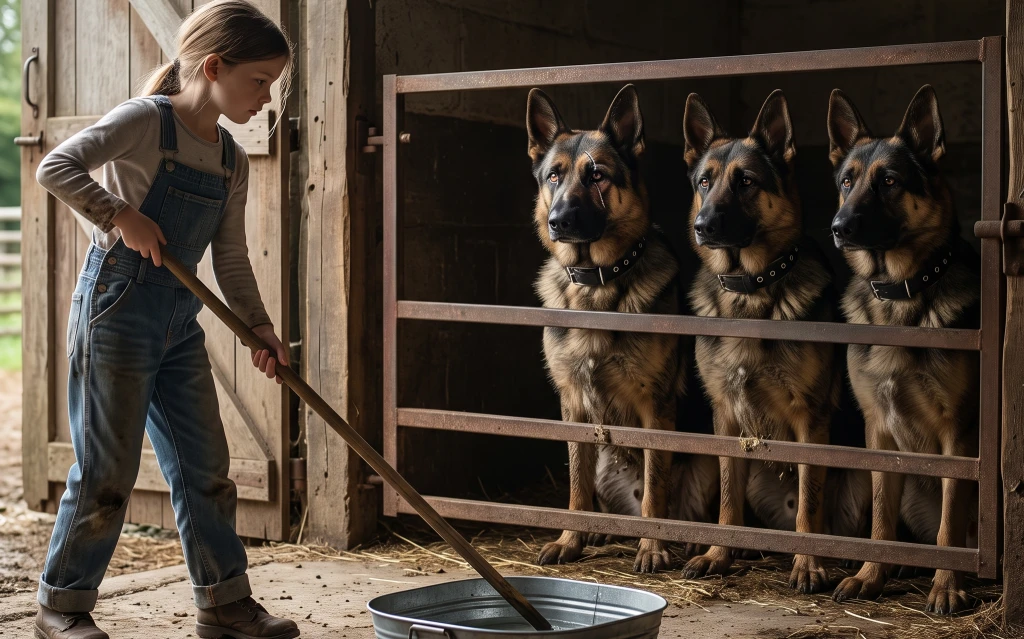
She picked up the long ash stick they used to push the coop door through snow and eased the barn door wider from an arm’s length away. Four dogs watched her from the empty lambing pen.
They were German shepherds, or close enough that Nora knew what they were at once: tall ears, sloped backs, black muzzles, the look of animals that missed very little. Three sat shoulder to shoulder against the whitewashed block wall. The fourth stood in front of them. A pale seam crossed the fur above his left eye.
None of them barked. That frightened her more than barking would have.
The lead dog wore a wide black collar with a silver number riveted to it. A rectangle of cleaner fabric showed where a patch had been cut away. The other collars were the same. Mud had dried halfway up the dogs’ legs, and burrs clung to their bellies. One of the females held her right forepaw just off the floor.
Nora remembered two things her father had taught her about strange dogs: do not stare, and do not run. She turned a little sideways, kept the stick pointed at the ground, and said, “I’m going to get my dad. You stay there.”
The scarred dog took one step toward her.
Nora stopped. He stopped. When she lowered her gaze, she saw an empty galvanized water pan near the pen gate. The dog’s eyes moved to it and back to her.
“Water?”
His ears tipped forward. There was a frost-free hydrant just inside the door. Nora hooked the pan with her stick, dragged it close enough to reach, and pumped water into it without turning her back. The metal handle squealed. All four dogs flinched at the sound, not wildly, but together, as if one current had passed through them.
She pushed the pan across the floor. The scarred dog waited until it stopped moving, sniffed it, and looked at the others. Only then did they drink. The injured female went first.
That small courtesy changed the shape of Nora’s fear. Dangerous dogs, she thought, would have fought over water. These dogs had rules.
“Dad!” she called without taking her eyes off them. “I need you in the lambing barn. Walk, don’t run.”
The pump shut off behind the farmhouse. A moment later, Ben Hale came around the corner in mud-streaked coveralls, carrying a crescent wrench. He had been repairing the line to the south trough since before sunrise, and irritation was already prepared on his face.
Then he looked through the barn door, and the wrench fell into the gravel.
Nora had seen her father angry, tired, and once so sick with flu that he had sat on the bathroom floor and laughed because standing seemed unreasonable. She had never seen his face empty itself the way it did then.
“Nora,” he said. “Come to me. Slowly.”
“They’re drinking. The girl with the dark face hurt her foot.”
“Come to me now.”
His voice was quiet, but it left no room. Nora backed toward him. The scarred dog lifted his head from the pan, water hanging from the fur beneath his jaw. Ben raised his left hand, palm down.
“Rook,” he said. “Mat.”
The dog turned at once and walked to an old rubber stall mat laid beside the wall. The other three followed him and lay down, chests aligned with the mat’s edge.
Nora forgot to keep moving. “You know them.”
Ben did not answer. He stepped inside and crouched several feet from the dogs, his hands resting loosely on his knees. The injured female watched him, panting though the barn was cold. The smallest dog—a narrow-faced shepherd with a gray chin—pressed close to her side.
“Rook,” Ben said again, and this time the name came out rough.
The scarred dog’s tail struck the rubber once. Ben closed his eyes. When he opened them, he looked at Nora. “Go get your mother. She’s at the Breyers’ place. Her number is on the refrigerator. Tell her we have four working dogs here and one may be injured. Don’t say anything else on the phone.”
“Police dogs?”
“Go, Nora.”
She ran, not because he had shouted—he had not—but because his hands had begun to shake.
Claire Hale arrived twenty-eight minutes later in her veterinary truck, the hem of her coveralls wet from helping pull a foal. Nora had spent the time watching from the barn doorway while Ben sat on an overturned bucket. He had not touched the dogs. He had spoken their names once, in order: Rook, Sable, Finn, Mercy. Each name made an ear turn or a tail move.
Claire listened to Nora’s account before she went inside. She listened with her whole face, the way she did when an animal’s owner was frightened and trying to be useful. Then she made Nora wait behind the half door while Ben muzzled each dog with soft cloth loops and Claire examined them.
The dogs submitted to Ben’s hands. That was almost worse than if they had resisted.
Mercy’s paw was not broken, Claire said, but one pad had been sliced and packed with road grit. Finn was dehydrated. Sable had raw bands beneath her front legs where a harness had rubbed for too long. All four had small shaved patches on their forelegs.
“Needle sites,” Claire said. “Recent.”
When Claire finished, Ben removed the cloth loops one by one. Each dog stayed where he placed it.
Ben ran his thumb over the clean rectangle on Rook’s collar. “Somebody removed the unit patches.”
“Before or after the injections?”
“I don’t know.”
Claire looked at him. “Tell me what you do know.”
Ben sat back on his heels. The dogs watched him as if the answer mattered to them too.
“I raised Rook from fourteen months,” he said. “Finn and Sable came the next spring. Mercy washed out of patrol work and retrained for search. They spent their first year here before the county kennel opened.”
Nora gripped the top of the half door. “Here? On our farm?”
“You were little.”
There was a photograph in the hallway of Nora at three, sitting in a blue plastic pool with two wet shepherds behind her. Her father had always said they belonged to a friend. She could see the scar over Rook’s eye in her mind now, though the scar in the photograph had been newer and pink.
“You said you used to train farm dogs.”
Ben looked down at the dirt caught in the tread of his boots. “I didn’t tell you all of it.”
Claire’s mouth tightened, but she did not pursue it in front of Nora. She took a scanner from her truck and passed it along each dog’s shoulder. Four numbers appeared, and Ben wrote them on the back of a feed receipt. Beside each number, Claire noted the dog’s condition in the compact handwriting she used for field calls.
“I have to report found animals,” she said. “And if they belong to a law-enforcement agency, we can’t simply keep them.”
At the word keep, Nora felt Rook’s gaze move to her.
Claire called the county’s after-hours animal-control line on speaker so Ben could hear. She gave their address, the microchip numbers, and her veterinary license information. The dispatcher asked her to repeat the first number, then put them on hold.
While they waited, Ben found an old whistle on a nail above the tack shelf. He did not put it to his lips. He only closed his fist around it until the chain hung between his fingers.
The dispatcher returned with a different voice.
“Dr. Hale, are you physically looking at all four animals?”
“Yes. They are alive. One requires treatment, none appears immediately aggressive, and they are secured.”
There was a rustle of paper. “Could you verify the numbers one more time?”
Claire did.
The woman exhaled into the line. “Don’t move the dogs and don’t let anyone remove their collars. I’ll notify my supervisor.”
“Who are the registered owners?” Ben asked.
Another pause followed, long enough that Nora heard Mercy licking water from her injured paw.
“The Ridge County Sheriff’s Office,” the dispatcher said. “But according to the disposition entered yesterday evening, those four K-9s were euthanized at six-thirty p.m…”
To read the rest of the story – CLICK the NEXT button 👇👇👇