


The first dog did not growl when nine-year-old Wren Bell lifted the north-barn latch. He stood behind a row of calf pens, one forepaw slightly ahead of the other, watching her through the dimness with the fixed attention of an animal waiting for a command. Three more dogs waited behind him.
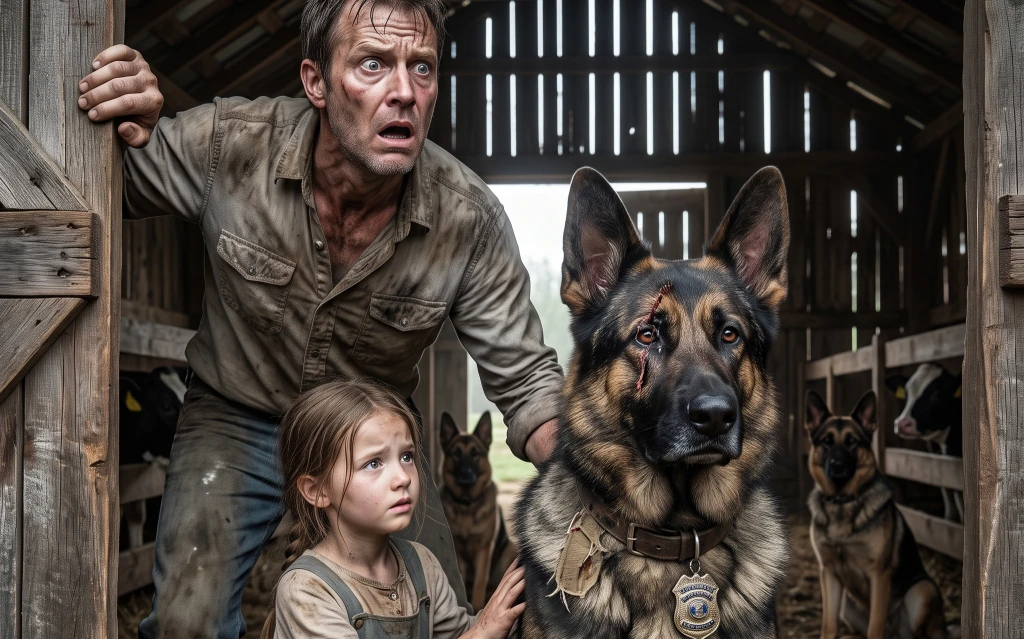
Wren kept one hand on the door and made herself breathe through her nose. The county 4-H leader had taught her what to do around a strange dog: turn a little sideways, keep your hands low, never run. He had not said what to do when four German shepherds appeared before breakfast in a barn that had been empty at sundown.
The Holstein calf in the nearest pen bawled from behind her. None of the dogs looked away.
Morning light entered through the roof seams in narrow white bars. It picked out ribs beneath dusty coats, mud dried high on their legs, and wide leather collars rubbed pale at the edges. The lead dog was sable, broad through the chest, with a healed scar cutting through the fur above his left eye. A tarnished badge hung under his throat, and Wren could read only part of it from where she stood: BENTON COUNTY and K-9.
“Okay,” she said, because silence made the barn feel smaller. “You’re police dogs.”
The scarred dog’s ears shifted toward her voice. Behind him, a black female lay with her chin between her paws. The largest dog stood facing the side door rather than Wren, while the leanest one—a red-brown shepherd with a graying muzzle—watched the loft ladder. They did not look like a pack deciding whether to chase her. They looked as if someone had put them in four particular places and told them not to move.
Wren glanced into the yard. Her father’s truck was gone from its usual spot; he had driven to the lower pasture before daylight to check a heifer that had stopped eating. The farmhouse sat eighty yards away. She could reach it in twenty seconds if she sprinted.
Being trusted with the morning calf chores was new. Caleb had made her promise to call him if she found a broken fence, a sick animal, or anything she could not name. Four police dogs qualified three different ways, but her phone sat charging beside the kitchen sink.
Running would be the worst thing she could do.
“I’m going to get you water,” she said. “That is not the same as leaving.”
She backed out, pulled the door almost closed, and hurried to the hydrant without taking her eyes off the gap. The green calf bucket was too deep, so she chose the shallow black pan used for soaking feed scoops. Her hands shook enough to throw water over her boots.
When she returned, the dogs had not changed places. Wren set the pan six feet inside the door and pushed it forward with the handle of a broom. The scarred dog looked at the water, then at her. His tongue touched his nose, but he stayed.
“You can drink. I’m not going to tell anybody you broke the rules.”
The black female rose first. She moved stiffly, favoring her right hip, and drank in quick, desperate laps until the lead dog stepped beside her and nudged her shoulder. She stopped. The others took turns without crowding, each yielding after a few seconds as neatly as cows filing through a gate.
Someone had trained them well. Someone had also left them thirsty.
Wren’s fear changed shape. It did not disappear; it settled lower, beneath her ribs, where anger usually lived.
She studied the dirt while they drank. Two closely spaced trailer-tire tracks crossed the wet strip beyond the side door and ended beside the barn. Fresh straw clung to the tread marks. Whoever had brought the dogs had backed close, unloaded them, and driven away before the dew dried.
The scarred dog finished last. When he raised his head, a rope of water fell from his muzzle. Wren noticed an old canvas harness under the leather collar, its handle cut halfway through as if someone had tried to remove it in a hurry. A clean rectangle showed where a patch had recently been torn away.
“Did they dump you?” she asked.
He took one step toward her. Wren’s fingers found the piece of blue baling twine she kept looped through her belt. She rubbed the knot with her thumb, a habit her father disliked because he said one day she would worry it to pieces. The dog took another step, then stopped with his weight balanced over all four feet.
She did not offer her hand. That was another thing the 4-H leader had taught her. Let the dog decide how much distance to close.
From the calf pen came a second impatient bawl. Without thinking, Wren gave the two-note whistle she used at feeding time—low, then high, the same whistle her father used when his hands were full.
All four dogs reacted.
The black female lifted her head. The dog by the side door turned. The lean one sat so quickly his haunches struck the floor. The scarred shepherd crossed the remaining distance and stopped in front of Wren, close enough that she could see one cloudy fleck in his right eye.
He lowered his head.
Wren touched two fingers to the thick fur between his ears. His body stayed taut for a moment. Then a long breath left him, and the weight in his neck came gently into her palm.
“You know that sound,” she whispered.
The dog smelled of wet straw, old leather, and the sharp medicinal odor of a kennel. There was no magic in the way he leaned against her. He was tired, and she had offered water, and something familiar had happened in a strange place. Still, when Wren moved her hand, he followed it with a small turn of his head.
The other dogs began to settle. The one at the side door lay down without abandoning his view of the yard. The black female curled near the water pan. For the first time since Wren opened the door, the barn seemed large enough for all of them.
Then a truck engine climbed the lane.
The change in the dogs was immediate. The scarred shepherd moved between Wren and the door. The black female struggled to her feet. No barking, no lunging—only four bodies coming alert at once.
“It’s my dad,” Wren said, though she could not tell whether she meant to reassure them or herself.
Caleb Bell’s pickup stopped hard beside the milk house. He got out before the engine died, leaving the driver’s door open. Mud darkened both knees of his jeans.
“Wren?” he called. “Why is the calf bucket in the yard?”
“Don’t come in fast.”
His boots slowed outside the barn. “What happened?”
“There are dogs in here. Four. They have police badges, but somebody left them without water.”
For a second, the only sound was the ticking of his truck engine. Then Caleb appeared in the doorway.
He looked first at Wren, checking her face and hands. His gaze passed to the dog in front of her—and stopped.
The color left him so quickly that Wren stepped toward him. “Dad?”
The scarred dog’s ears came forward. Caleb gripped the doorframe. His mouth moved once before sound came.
“Rook,” he said.
The dog did not run to him. He stood very still, staring at Caleb with the same hard attention he had given Wren. Then Caleb made a small downward motion with two fingers.
Rook lay down. Behind him, all three dogs did the same.
Wren looked from the animals to her father. She had seen him angry, exhausted, and once, after her mother’s birthday, crying soundlessly over the kitchen sink. She had never seen him frightened by his own voice.
“How do you know his name?” she asked…
To read the rest of the story – CLICK the NEXT button 👇👇👇