


The cry came from somewhere below the trail, thin enough to pass through the pines without disturbing a single branch. Cal Mercer stopped with one boot planted in the track of a mule deer. He had spent thirty-one winters in Arizona’s high country, long enough to separate the click of ice from the snap of bone, a raven’s imitation from a lost hiker’s whistle. This sound belonged to nothing he knew. It rose once, faltered, and rose again.
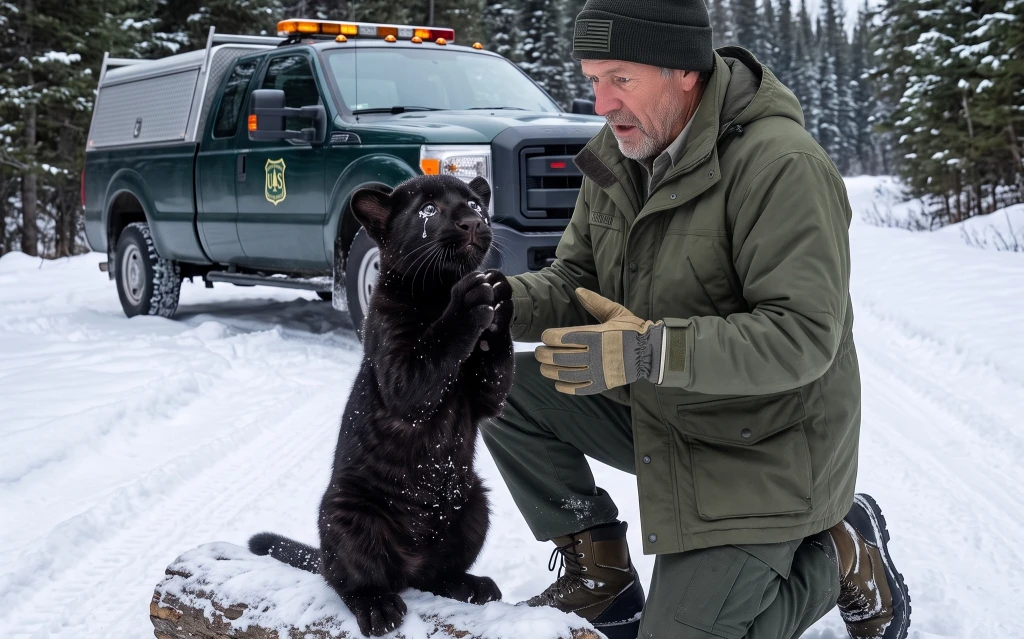
Not a bird. Not a fox. Too small for a mountain lion and too raw for anything calling to a mate.
The storm had dropped nine inches across the southern end of Coronado National Forest, closing the ridge road and folding the oak canyons into a white silence. As the senior U.S. Forest Service law-enforcement officer assigned to the district, Cal had come out alone to inspect a gate that somebody had cut for the third time that month. He had found fresh tire marks, a cigarette filter pressed into the snow, and one empty snare looped beneath a juniper half a mile back. The cry made the empty snare feel less empty.
He loosened the retention strap on his holster but left the pistol where it was. The slope below him was steep, its loose rock hidden beneath new snow. He moved sideways between manzanita and young ponderosa, placing each heel before trusting it with his weight.
The black shape appeared twenty yards downslope. At first he took it for a house cat gone feral, though no house stood within twelve miles. Then it stepped into a seam of sunlight. The shoulders rolled too heavily beneath the dark coat. The paws were broad, the tail thick and low. Faint rosettes surfaced in the black fur like marks under wet ink.
Cal forgot the cold as the cub stared at him with round amber eyes.
It was perhaps five months old, old enough to have learned that a human scent meant distance, young enough that hunger had sharpened every ridge of its body. When the cub turned sideways, Cal could see it was male. Snow clung to the whiskers on one side of his face. When he opened his mouth, the impossible cry came out again.
“Jaguar,” Cal said, and the word left a small white cloud between them.
People in the border counties still told stories about black panthers. Cal had listened to plenty across diner counters and tailgates, usually after somebody had seen a dark dog at dusk. Jaguars were different. A few males had crossed north from Mexico over the years, traveling through these sky-island ranges like old rumors with paws. A female with a cub would be something else entirely. A black cub was the sort of claim that could ruin a careful man’s reputation before breakfast. Yet there it stood.
Cal lowered his eyes and turned one shoulder away, making himself narrower. The cub retreated behind an alligator juniper. He could see the curve of one ear and nothing more.
“That’s right,” he murmured. “You don’t know me. Keep it that way.”
He took one backward step toward the trail. The cub came out.
It crossed half the distance between them in three uncertain bounds, stopped well beyond arm’s reach, and cried again. Its gaze flicked past Cal, uphill, then returned to his face. When he did not move, it approached close enough to smell the cuff of his canvas coat. Its nose touched the toe of his boot for less than a second.
Then the cub spun, ran downslope, and stopped. It looked back.
Cal had watched dogs ask people to follow. He had seen a cow elk circle a dead calf and a javelina stand over a wounded littermate. He knew how quickly a lonely man could turn animal behavior into a message meant for him. So he waited.
The cub came back to within ten feet, made the same broken cry, and ran down the slope again. This time Cal followed.
The route made no sense for an animal trying to escape. The cub kept to open snow where Cal could see it, slowing whenever he fell behind. Twice it vanished around a shoulder of rock and returned almost at once. It did not lead him toward water or the warmer lower canyon. It climbed across the face of the ridge toward a line of granite ledges that held shadow all day.
Cal marked their direction and tried his radio. The ridge blocked the first call with static. He could have climbed fifty yards for a cleaner signal, but the cub was already moving again, and he did not want to lose the only fact he had.
They traveled perhaps forty minutes. The cub tired before it quit. Its hind feet began to drag furrows through the powder, and once it misjudged a buried rock and rolled onto its side. Cal took a step toward it. The animal sprang up, hissed with surprising force, then continued as if embarrassed by the fall.
The smell reached him before the ledge did. Blood had a mineral edge in cold air. This was blood mixed with cat musk, urine, and the sour damp of an animal that had been lying too long in one place.
Cal slipped the radio from his shoulder and moved the last yards with his back close to the rock. The cub squeezed through a stand of scrub oak beneath an overhang. A growl rolled out of the dark, too deep for the small body Cal had followed. He stopped.
Under the ledge lay a full-grown female jaguar. Her coat was gold even in the blue shade, broken by black rosettes along her shoulder and ribs. One foreleg reached at an unnatural angle toward a cable fixed around the base of a pinyon. The loop had cut through fur and swollen the limb on both sides. Snow around her had been beaten down to frozen dirt. The cub pressed itself against her neck.
The female lifted her head. She did not have enough strength to rise, but she pulled her body between Cal and the cub. Her lips peeled back. The warning she gave him was little more than breath over teeth.
“Easy,” Cal said. “I see him. I’m backing off.”
He moved one step at a time until the rock between them hid most of his body. Only then did he let himself breathe fully.
The cable was not a rancher’s fence wire or an old trap left from another decade. Its lock was clean. The disturbed snow showed boot marks beneath the newer powder, and a narrow drag line came from the east, where an abandoned fire road ran through the canyon. Somebody had set it recently. Somebody had anchored it for an animal powerful enough to pull a lesser trap out of the ground.
The cut gate. The tire tracks. The empty loop under the juniper.
Cal pressed the transmit button and tried dispatch again. Static swallowed his call. He climbed ten yards along the rock until the radio gave him one wavering bar, then sent a brief emergency code and his grid location. He did not say jaguar. Not yet. Anyone with a scanner could hear the local repeater when the mountains allowed it.
“Adult cat in illegal restraint,” he said. “Severe limb injury. Dependent young present. Send wildlife veterinary response and law enforcement. Approach from the north road only.”
A dispatcher repeated the coordinates. Cal confirmed them, then dropped back below the ledge.
The cub had followed him out of the scrub. It stood beside his pack, swaying slightly. Cal wanted to offer water or the strip of venison in his lunch, but a half-starved wild cat could choke, gorge, or bite through a glove before either of them understood what had happened. He set his canteen in the snow to remind himself not to touch it.
Instead he removed his old canvas coat. Woodsmoke from his stove lived permanently in the sleeves. He laid it against the windward gap beneath the ledge, no closer than the female would tolerate, and weighted the corners with stones. The cub watched every movement. When Cal withdrew, it sniffed the coat, stepped onto one sleeve, and folded its exhausted legs beneath itself.
That was when Cal saw the camera. It was strapped high on a juniper, its lens aimed not at the game trail but directly at the snare. A short black antenna rose from its case. Cellular model. It could transmit a copy of an image as soon as it was taken while keeping the original on a local card.
Cal looked up just as the tiny status light blinked. He had to assume that somewhere beyond the canyon, the person who had set the trap now had a picture of the black cub, the injured mother—and the ranger who had found them…
To read the rest of the story – CLICK the NEXT button 👇👇👇