


The sound came through nine inches of new snow, too thin to belong to the country around it. Mack Ellison stopped beside the severed chain at Sycamore Gate. For thirty-one winters, he had worked the high country of southern Arizona, first as a patrol ranger and then as a U.S. Forest Service law-enforcement officer. He knew the complaint of a deer caught in wire, the rasp of a bobcat, and the tricks ravens played with human voices. This was none of those.
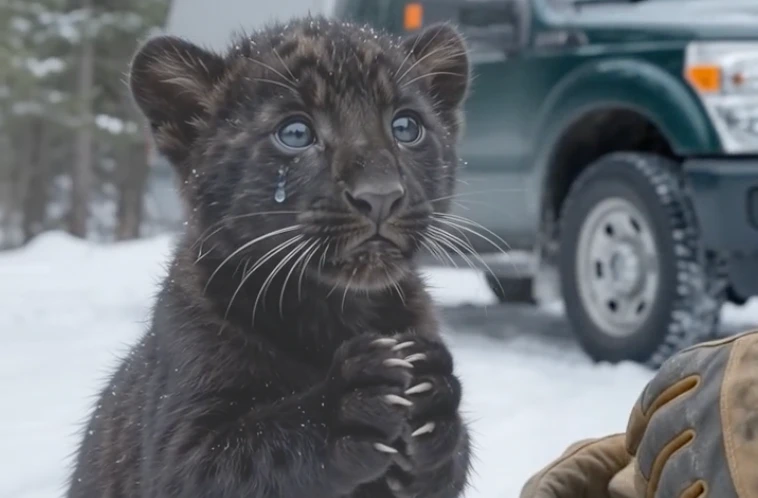
The cry came again from below the trail.
Mack studied the slope before moving. Fresh tire tracks ended near the gate, and an empty cable restraint lay beneath a juniper half a mile behind him. Somebody had cut into federal land after the storm and set equipment meant for something larger than a coyote.
He stepped sideways through scrub oak and manzanita, testing each patch of covered rock. A black animal moved between the ponderosas twenty yards downslope. Mack first saw a thick tail, then shoulders rolling beneath a coat that swallowed the winter light.
The animal entered a narrow band of sun. Dark rosettes appeared inside the black fur.
Mack lowered his binoculars and looked again without them.
The jaguar cub was perhaps five months old. Hunger had narrowed its hips, and frozen mud clung to one hind leg. It watched him with amber eyes, mouth partly open. When the cry came a third time, Mack saw the small chest strain to produce it.
No breeding female jaguar had been documented this far north in years. A melanistic cub belonged to the category of things a careful officer photographed before allowing himself to believe.
Mack did not reach for his phone. He turned one shoulder away and lowered his gaze.
The cub backed behind an alligator juniper. Mack took a step toward the trail, expecting it to disappear. Instead, it emerged, crossed part of the distance between them, and stopped beyond reach. Its nose lifted toward the cuff of his coat.
Then it turned downhill.
Mack waited. The cub looked back once before continuing through the snow. It was not proof of an invitation. A hungry young cat might simply be returning to shelter, circling a threat, or following a route it had already traveled. Mack had seen people assign messages to animals because they needed the world to speak directly to them.
When the cub returned and passed him again, dragging one hind foot, he followed.
The route angled across the ridge instead of descending toward water. The cub kept to openings where Mack could see it, sometimes vanishing around rock and reappearing after he had covered a few more yards. It stopped often enough that he could not tell whether it was waiting or merely exhausted.
After half an hour, the snow around its tracks became stained with drops of old blood that had not come from the cub.
Mack tried his radio. The ridge gave him static, so he marked his position and continued until a mineral smell reached him through the trees.
The cub slipped beneath a granite overhang. A growl came from the shade, deep enough to tighten every muscle along Mack’s back.
A full-grown female jaguar lay against the rock. Gold fur showed beneath dried blood and mud. Her right foreleg stretched toward a cable anchored around the roots of a pinyon. The loop had cut into the limb above the paw, and swollen tissue bulged on either side.
The cub pressed itself beneath her jaw.
The female lifted her head and tried to pull her body between Mack and the cub. She could not rise. Her warning was no louder than air moving over exposed teeth.
“I see you,” Mack said. “That’s far enough.”
He backed behind a granite shoulder and let the rock hide most of him. Beneath the newer snow, the ground around the restraint had been churned to frozen dirt. The drag marks and blood suggested she had fought it for many hours.
The cable was clean, the lock recent. This was not ranch wire or forgotten equipment from another decade.
Mack climbed until his radio found the repeater and gave dispatch his location. On the open channel, he described an adult cat in an illegal restraint with severe limb damage and dependent young. He requested wildlife veterinary support, a county deputy, and a tracked vehicle. He told everyone to use the north road.
Once dispatch transferred him to a secure channel, Mack added what he had withheld from the open frequency: probable adult female jaguar, dependent melanistic cub. The dispatcher acknowledged the update and patched in the veterinary lead.
“How close are you?” Dr. Lena Ellison asked.
“Thirty yards. Granite between us.”
“Has anyone touched the restraint?”
“No.”
“Has she moved since you arrived?”
“Head and neck. One attempt to shift her chest. She can’t stand.”
Lena asked him to count respirations, describe the visible tissue, and tell her whether the cable tightened when the female moved. She spoke as the Arizona Game and Fish Department veterinarian assigned to the emergency, not as his daughter.
Mack answered in the same manner. It was the safest language they had left.
Nine months earlier, Lena had crossed a marked line during the immobilization of a black bear whose airway had become obstructed. Her intervention saved the bear. Marisol Vega, the veterinary technician who followed with equipment, slipped on loose ground and fractured her forearm.
Mack’s report accurately described both events. Then he added a recommendation that Lena be removed from field leadership until she demonstrated what he called a reliable risk threshold. He sent it through his own chain of command without showing her.
Lena learned about the recommendation when her supervisor suspended her from leading backcountry operations.
She had come to Mack’s house carrying the printed report. She did not shout until he said he had been trying to protect her.
“You wrote me out of my own job before you let me answer,” she said.
Mack had replied that a field leader answered for everyone who crossed a line behind her. That was true. It was also not the whole reason he had written the paragraph, and both of them knew it.
Now Lena’s voice remained controlled over the radio.
“The pressure may be limiting blood loss,” she said. “If you release it before she’s immobilized and we can manage the wound, she could hemorrhage.”
“I won’t touch it.”
“We’re bringing the tracked rig from Patagonia. The north switchbacks haven’t been cleared, so give us at least an hour and fifteen.”
“The temperature will be below twenty by then.”
“I know. Build a windbreak if she’ll tolerate it. Don’t feed the cub, don’t try to handle him, and don’t move closer because he seems interested in you.”
Mack looked toward the ledge. “Understood.”
There was a pause.
“If anyone approaches from the east road,” Lena added, “move away from the cats. Don’t use them as cover.”
“I heard you.”
“That wasn’t what I asked.”
Before Mack could answer, dispatch interrupted with an update. The tracked rig was moving.
He returned to the ledge and extended his emergency blanket across the windward gap, keeping its reflective side hidden. The female watched but did not growl again.
The cub had come out of the shelter. It stood beside Mack’s pack, swaying.
He removed his faded canvas coat and laid it near the outer edge of the overhang. Woodsmoke had settled into the fabric over years of evenings beside his iron stove. He weighted the coat with two stones and retreated.
The cub sniffed one sleeve. After circling twice, it folded its legs beneath itself on the canvas. Its eyes remained fixed on the female.
Mack saw the trail camera when he followed the cub’s gaze uphill.
It had been strapped high on a juniper and aimed directly at the restraint. A short antenna rose from the weatherproof case. Whoever had installed it did not need to return for the memory card; the camera could transmit images whenever it found a signal.
Mack photographed it in place. As he lowered his phone, a small green light blinked.
Somewhere beyond the ridge, the person who had set the restraint might already be looking at the black cub, the trapped mother, and Mack standing between them.
An engine sounded from the east.
Mack pressed his emergency alert and moved away from the ledge as Lena had ordered. The cub lifted its head but stayed on the coat.
A utility vehicle climbed the abandoned fire road. Tire chains struck exposed stone, stopped, and started again. An aluminum animal crate had been bolted into the bed.
Tom Rourke stepped out wearing a waxed jacket and clean leather gloves.
For years, Tom had been the guide deputies called when a horse threw a rider or a child wandered away from a campground. He could read disturbed gravel after wind had erased everything else. Then investigators found untagged carcasses linked to his clients, and Mack supplied the maps that tied three illegal kills to Tom’s camp.
Tom lost his guiding license. He had treated Mack as if the loss had been a personal decision rather than the consequence of what the maps showed.
Now he looked past Mack and saw the female.
The anger left his face. “She’s still alive.”
“You knew she was here.”
Tom’s eyes moved to the cub. The faint rosettes appeared as it rose from the coat.
“She wasn’t supposed to get into it,” he said.
He reached into the vehicle and removed a pair of long-handled cable cutters.
“Put those down,” Mack said.
“I can free her.”
“You cut that restraint now, she may bleed out.”
“The camera alerted yesterday morning. Your people are already late.”
Tom stepped toward the ledge. The female tried to raise her chest, and the cable drew tight against the injured leg.
Mack’s hand settled on his holster.
Tom opened the cutters…
To read the rest of the story – CLICK the NEXT button 👇👇👇