


The black mustang struck the pipe panels hard enough to shake dust from every joint. Micah Vance felt the impact through the push rims of his wheelchair. Around him, the crowd at Juniper Wells Mustang Center drew a single startled breath. A toddler began crying near the concession tent, and someone behind Micah said the horse was crazy. Micah had been on the property for eleven minutes and already wanted to leave.
His mother had chosen a place near the accessible exit, close enough to watch the demonstration but far from the loudspeakers. In the back of their van, Micah’s old show saddle lay beneath a moving blanket, waiting to be taken to the tack consignment table. Ellen had asked him three times if he was certain he wanted to sell it. He had answered only once.
The saddle belonged to someone who could use it.
Inside the round pen, the mustang galloped another tight circle. He was nearly black except for a gray smudge along his muzzle and the pale freeze mark beneath his mane. Sweat had darkened his shoulders. A trainer stood near the center with a coiled rope and a short flag lowered against his leg.
The man was not chasing him. Micah could see that much. He was trying to draw the pressure away, but the crowd had become another kind of fence—faces along the rails, phones raised, bodies blocking every quiet place the horse might have chosen.
“Cinder has been in professional care for six weeks,” the announcer said. “As you can see, he still has plenty of Nevada in him.”
A few people laughed.
The trainer did not. He lifted one hand toward the announcer and called, “We’re done.”
Then the sound system squealed.
Cinder spun toward the noise, slipped in the loose dirt and recovered with his hindquarters inches from the panels. The rope in the trainer’s hand dropped at once. He moved sideways, trying to open a path, but three event volunteers had crowded the outer gate.
Micah saw the mustang’s left eye—a white-rimmed flash moving from the volunteers to the bleachers and back again. Twenty months earlier, people had leaned over Micah in much the same way while he lay strapped to a trauma board. Everyone had told him not to move. No one had left him anywhere to look except up.
“Clear the far corner,” Micah said.
His mother glanced at him. “What?”
“The people by the red gate. They need to move.”
She looked toward the pen, then back at him. “Ray knows what he’s doing.”
The trainer’s head turned. He had heard.
Micah raised his voice. “Everybody’s standing in his exit.”
For a moment, the trainer studied him: an eighteen-year-old in a rigid-frame chair, shoulders too thin for the faded ranch jacket he had once filled out. Then he pointed sharply at the volunteers.
“You three, behind the solid panel. Now.”
They moved. The far corner opened.
Cinder stopped running.
He stood with his sides working, his head high and his nostrils wide. The crowd settled into an uneasy silence. Micah knew that silence could be its own demand, hundreds of people waiting for an animal to do something worth recording.
He released his wheel locks.
“Micah,” Ellen said.
“I’m staying outside.”
He rolled along the perimeter until he reached the quiet corner. The ground there sloped slightly, and his small front casters dragged through the sand. He turned the chair sideways to the fence rather than facing the horse head-on.
The trainer came closer on the other side of the panels but kept a safe distance from Cinder.
“You’ve worked horses?” he asked.
“Before.”
“Name’s Ray Calder.”
Micah nodded once.
“Don’t reach through the rails,” Ray said. “Don’t call him. If he moves away, let him.”
It was the first instruction anyone had given Micah in months that did not sound softened for his benefit.
Cinder’s ears moved toward the scrape of Micah’s push rim. He took one step, then stopped. The black line of his back remained tight, but he lowered his head by an inch.
Micah rested his hands in his lap.
His mother had gone still behind him. He could feel her wanting to take hold of the push handles. Since the accident, she had developed the habit of moving his chair whenever she became frightened, as if three unexpected inches might save him from the rest of his life.
This time, she did not touch it.
Cinder crossed half the pen. Dust clung to the sweat on his legs. He approached at an angle, ready to leave, and stopped beside the fence with one dark eye fixed on Micah.
A phone camera clicked.
The mustang raised his head.
“Put them down,” Ray said to the crowd.
Not everyone obeyed, but enough did.
Micah turned his face slightly away. Before the accident, he had entered an arena by making himself larger—shoulders back, chin lifted, every movement announcing that the horse beneath him belonged with him. Now he let his arms hang loose and listened to Cinder breathe.
The mustang stepped closer.
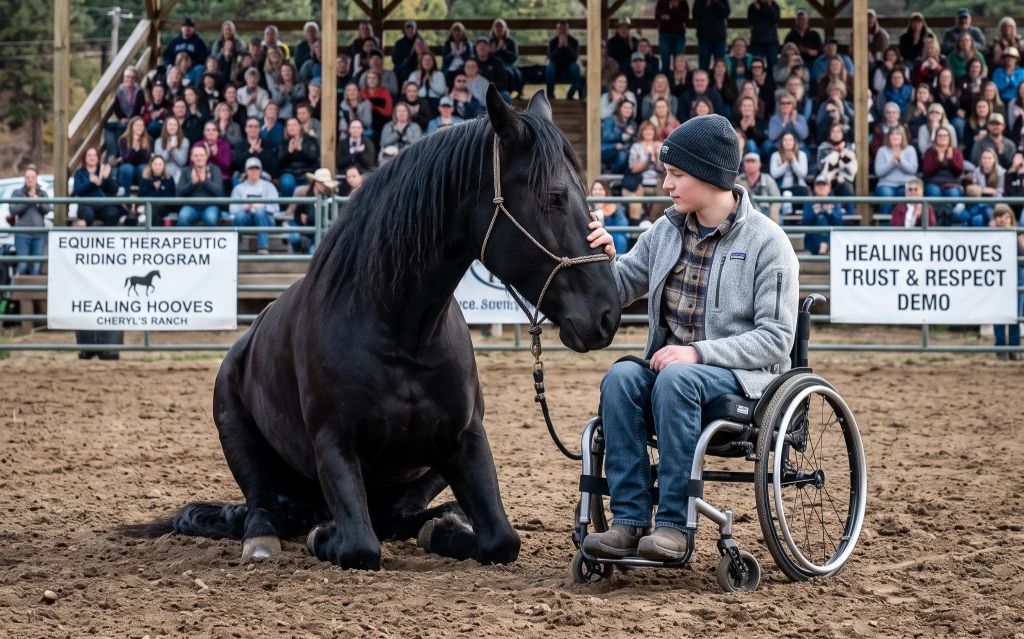
His muzzle came over the middle rail, warm air touching Micah’s knuckles. Micah did not reach. Cinder sniffed the rubber guard on the wheel, the leather of Micah’s glove, then the denim over his left knee.
Micah watched the fabric dimple beneath the horse’s nose.
He felt nothing there. That absence had surprised him in a hundred cruel ways: hot shower water he could not judge, a shoe twisted on his foot, his mother’s hand resting on his shin in the hospital while she thought he slept. But seeing the horse move the denim was different. It gave the numb place a shape outside his own body.
Cinder lowered his head farther until his muzzle hovered over Micah’s lap. From the bleachers, it might have looked like a bow.
The first clap came from somewhere near the concession tent.
Cinder jerked back.
“Please don’t,” Micah said.
He lifted one hand, palm down, stopping several inches from the horse. Cinder stretched forward again. The coarse hair above his nostril brushed Micah’s fingers.
For the first time since the crash, Micah touched a horse.
He had expected memory to arrive as motion: the rise of a lope, the pull through his thighs, the turn that used to begin at his hip before it reached the reins. Instead, he remembered the ordinary smell of dust warming in a mane.
His breath broke. He looked down before anyone could see what had happened to his face.
Cinder remained at the fence.
Ray watched the two of them without smiling. There was caution in his expression, but something else had entered it too—an unwilling attention, as if a fact he had trusted had shifted beneath his boots.
Ellen crouched beside Micah’s chair. She did not tell him the moment was beautiful. She did not say he was back.
“Do you want to go?” she asked.
Micah looked at Cinder.
“No.”
The answer changed her face more than the horse’s approach had.
For another minute, Cinder investigated the wheel and Micah’s glove. Then Ray stepped away from the center, drawing the stallion’s attention with him. Cinder followed only a few feet before returning to the far side of the pen.
The crowd began to disperse. People spoke softly now, though several still aimed their phones at Micah. He turned his chair so his back faced them.
Ray opened the outer gate and came around to the public side. Up close, he was younger than Micah had thought, perhaps fifty, with a strip of pale skin where a hat usually shaded his forehead. Two fingers on his right hand did not close completely.
“He didn’t bow,” Micah said.
“I know.”
“He was checking the chair.”
“I know that too.”
Micah waited.
Ray looked through the rails at Cinder. “He’s curious about what doesn’t chase him.”
The words landed harder than Micah wanted them to. “Can I come back?”
Ellen rose. “Micah—”
“He stays outside the pen,” Ray said. “So do you, unless I’m here. We work behind a barrier until I say otherwise.”
Micah’s hands tightened around his push rims. “That’s not a no.”
“No. It isn’t.”
For a moment, hope was an awkward thing between them, too new to hold without damaging it. Then Ray glanced toward the center office. “You should know something before you decide this matters.” Micah looked up. “Transport back to long-term holding is booked for Monday morning…”
To read the rest of the story – CLICK the NEXT button 👇👇👇