


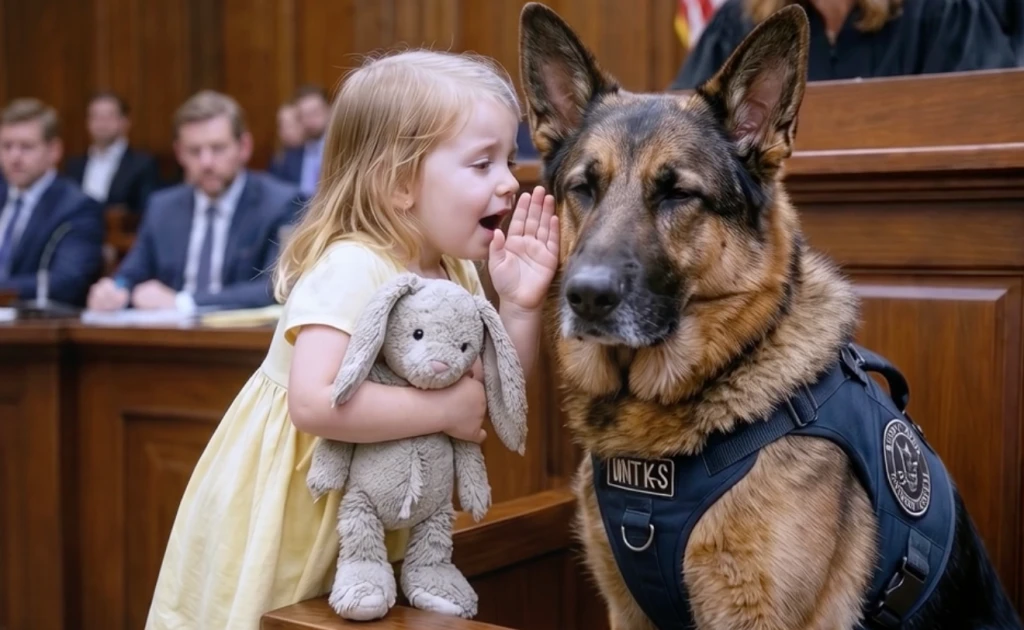
Maisie Harper was under a courthouse bench when Gus found her. The golden retriever did not nose beneath the oak slats or drag her into view. He lowered his broad body onto the tile, turned his head sideways, and looked into the dim space where she had folded herself around a stuffed rabbit. His blue vest whispered against the floor. After a moment, his tail tapped once.
Nell Harper stayed on her knees beside the bench. At forty-six, after nineteen years of managing an elementary-school cafeteria, she could crouch to the height of a frightened child without thinking about it. She knew how to wait out a first grader who would not admit he had no lunch money. She knew which children needed a choice and which needed silence.
With Maisie, she kept getting it wrong. “We don’t have to go through that door yet,” Nell said.
Maisie rubbed the flattened ear of her rabbit across her mouth. Six weeks had passed since paramedics found her mother, Laurel, unconscious on the kitchen floor and Maisie wedged behind the coats in the laundry closet. The bruises on the child’s knees had faded. Her words had not come back.
Nell had promised her there would be no crowd, no shouting, and no man in handcuffs. All three promises were technically true. The courtroom had been closed to the public, Cal had waived his physical presence after consulting with Jonah and watched from a holding room downstairs through a secure video feed, and Judge Elaine Hart had ordered everyone to use quiet voices.
But it was still a courtroom, and Nell had learned too late that children could hear the difference between a promise and its careful wording. Tori Alvarez, Gus’s handler, sat against the opposite wall with the loose end of his leash across her knee. “He can stay right there all morning,” she told Maisie. “He has no appointments more important than this one.”
Gus exhaled through his nose. His breath lifted a small drift of dust beneath the bench.
Maisie’s fingers appeared first. They touched the white blaze on his muzzle, then withdrew. Gus did not follow. On the second try, she left her hand there.
Nell felt the relief in her own body and mistrusted it immediately. Relief had made her careless before.
Assistant District Attorney Leah Mercer waited near the closed courtroom door, a legal pad tucked to her chest. She wore a navy suit and the tired expression of someone who had spent several nights rearranging the same facts. Beside her stood Jonah Price, the attorney representing Cal Doran, the man charged with attacking Laurel. Jonah had opposed almost every motion Leah filed, but not the one requesting Gus.
“My client doesn’t need the child hurt to prove he didn’t hurt her mother,” he had said at the first hearing.
Nell had disliked him for making the sentence sound so simple. The State’s case against Cal had never been simple.
He and Laurel had argued the evening of the attack. A downstairs neighbor heard his voice through the heat vent. Cal admitted knocking over a chair and leaving angry. His phone remained on Laurel’s kitchen charger, placing it uselessly at the scene, and a text he sent an hour earlier—Tonight this ends—looked uglier on an evidence screen than it had inside a fight about Laurel lending money to her brother.
Cal also had a temper. Nell had told the detective that much before sunrise, while Laurel was in surgery and Maisie sat mute in a hospital blanket. She had described the slammed doors, the cracked mug, the Thanksgiving when Cal walked into the yard because he was afraid of what he might say if he stayed.
What Nell had not described with the same care was that he had walked into the yard. She had given Wade an alibi just as quickly.
Her brother had been at her house, she told police. He had eaten leftover pot roast at her kitchen counter and slept on her couch because the furnace in the apartment over his roofing shop had quit. She had said it with such brisk certainty that the detective wrote it down and moved on.
Now every time Leah mentioned the estimated time of the assault, Nell saw the green digits on her microwave: 10:04. The time Wade had actually knocked on her back door.
Under the bench, Maisie shifted. Gus rolled from his side onto his stomach but kept his chin on the tile.
“Can he come in?” Maisie whispered.
It was the first sentence Nell had heard from her in nine days.
Tori did not celebrate. She merely said, “If you want him to.”
Maisie crawled out with one fist twisted into the fur at Gus’s shoulder. Her yellow cardigan had bunched under one arm, and a dust mark crossed her cheek. Nell reached to brush it away, but Maisie turned her face.
The gesture was small. Nell let her hand fall.
Judge Hart had come down from the bench by the time they entered Courtroom 2A. A child-sized table and two chairs had been placed inside the rail. There was no jury.
Only the judge, clerk, court reporter, attorneys, Dr. Priya Shah, Tasha Green from county child services, and Nell were present. A video camera recorded the limited pretrial hearing. Judge Hart had said its purpose was to determine whether Maisie could communicate reliably and what accommodations she would need if she were ever asked to testify. It would decide neither Cal’s guilt nor whether any new statement could be used at trial; anything Maisie disclosed would have to be investigated outside this room.
It was not the trial. No one in the room forgot that Cal had been in the county jail for forty-three days anyway.
Maisie stopped at the rail. Gus stopped with her.
Judge Hart spoke from an ordinary chair instead of the bench. “I like your rabbit.” Maisie pressed the toy under her chin.
“Does your rabbit have a name?”
No answer came. Gus sat, and Maisie leaned her hip against him.
Nell’s impulse was to supply the name—Button—and spare Maisie the pressure. Dr. Shah caught Nell’s eye and moved one finger against her own knee: wait.
“Button,” Maisie said at last.
The judge nodded as if this were useful testimony, which perhaps it was. “And this is Gus?”
Maisie looked down at the dog. “He’s warm.”
“He is. Would you and Gus like the little table or the rug?”
Maisie chose the rug. Tori unclipped the working leash and gave Gus a hand signal. He lay across Maisie’s feet, leaving his head where her fingers could reach it.
Judge Hart asked whether Maisie knew the difference between something that happened and something somebody pretended. Dr. Shah had advised against abstract questions about truth and lies. So the judge held up a red block and called it blue.
Maisie frowned. “Red.”
“What if I really want it to be blue?”
“Still red.”
Jonah Price wrote something on his pad. Leah did not.
The first few questions were about Button, Nell’s house, and the cinnamon cereal Maisie had eaten that morning. Leah kept her voice plain. She did not praise every answer. She did not say brave.
When Maisie stopped, Leah stopped too. Then Leah set a box of thick crayons on the rug and placed a sheet of paper beside it.
“Dr. Shah told me you draw rooms sometimes,” she said. “Would you draw the room where you hid?”
Maisie took the blue crayon. She drew a square too hard, tearing the paper near one corner. Inside it she made three long strokes for coats and a small shape beneath them. Gus’s breathing moved the edge of the page.
“Is the small shape you?” Leah asked. Maisie nodded.
“Where was your mom?”
A black line appeared outside the square. Maisie laid the crayon flat and rubbed it back and forth until wax covered the place where a body might have been.
Nell looked at the clock above the clerk’s desk. She had learned to watch clocks while feeding three hundred children in twenty-two-minute shifts. Here the second hand seemed indecently loud. Maisie chose yellow next and drew something with sharp rays near the black shape.
“The lamp had teeth,” she told Gus.
Leah’s eyes moved briefly to Dr. Shah. Crime-scene photographs showed a yellow ceramic lamp shattered beside Laurel. Maisie had not been shown them.
“Did the lamp break?” Leah asked.
Maisie pushed the yellow crayon away. “It bit him.”
“Who did it bite?”
The child’s hand disappeared into Gus’s neck fur. His eyes remained half closed.
Nell wanted Leah to stop. She wanted her to continue. Both desires felt selfish.
Maisie reached for red and made circles over a pair of large hands at the edge of the page. The figure had square shoulders and one long leg that ran off the paper.
“Is that Cal?” Leah asked.
Jonah rose halfway. “That’s leading.”
“You’re right,” Leah said before the judge could rule. She looked back at Maisie. “Who did you draw?”
Maisie bent until her lips touched Gus’s ear. Her whisper was too soft for Nell to hear, but the court reporter leaned toward her machine.
Leah waited. “Can you tell us what you told Gus?”
“The man was loud.”
“Did you know him?” Maisie nodded.
“Is he Cal?”
This time Jonah did stand. Judge Hart lifted a hand, but Maisie answered before either lawyer spoke.
“Cal went away.”
Nell gripped the wooden rail. Leah lowered herself to the carpet, not closer to Maisie, only lower. “Who stayed?” Maisie rubbed Button’s worn ear across Gus’s head as if introducing the two animals. Then she looked at Nell. “Uncle Wade,” she said. “Uncle Wade hurt Mama…”
To read the rest of the story – CLICK the NEXT button 👇👇👇