


The sound made Eli Carden think first of metal. It came from below the trail in two ragged notes, like a gate hinge forced in winter and then something smaller trying to breathe. Eli stopped beside the print of a mule deer and listened until the wind moved through the ponderosas again. Thirty-two years in the Coronado National Forest had taught him which noises deserved a second look. This one deserved more than that.
He had come to inspect a service gate cut open for the third time that month. Beyond it, tire chains had pressed a fresh ladder into nine inches of snow. Half a mile back, beneath an alligator juniper, he had found an empty cable restraint anchored to the roots.
Now the strange cry came again.
Eli tried his radio, got only static, and marked his position before leaving the trail. The slope fell toward a granite canyon in shelves of loose rock hidden by snow. He moved sideways, testing each foothold before giving it his weight.
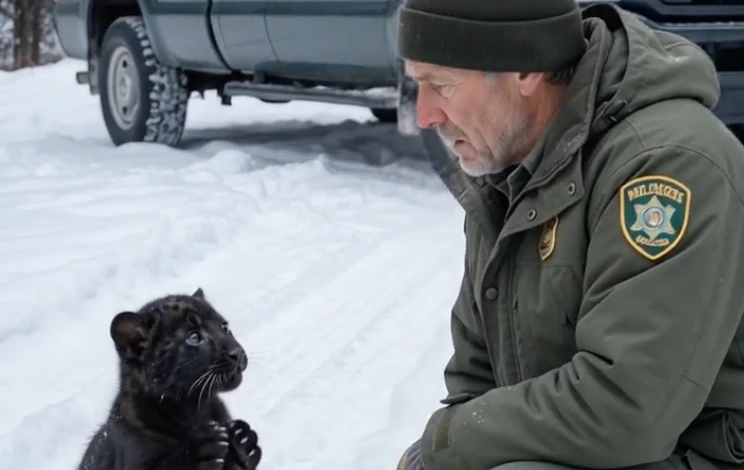
A black animal stepped from behind a manzanita twenty yards below.
For one confused moment, Eli thought of a feral house cat. Then sunlight passed over its shoulder, and darker rosettes appeared inside the black coat. The paws were too broad, the chest too deep, the tail too heavy. It stood no higher than Eli’s knee, but nothing about its shape belonged to a domestic animal.
“Jaguar,” he whispered.
The cub watched him with amber eyes. Snow crusted the whiskers on one side of its face, and hunger had pared its flanks until the ribs showed beneath the coat. It was perhaps five months old—old enough to distrust him, too young to be alone.
Jaguars crossed north from Mexico occasionally, most often solitary males moving through the isolated mountain ranges people called sky islands. A female raising a cub in southern Arizona would alter years of assumptions. A melanistic cub would sound like a campfire lie even to people who wanted it to be true.
Eli lowered his gaze and turned one shoulder away. “Keep your distance.”
The cub slipped behind the manzanita.
Eli backed uphill. He had taken three steps when the animal reappeared, crossed part of the slope in an awkward rush, and stopped beyond reach. Its nose lifted toward him. Then it turned, bounded downhill, and looked back.
Eli waited.
He had seen frightened people read intention into every animal that paused near them. The cub might simply be hungry and confused.
It returned, cried once, and set off again.
This time Eli followed.
It did not flee as a cat should have fled. It kept to patches of open snow, slowing whenever Eli lost ground. Twice it disappeared behind rock and came back to find him. The route climbed across the face of the ridge instead of descending toward water and warmer country.
After forty minutes, the cub began dragging its hind feet. It stumbled over a buried stone and rolled onto its side. When Eli moved toward it, the animal sprang up and hissed, small body bristling with an adult’s fury.
“All right,” he said. “Your terms.”
The cub continued toward a band of shadow beneath the cliffs.
Blood reached Eli as a mineral taste at the back of his throat. Beneath it lay urine, cat musk, and the sour odor of an animal that had been unable to leave its own waste. He slipped his sidearm free of its retention strap but kept it holstered.
The cub pushed through scrub oak beneath an overhang. A growl came from the dark, low enough that Eli felt it through his boot soles.
He stopped behind a shoulder of granite.
A female jaguar lay under the ledge, her gold coat broken by rosettes that crowded together along her spine. One foreleg stretched toward a pinyon where a steel cable had been fixed around the trunk. The loop had cut through the fur above her paw. Flesh bulged darkly on both sides, and the snow around her had been beaten down to dirt and blood.
The cub pressed itself against her neck.
The female raised her head. She could not stand, but she gathered enough strength to drag her body between Eli and the cub. Her lips lifted from her teeth. The warning came out as breath.
“I see him,” Eli said. “I’m leaving him with you.”
He withdrew one step at a time until granite blocked most of him from her view. Only then did he climb far enough to raise dispatch through the broken signal.
He gave his location, the injured animal’s condition, and the presence of dependent young. He asked for a wildlife veterinarian, county backup, and a tracked rescue vehicle. He did not use the word jaguar until the dispatcher repeated the coordinates on a secure channel.
“Approach from the north,” Eli said. “Nobody uses the old road from the east.”
The restraint was new. Its lock showed no rust, and the anchor had been chosen for an animal capable of pulling lesser hardware out of the ground. Boot marks survived beneath the latest snow. A narrow drag line disappeared toward the closed fire road.
Eli returned below the ledge. The cub stood beside his pack, swaying. He considered the venison in his lunch, then left it where it was. A starved cat could gorge, choke, or learn far too quickly that people carried food.
Instead, he removed his waxed-canvas coat. Cedar smoke from his stove had worked into the sleeves over years of winter patrols. He laid it across the windward gap under the overhang, using stones to hold the corners, and retreated before the female had to warn him again.
The cub sniffed the canvas. It stepped onto one sleeve, turned twice, and folded its legs beneath itself.
For the next half hour, Eli watched the female’s breathing. Her sides rose too quickly and not deeply enough. Once, the cub touched its nose to her jaw. Her ear moved, but her eyes remained on Eli.
He was searching the nearby trees for another restraint when a square shadow high on a juniper caught his attention.
A cellular trail camera had been strapped twelve feet above the ground. It was not aimed along the game path. Its lens pointed directly at the snare.
Eli photographed the camera without approaching. The manufacturer’s label had been scraped from the case, but a short antenna rose from the top. A model like that could store images locally and transmit reduced copies whenever it found service.
A tiny green light blinked.
Somewhere outside the canyon, a photograph had just arrived: the trapped female, the black cub, and Eli kneeling beside them.
Then an engine changed gears far below. It was climbing from the east—the only road Eli had told rescuers not to use…
To read the rest of the story – CLICK the NEXT button 👇👇👇