


The rope wasn’t the first thing I understood. The first thing was the breathing. It came from somewhere in front of me, low and heavy, pushing through the cold timber like a storm trying to decide whether to break. My eyes opened by inches. Bark scraped the back of my neck. My shoulders burned. Something sticky had dried behind my ear, and when I tried to lift my hand, pain tore through both wrists so sharply that I almost blacked out again.
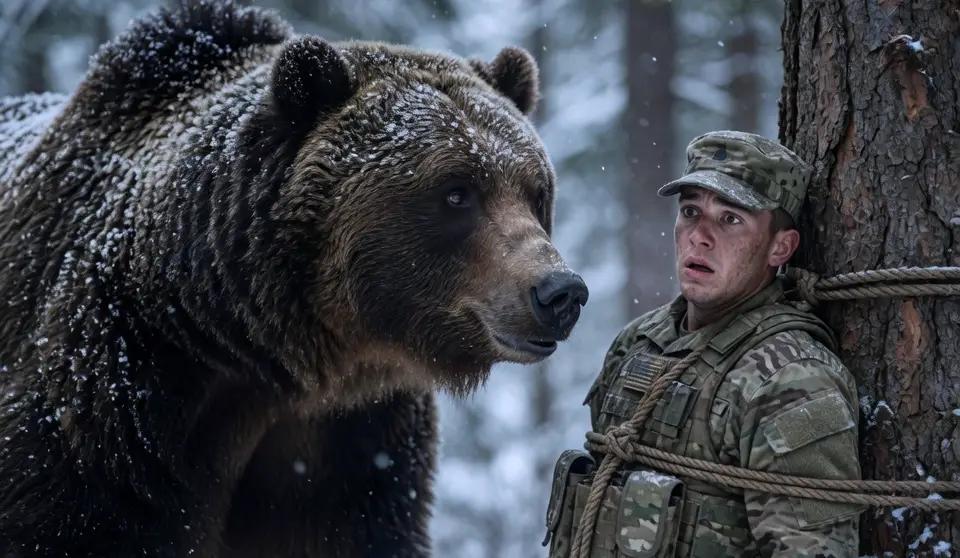
I was tied to a lodgepole pine with climbing rope.
Not wrapped once. Not carelessly. Whoever had done it had taken their time, cinching the rope across my chest, stomach, thighs, and ankles until I could barely draw a full breath. My radio was gone. My phone was gone. My service belt had been cut away. The only thing left of my life as a Montana wildlife officer was the badge-shaped bruise where the buckle had been driven into my ribs.
Then the brush moved.
A grizzly stepped out between the trees.
He was close enough that I could see the damp earth clinging to his claws. Close enough to hear the wet click of his nose as he pulled my scent from the air. He was a dark, massive animal, wide across the shoulders, his coat rough with burrs and pine needles. When he turned his head, the last gray light of evening caught in his eyes and made them look almost amber.
I stopped fighting the rope.
There are moments when the body knows before the mind does. Mine went still in a way no command could have managed. I had worked this country for nineteen years. I had seen bears feed, fight, bluff, run, and stand their ground. I knew what distance meant. I knew what hunger meant. I knew what a wounded, bleeding man smelled like in the backcountry.
And I knew I had no distance at all.
My name is Mason Reed. Most people in Ridge County knew me as the game warden who didn’t take bribes, didn’t laugh off illegal kills, and didn’t look the other way when a trophy rack showed up in the wrong truck bed. That had made me some enemies over the years. What I never expected was that two of them would be men I had once called friends.
Wade Mercer and Travis Bell had grown up fishing the same creek with me. We had eaten dinner in each other’s kitchens, stood beside each other at funerals, and shared camp coffee on mornings when the world seemed young enough to forgive anything. But somewhere along the way, they stopped hunting for meat and started killing for money. Elk racks, bear parts, anything somebody would pay for if no one asked too many questions.
I had spent the last eight months building a case on them.
That afternoon, I found their fresh tire tracks cutting into a closed drainage above Redtail Pass. I should have waited for backup. I knew that even before I followed those tracks through the spruce. But there had been blood in the dirt and drag marks heading toward a place where no legal hunter had any business being, and instinct pulled me forward faster than caution could stop me.
I remembered Wade’s voice before the blow came.
“You always did think that badge made you better than us, Mace.”
Then Travis, quieter. “This is enough, Wade.”
Then nothing but pain.
Now I was here, lashed to a pine in a hollow so deep the radio signal would have struggled even if I still had a radio. The air smelled of cold sap, old needles, and my own blood. Somewhere high above the branches, a raven called once and went silent.
The grizzly took another step.
His head swung slowly from side to side as he studied me. He wasn’t charging. He wasn’t bluffing. That almost made it worse. A charging bear gives the mind one clean terror to hold. This one moved with awful patience, like he had all evening and knew I did not.
“Easy,” I tried to say, but my mouth was too dry. The word came out as a scrape.
The bear stopped.
His ears shifted forward. His nose worked again, pulling at the air between us. For a strange second, he looked less like a predator deciding what to do with me and more like an animal trying to place a sound he almost remembered. Then he rose.
I had seen grizzlies stand before. People who haven’t think it looks like a trick, like the bear is making himself taller only to frighten you. It isn’t that simple. When a grizzly stands, the whole world seems to tilt toward him. He becomes less an animal than a wall of muscle, heat, and breath.
This one lifted one enormous paw.
I shut my eyes.
I thought of stupid things in that last second. The chipped blue mug on my kitchen counter. The loose screen door I had meant to fix before winter. My father’s old field knife in the top drawer of my desk. I thought of how Wade had laughed when we were boys, before greed had gotten its hooks in him.
The blow came with a crack that shook the tree.
But it did not hit me.
The rope across my right shoulder jerked violently, burning through my shirt as the bear’s claws tore into it. I opened my eyes in time to see frayed orange fibers hanging loose where the strand had been cut nearly halfway through. The grizzly dropped back down, snorted hard, and struck again.
This time I felt the wind from his paw against my cheek.
The claws missed my skin by less than an inch. They hit the rope across my chest instead, ripping through the outer braid. The sound was ugly and beautiful at the same time, a dry, tearing rasp that meant something in this impossible situation was changing.
He wasn’t trying to kill me.
He was trying to free me.
The thought was so absurd I almost rejected it. Wild animals do not perform miracles on command. They do not repay debts in tidy ways meant for human stories. A grizzly does not look at a man tied to a tree and decide, with gentle moral clarity, to help.
And yet he lowered his head, seized the rope between his teeth, and pulled.
My chest crushed tighter against the pine. The rope bit into old cuts and new bruises. I groaned, and the bear released at once, backing half a step as if the sound had mattered to him. His eyes stayed on my face. Not tame. Not soft. But aware.
He moved closer again, slower this time. His nose brushed my sleeve, then my collar, then the side of my jaw where dried blood had stiffened against my skin. His breath was hot and wild, carrying the smell of berries, fish, and wet earth. I could see scars across his muzzle, a notch in one ear, a burr caught above his eye.
Then he shifted his body, and the last light slid along his left side.
Under the thick, matted hair, cutting through the dark coat in a pale, crooked line, was a scar I had made with my own hands.
My throat tightened so hard I could barely speak. Five years had passed since I had seen that mark. Five winters. Five springs. Long enough for a starving cub to become the kind of animal men tell stories about in bars and pretend not to fear. I had not spoken the name in years. It came out cracked and useless, more breath than voice. “Scout?” The bear stopped chewing…
To read the rest of the story – CLICK the NEXT button 👇👇👇