


By the third blow against the pipe panel, Noah Mercer knew the black mustang had stopped looking for a way out. He was trying to make one. The horse hit with his right shoulder, spun, and hit again. Dust lifted from the arena floor and clung to the sweat along his neck. Above him, a blue sponsor banner snapped against the rail each time the desert wind found the open end of the grandstand.
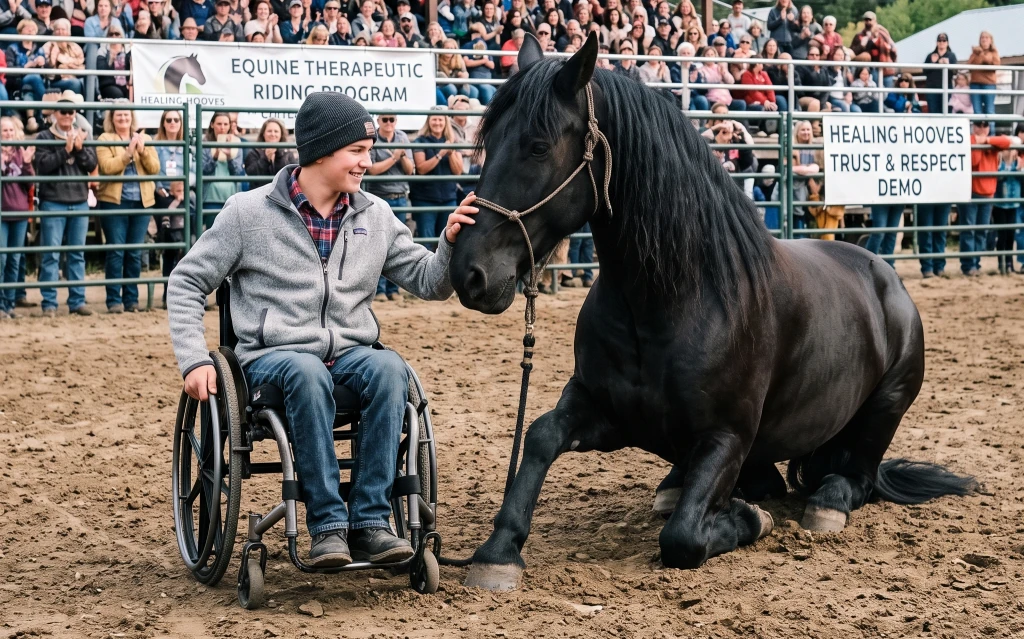
“Mom. That banner.”
Kate Mercer leaned close, as if Noah had spoken too softly. Since the accident, she listened to him that way—with her whole body, ready to turn a sentence into an emergency.
“What about it?”
“It’s trapping him on the turn. Tell them to drop it.”
The announcer was still filling the arena with his polished baritone. “Rook came off the range less than a year ago, folks. Lena Ortiz has had just eleven weeks to show him that people can be partners—”
Rook struck the panel again. This time the top rail jumped in its socket.
Noah released the brakes on his chair. Kate’s hand went automatically to one push handle, and he caught the wheel before she could move him.
“Don’t.”
Her fingers opened. “I was only—”
“I know.”
He rolled down the concrete aisle toward the arena gate. Nineteen months earlier, Noah would have gone over the rail if a horse was in trouble. He had been sixteen then, lean from barn work, quick enough to step into a stirrup without looking. Now the bottom rail met him at eye level, and two event volunteers stood in front of the accessible opening as though his chair were one more thing that needed containing.
Inside the pen, Lena Ortiz had already lowered the training flag. She was a compact woman in a gray felt hat, with a rope-burn scar pale across one wrist. She kept her body angled away from Rook and waited for him to find the space she was offering, but the banner cracked again and he wheeled toward it.
“Take the blue vinyl down,” Noah called.
One volunteer looked at the other. The announcer talked over him.
“Take it down!”
Lena glanced toward the rail. Her eyes found Noah, then followed his line of sight. She lifted one hand.
“Kill the mic,” she said.
The announcer faltered. Lena pointed to the banner, and a groundskeeper cut its zip ties. The vinyl collapsed in a bright heap. Without the movement at his shoulder, Rook completed one more ragged circle, stopped at the far side of the pen, and stood with his legs spread and his head high. Air tore in and out of his nostrils.
Lena did not approach him. She told the crowd the demonstration was over.
The boos were few, but Noah heard them. Most people simply rose, disappointed, and began carrying their drinks and children toward the next event at the High Desert Mustang Weekend. The announcer promised a roping clinic in twenty minutes. Music came back through the speakers before the black horse had stopped trembling.
Kate reached Noah at the gate. “You saw that before anybody.”
“She saw it.” He watched Lena unclip two sections of the round pen so Rook would have a wider, quieter enclosure. “She just had six hundred people waiting for her not to see it.”
“Do you want to go?”
He had wanted to go from the moment she parked at the Sage County Fairgrounds that morning. Kate had called the trip a change of scenery, as if the problem were the view from his bedroom. She had packed his pressure-relief cushion, pain medication, two bottles of water, and the rain shell he had not needed since April. She had not said there would be horses until the highway signs made lying pointless.
Now Noah looked past her toward the service aisle behind the arena. It ran along Rook’s expanded pen and ended near the livestock wash racks, away from the speakers and the departing crowd.
“Not yet.”
He rolled that way before she could ask another question. The pavement changed to hard-packed screenings under his front casters, and Noah slowed, picking a line between shallow ruts. On the other side of the fence, Rook stayed at the far end while Lena removed the flag, a coiled rope, and a plastic pedestal left from the planned demonstration. She carried each object out without trying to win anything back from him.
Noah stopped beside a solid gate and turned his chair at an angle. Facing a frightened horse head-on was a kind of demand. So was staring. He rested his hands on his thighs and studied a bolt in the gate as if he had come all that way to inspect the hardware.
The old part of him counted anyway: one ear on Lena, one on the wash rack; weight held behind; right shoulder guarded; eye bright but no longer blind with panic. Rook was not raging. He was waiting for the next thing to chase him.
Noah heard Lena lead the last volunteer out. A latch dropped. Then there was only the wind pushing grit along the service aisle and the far-off instructions from the roping clinic.
Rook moved first. One step brought him parallel to the fence. He stopped, looked away, and tore up a mouthful of dry hay that he did not chew. Noah kept his hands still while the horse took two more steps.
“You’ve got plenty of room,” Noah said. His voice came out rough from disuse. “I’m not taking any of it.”
Rook’s ear turned toward him. Noah had once narrated entire rides to his chestnut mare, June, mostly insults about cattle and apologies for his own bad timing. After the wreck, he had refused to visit her at the ranch where she was leased. He could not bear the smell of saddle soap on anyone else’s hands. Yet here he was talking to a horse who did not know his name and had no reason to care.
Rook came to the fence in a wavering line. At ten feet he stopped. Noah could see the dark crescents of dust above his eyes and a burr caught low in his mane. He could also see Lena beyond the corner of the pen, motionless, watching without pretending not to.
“That’s close enough,” Noah murmured.
The horse came closer.
His muzzle reached through the lower gap in the gate, then withdrew. Noah did not offer a hand. He had seen too many people turn a horse’s curiosity into an obligation. Rook stretched again and breathed against the rubber of Noah’s front tire.
Warm air touched Noah’s shin, where he could not feel it.
The knowledge landed strangely. He knew the breath was there because the fine dust on his jeans stirred. For months after the spinal cord injury, people had asked whether he felt things—needles, pressure, heat, hope—as if every answer might be the first rung of a ladder back to the person they remembered. Rook asked nothing. He smelled the tire, the metal fork, the leather of Noah’s glove, and took the information for what it was.
Noah lifted his eyes. The horse’s face was level with his.
Rook lowered his head another inch and rested the soft weight of his muzzle against the silver push rim. The contact made a small hollow sound. Noah’s right hand tightened, but he did not reach.
Behind him, Kate drew in a breath. For once, she did not say his name.
Rook stayed until a truck door slammed near the wash racks. He lifted his head and moved three strides away, alert but not fleeing. Noah found that he was smiling. It felt unfamiliar enough that he stopped when he noticed it.
Lena approached along the outside of the pen. She took off her hat before she came close, leaving a dark line across her forehead.
“Thank you for spotting the banner,” she said.
“You stopped the session.”
“About thirty seconds later than I should have.” She looked toward Rook. “His warning was plain. I let the crowd make me late.”
Noah liked her less for sounding as if she understood, and more for admitting the delay. “Is he always like that?” Kate asked.
“Not every time.” Lena set her hat on the gatepost. “But he learned before he came to me that when he feels trapped, pushing a wall sometimes makes the wall move. Today we put him in a smaller space than he was ready for, then dressed it up as education.”
Rook had gone back to the hay. He chewed now, though his eye remained on them.
“He touched the chair,” Kate said.
“He investigated the chair.” Lena’s correction was gentle. “That’s enough. More than enough.”
She turned to Noah. “You still lean away before a horse enters your space. Most people lean in.”
The smile left him. “Most people haven’t been stepped on.”
“Your mother said it wasn’t a horse that injured you.”
Noah looked at Kate. Her face changed by degrees—the hopeful lift around her mouth disappearing first, then the color under her freckles. Lena glanced between them and seemed to understand that she had opened the wrong gate.
“I thought he knew you’d contacted me,” she said.
Kate gripped the strap of the bag hanging from Noah’s chair. “Noah, I can explain.”
He put both hands on his wheels. Rook raised his head at the faint squeak of rubber against metal.
“What did you promise her?” Noah asked…
To read the rest of the story – CLICK the NEXT button 👇👇👇