


The knot was not the worst part. The worst part was how gently Grant Whitaker tied it, using the same careful hands he had once used to brush snow from Mara Hayes’s hair. He looped the rope around the old pine, drew her wrists behind the trunk, and tested the knot with a small tug, as if he were securing a canoe to a dock instead of leaving a woman to die in the Montana cold.
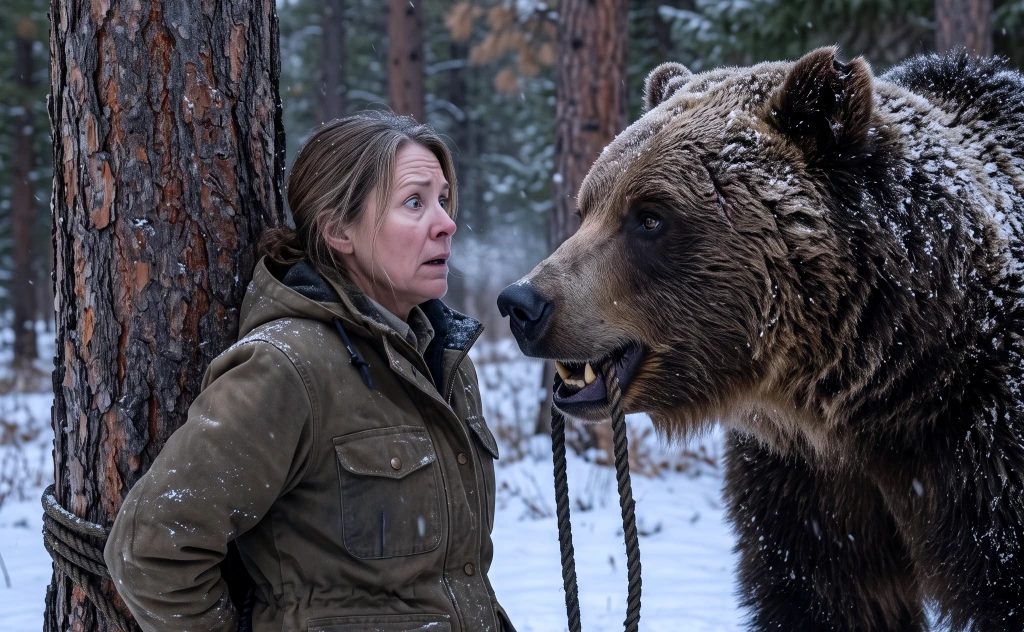
Mara did not scream at first. Her throat had closed around the sound. She watched his face instead, waiting for the mask to crack, waiting for the man who had kissed her beside the stove at Eagle Creek Station to come back through his eyes and realize what he was doing.
He only looked tired.
“You always said the wild knows who belongs to it,” he said.
His voice was calm enough to make the woods around them feel louder. Snow fell through the blue afternoon light in thin, dry needles, settling on the shoulders of his black field jacket. Behind him, his dark SUV idled on the frozen track, exhaust climbing through the spruce like smoke from a warning fire.
“Grant,” Mara managed. Her lips were stiff from cold and fear. “Please.”
He looked at her for another second, and something almost human crossed his face. Not regret. Not mercy. Maybe irritation that she still expected either one from him.
“You should have left your father’s papers alone,” he said.
Then he stepped closer and checked the rope again.
It was a rough utility rope, the kind her father had kept in every shed and truck at the station, but this one had been soaked in something oily and sour. The smell clung beneath the clean bite of pine and snow. It had been on Grant’s gloves too, and on the rag he had used to wipe down the tailgate after he dragged her from the vehicle.
Mara twisted once, hard. The rope burned into her wrists. She felt skin tear, felt the cold move into the wet places immediately, and bit down on the inside of her cheek until she tasted blood.
Grant sighed. “Don’t do that.”
“You killed him,” she said.
For the first time, his jaw tightened.
Her father’s name sat between them without being spoken. Caleb Hayes had spent thirty-six years reading the mountain as if it were a language only patient men could learn. He had known which game trails would flood before the rain came. He had known when a sow grizzly was close by the silence of the jays. He had known, almost from the beginning, that Grant Whitaker was not the conservation photographer he claimed to be.
Mara had not known.
Or maybe she had known in small ways and chosen not to assemble them.
Grant turned away from her and walked back to the SUV. He opened the rear door and took out her phone, her radio, and the small canvas pack she had tried to keep hidden under her feet. He tossed them into the front seat as if they belonged to him now, then came back carrying her father’s old hunting knife in its worn leather sheath.
Mara’s breath caught.
He did not use it on her. He lifted it just enough for her to see, smiled faintly, and slid it into his own belt.
“Your dad should have minded his job,” he said. “And you should have minded your grief.”
The words did what the rope could not. They made her go still.
Grant had held her after Caleb’s funeral. He had stood in the kitchen while neighbors brought casseroles and coffee and sympathy in paper cups. He had been the one to tell her she did not have to be strong every minute. He had stood beside her at the grave, one hand warm at the center of her back, while the wind moved through the bare cottonwoods and the preacher mispronounced Caleb’s middle name.
Now that same hand patted the trunk above her shoulder, almost affectionately.
“I’m sorry,” he said, but he said it like a man ending a phone call.
He walked away before she could answer.
The SUV’s tires crunched over packed snow. For several seconds, the red taillights burned between the trees. Then the vehicle turned behind a shoulder of rock, and the lights vanished. The engine faded next, swallowed by the timber and the long white emptiness of the Crown Range.
Mara was alone.
She waited until she could no longer hear the motor before she let herself pull against the rope again. Panic came up fast, bright and stupid. Her father had warned her about that too. Panic wastes heat, Mara. Panic makes you dumb. You get one bad minute if you need it. Then you work the problem.
She took her bad minute.
She cursed Grant until her voice cracked. She cursed herself until the words turned into vapor and disappeared. She kicked backward at the trunk, scraping her boots against bark, trying to find leverage. The rope only tightened. Her hands, trapped behind the pine, began to pulse with a deep, sickening ache.
The temperature had already dropped into the teens. It would fall lower after dark. She knew that without needing a forecast because the snow had gone dry and squeaky underfoot, because the air had that metallic taste that came before a hard freeze, because the forest had drawn itself inward in the way it did when night meant business.
Mara had grown up fourteen miles from the nearest paved road, in a ranger station most people only saw on old maps. Caleb Hayes had raised her there after her mother died, though “raised” was not the word most parents would have used. He had taught her to split wood before he taught her to drive. He had taught her to identify scat, read wind, clean a stove pipe, dress a wound, and never step over a log without looking at the other side first.
He had not taught her how to survive the betrayal of someone she loved.
The cold moved from her fingers into her wrists. She flexed against the rope, trying to keep blood moving, but the knot had been tied too well. Grant was good with knots. She remembered him laughing about that once when they had strung a tarp behind the station during an October storm.
“My grandfather had a sailboat,” he had told her. “A man who can’t tie a proper knot has no business near weather.”
She had smiled then. She had thought it was charm.
Now she understood that charm was only a tool, no different from the camera he carried, the satellite phone he hid, the stories he used to open doors that should have stayed locked.
A branch cracked somewhere downhill.
Mara lifted her head.
The forest went still again, but not empty-still. Listening-still.
She held her breath. Snow ticked softly through the needles overhead. Somewhere far off, a raven gave one harsh call and went quiet. Mara turned her face as far as the rope and trunk allowed, scanning the darkening wall of spruce and fir.
Another crack came, heavier this time.
Not a deer. Too slow.
She tried to swallow and could not.
The shape came out of the young timber with the patience of something that did not have to hurry. At first, it was only a dark mass moving between darker trunks. Then it stepped into the open, and the fading light caught the hump over its shoulders, the broad head, the long pale claws that carved the snow with each deliberate step.
A grizzly.
Mara stopped breathing.
The bear was enormous, but not fat the way a bear should have been before deep winter sleep. His coat hung rough along his ribs. Snow clung to the guard hairs at his shoulders. He moved like an animal dragged out of a dream too soon and made angry by waking.
A winter-stirred grizzly was one of the few things Caleb had never softened with poetry.
If they’re out when they shouldn’t be, he had told her, you give them the whole mountain.
Mara had no mountain to give.
The bear stopped about thirty feet away and lifted his nose.
Mara squeezed her eyes shut for half a second. Her wrists were bleeding. Her boots had scuffed the snow. Her fear was pouring out of her in waves she could almost smell herself. But under all that was the sour oil on the rope, the thing Grant had left behind on purpose.
She understood then with a clarity so sharp it felt like mercy.
Grant had not left her for the cold.
He had left her for whatever found her first.
The grizzly took another step. His breath steamed in thick bursts. His small dark eyes fixed on the tree, on the rope, on the woman bound to the trunk. Mara pressed the back of her head against the bark and forced herself not to thrash.
“Easy,” she whispered, though she did not know whether she was speaking to the bear or to herself.
The bear lowered his head and came closer.
At twenty feet, she saw the tear in his right ear.
Her heart struck once, hard.
“No,” she breathed.
The bear’s right ear was split near the top, healed into a ragged notch. A faded yellow tracking tag hung below it, half hidden by fur. Caleb had known that bear for years. He had never called him tame, never called him safe, never even called him friendly. But in the old field journals stacked by the stove, the bear had a name written in Caleb’s square hand.
Boone.
Caleb had found him years earlier with a wire snare buried in the thick fur around his neck. It had taken three officers, a wildlife vet, and Caleb cussing under his breath for two hours to save the young male’s life. After that, Boone had wandered the high drainages like a scarred king, turning up on trail cameras every season, always alive, always alone, always wearing that torn ear like a warning.
Mara had seen him from ridgelines and creek beds, always from far away. Her father had once rested a hand on her shoulder while Boone fed on huckleberries across a valley washed gold by September light.
“Don’t make a pet out of wonder,” Caleb had said. “That’s how people get hurt. You respect him because he can kill you. You admire him because he doesn’t have to.”
Now Boone stood close enough that Mara could hear the wet pull of air through his nose.
“Boone,” she whispered.
The bear’s ears flicked.
Mara knew better than to believe he recognized his name the way a dog would. But he knew sound. He knew scent. He knew the smoke that lived in the wool of Caleb Hayes’s old station blankets. He knew the particular human smell of that place, the stove, the leather gloves, the cedar shavings Caleb used for kindling.
Mara was wearing her father’s old coat.
Boone came closer.
Her legs shook so badly her knees knocked against the trunk. She tried to keep her eyes lowered, but every instinct wanted to watch his mouth, his paws, his shoulders. The bear moved to her side, snuffling along the snow, then lifted his muzzle to the rope behind her wrists.
The hot blast of his breath hit her torn skin.
Mara made a sound she could not stop. Boone paused. His nose pressed once against the back of her hand, massive and damp and impossible. Then he shifted his head, opened his jaws, and closed his teeth around the rope Grant had tied there…
To read the rest of the story – CLICK the NEXT button 👇👇👇