


The first thing Alexander Hayes noticed when he entered his townhouse at four seventeen on a Thursday afternoon was that his son’s purple crutches were leaning against the courtyard wall. The second was that Ethan was nowhere near them. Alexander dropped his briefcase beside the open French doors and crossed the breakfast room in three long strides. Outside, five-year-old Ethan stood between two strips of blue painter’s tape laid across the stone terrace. Silver stars marked the route from one line to the other. His knees trembled above the braces hidden beneath his sweatpants.
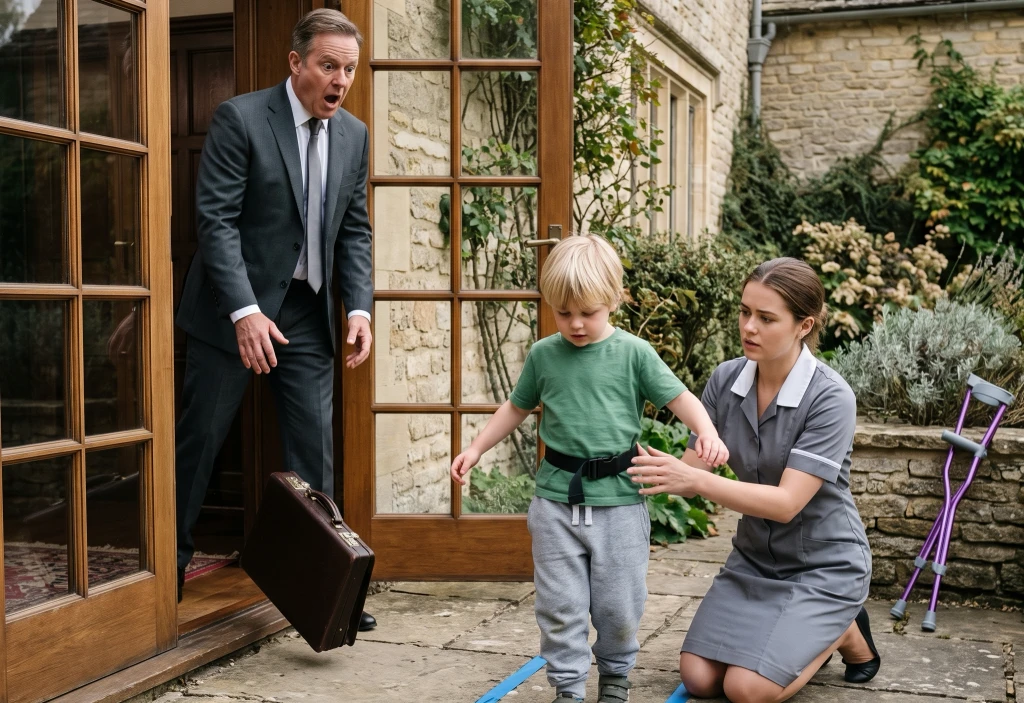
Sofia Ramirez knelt a few feet away, one hand hovering near the safety belt around his waist.
“Thrusters ready,” she said. “Next stop, Mars.”
“I’m not going to Mars.” Ethan’s face tightened with effort. “I’m going past Mars.”
He shifted his weight and dragged his right foot forward. The movement was awkward but deliberate. Sofia did not touch him.
Alexander’s breath caught.
“Where are his crutches?”
Ethan turned toward the voice. His right knee buckled.
Sofia caught the belt before he hit the stones, but Alexander was already there. He lifted Ethan against his chest and carried him back through the doors.
“Dad, put me down!”
“What were you thinking?” Alexander demanded.
The question was aimed at Sofia, but Ethan answered.
“I was walking.”
“You almost fell.”
“I fall sometimes.”
Alexander set him on a kitchen chair and crouched to examine his legs. No blood. No twisted ankle. The straps on his braces remained fastened. Still, Alexander could feel his own pulse beating behind his eyes.
Sofia removed the painter’s tape from the terrace. Her dark hair had worked loose from its knot, and a faint line from the safety belt crossed one palm.
“I’m sorry you were frightened, Mr. Hayes,” she said. “But that exercise is part of the home program Maya gave us.”
“You are not his physical therapist.”
“No.”
“You’re employed to help with the house.”
“And with Ethan when needed. That is what Mrs. Keene told me when I was hired.”
“Helping him does not mean taking away the equipment that keeps him upright.”
Ethan kicked the lower rung of the chair. “She didn’t take it away. I put it there.”
Alexander looked at his son. Ethan’s blond hair was damp at the temples, and a silver star clung to the sleeve of his green T-shirt.
“You know you’re not supposed to stand without support.”
“Yes, I am.”
“Ethan.”
“Maya said I could. Thirty seconds by myself, then three steps with Sofia holding the belt. I did four today.”
Alexander turned back to Sofia.
She had taken a spiral notebook from the windowsill. “Maya showed me exactly what to do. I don’t change the exercises. I record how long he stands, whether his legs feel tight, and when he needs to stop.”
Alexander opened the notebook.
Every page carried a date, a short list of exercises, and Sofia’s neat block printing.
May 8: tired after poor sleep—stretching only.
May 12: two controlled steps, then asked for chair.
May 18: frustrated; turned practice into astronaut rescue.
May 21: four steps. No pain. Very proud.
There were entries going back five months.
Alexander closed the book. During those same five months, he had approved invoices from Ethan’s physical therapist, occupational therapist, tutor, and orthotics clinic. His assistant placed them in a digital folder, and once a week Alexander pressed a button authorizing payment.
He could name the monthly total.
He had not known about Mars.
“Why didn’t anyone tell me?” he asked.
Sofia’s expression shifted, not quite hardening. “The reports are sent to you.”
“I mean about this.”
“This is in the reports.”
Ethan slid down from the chair. Alexander reached for him, but the boy grabbed the edge of the table and steadied himself.
“Dad, watch.”
“Not now.”
“I can show you.”
“You’ve done enough.”
Ethan’s face closed in a way Alexander had seen without ever studying. The boy reached for his crutches, but they were still outside. Sofia started toward them.
“I’ll get them,” Alexander said.
Ethan waited without looking at him. Alexander retrieved the crutches and held them out. Their cuffs were covered in silver star stickers, some bright and new, others rubbed pale by use.
Ethan fitted his forearms into them and moved toward the hallway.
“Where are you going?”
“To my room.”
“You have a lesson in twenty minutes.”
“I know.”
Alexander followed him as far as the base of the stairs. The townhouse had an elevator, installed after Ethan’s diagnosis, but the boy stopped at the first stair and looked up.
“Can I take the stairs?”
“No.”
“I practiced three with Maya.”
“Use the elevator.”
The answer came so quickly that Ethan did not argue. He turned toward the elevator and pressed the button.
Sofia folded the painter’s tape into a small ball. “He was supposed to practice transferring his weight today. The stars were his idea.”
Alexander stared at the closed elevator doors. “How often do you work with him?”
“Fifteen or twenty minutes most mornings. Only the routine Maya approved.”
“And no one else could do it?”
“Other people tried.”
“What does that mean?”
“It means he wouldn’t practice with them.”
Alexander looked at her more closely. Sofia had worked in the house for fourteen months, arriving before seven each morning and leaving at six. Until that afternoon, he could not remember having a conversation with her that lasted longer than the time required to ask whether a suit had returned from the cleaner.
“What did you do differently?”
“I asked him why he hated it.”
“And?”
“He said everyone watched his legs as if they were waiting for them to do something wrong.”
Alexander glanced at the notebook.
“So we stopped calling it therapy,” Sofia continued. “Some days we repair a satellite. Some days we escape a moon crater. He still does the movements Maya assigned.”
“And when it hurts?”
“We stop.”
Ethan’s voice drifted down from the landing. “Except stretching. Stretching always feels bad.”
Sofia looked up. “Tight is allowed. Sharp pain is not. You know that.”
“I know,” he called back.
Alexander stepped into the hall. “I told you to go upstairs.”
“I forgot my notebook.”
Ethan returned in the elevator and crossed toward the breakfast room. He moved confidently with the crutches, but Alexander noticed how his hips rotated and how the toes of his braces turned inward.
Ethan retrieved a blue folder from beneath the table. A picture had been taped to the cover: a redbrick building with a ramp beside its front steps. Children crowded around an open door.
Alexander recognized neither the building nor the children.
“What is that?”
Ethan hugged the folder to his chest.
“My school.”
“You don’t have a school.”
Ethan looked at Sofia, then back at his father. “Yes, I do.”
Alexander held out his hand. After a moment, Ethan gave him the folder.
RIVERSIDE DAY SCHOOL—KINDERGARTEN WELCOME PROGRAM was printed across the top. Inside were photographs of a bright classroom, an accessible playground, and a library with cushions scattered across the floor. Someone had circled a date in late August.
“You’re being taught here,” Alexander said.
“That’s preschool work.”
“Your tutor covers kindergarten material.”
“But she isn’t kindergarten.”
Alexander opened his mouth, then stopped. There was no useful response to that distinction because Ethan was right. Tutors could teach him letters, numbers, and the names of planets. They could not become a room full of children.
“Who gave you this?”
“Maya told us about the school,” Sofia said. “I printed the information after Ethan asked to see it.”
“You had no right to make plans without speaking to me.”
“I didn’t enroll him. Only you can do that.”
Ethan’s grip tightened around one crutch. “I want to go.”
“We’ll discuss it when I have all the information.”
“You always say that.”
Alexander felt the words strike somewhere beneath his ribs. “When have I said that to you?”
“When I asked about the playground. When I asked if I could ride in Ben’s car. When I asked if you could eat breakfast with me.”
Sofia turned away, giving father and son a privacy Alexander suddenly did not want.
“I work because I’m responsible for this family,” he said.
Ethan studied the rubber tip of his crutch. “Sofia works, too.”
“That isn’t the same.”
“Why?”
Alexander could explain the forty-two hundred employees whose paychecks depended in some measure on his decisions. He could explain the hospital networks and shipping companies that used Meridian Logic software, the investors who interpreted every absence as a warning, the board that had learned to expect his voice on every difficult call.
None of it would answer a five-year-old asking why his father could not eat pancakes with him.
“We are not deciding about school tonight,” Alexander said.
Ethan’s mouth trembled. “Are you sending Sofia away?”
“No one said that.”
“You used the voice.”
“What voice?”
“The one you use before people stop coming.”
Alexander remembered a night nurse dismissed after leaving a medication unlocked, a driver replaced after a minor collision, a tutor removed when Ethan came away from a lesson in tears. Some decisions had been justified. He had never considered what their accumulated disappearances looked like to his son.
“I’m not sending her away.”
Ethan glanced at Sofia for confirmation. She offered none.
“You promise?”
Alexander had made promises in boardrooms worth hundreds of millions of dollars. He knew how to qualify every one of them.
“I promise I won’t make a decision tonight.”
“That isn’t a real promise.”
“No,” Sofia said quietly. “It isn’t.”
Alexander looked at her, surprised by the interruption. Ethan planted both crutches firmly on the floor. “If Sofia goes, I’m done practicing.” “Ethan—” “And I’m not going to kindergarten. Not ever…”
To read the rest of the story – CLICK the NEXT button 👇👇👇