


The sound came between shutter clicks, a rough, breathy rasp from somewhere below the fog. Daniel Mercer lifted his eye from the viewfinder. His camera continued its programmed sequence without him, recording pale bands of morning sliding between the pines on Morrow Ridge. He heard the sound again—not the bark of a fox or the cough of a startled deer, but something deeper, dragged through pain. He stepped away from the tripod and looked over the edge.
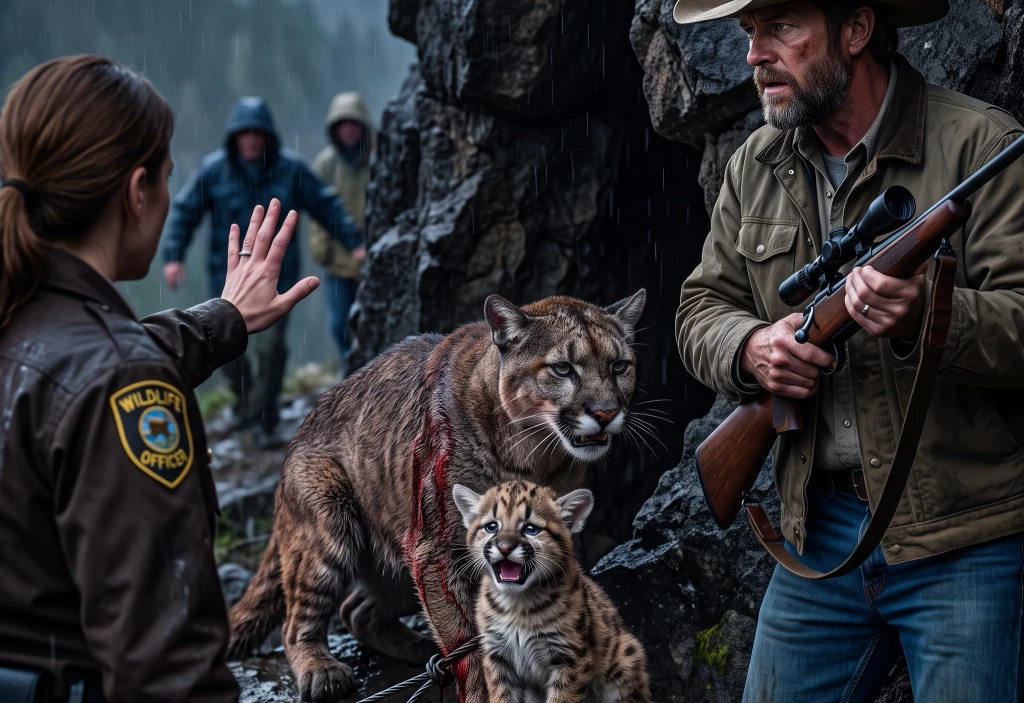
Twenty feet below, on a shelf scarcely wider than a dining table, a mountain lion lay pinned beneath the overturned roots of a ponderosa pine. Rain had loosened the slope during the night. When the tree fell, a slab of granite had broken free with it, trapping the lion’s left foreleg between stone and root.
Her hindquarters hung dangerously close to the drop.
Daniel had spent thirty years photographing animals most people never saw. He knew how efficiently a mountain lion could close twenty feet. He knew an injured cat was more dangerous than a healthy one, and a cornered cat more dangerous still.
None of that knowledge prepared him for her eyes.
They were fixed on him, amber and unblinking. Her ears lay flat against her skull. Blood darkened the tawny fur above her paw, and each breath moved through her ribs in short, visible waves.
Daniel took one step back.
The edge beneath his boot crumbled. Pebbles bounced onto the shelf, and the lion struck at them with her free paw. The movement shifted the root mass. Her body slid several inches toward the gorge.
“Easy,” Daniel whispered, although he knew the word meant nothing to her.
His phone showed one unstable bar. He used the satellite messenger clipped to his shoulder strap to send his coordinates to the emergency contact he had programmed months earlier. Then he called the one person who would understand exactly what he was seeing.
He had not spoken to her in eight months.
Lena answered on the fourth ring.
“Mercer.”
She used her work voice, clipped and alert. Daniel had heard it only twice before, both times when he had accidentally called during one of her shifts.
“It’s me.”
A pause followed, not long enough to be called silence.
“What happened?”
“I’m on Morrow Ridge, north side, about half a mile above the old quarry road. I found a mountain lion.”
“If you can see it, back away.”
“She’s trapped.”
The word changed Lena’s breathing.
Daniel described the ledge, the fallen pine and the angle of the cat’s body. He tried to give measurements instead of impressions. Lena had always distrusted impressions when numbers were available.
“Is she looking at you?” Lena asked.
“Yes.”
“Are her ears back?”
“Yes.”
“Then stop talking and move away from the edge.”
“The root plate is shifting. If it rolls, she goes over.”
“Daniel.”
“I sent you the coordinates.”
“My office just received them. Torres is calling county dispatch. Stay where you are, and don’t try to free her.”
The command came with the flat authority Lena used when she expected resistance. It was the same tone she had used four years earlier in a hospital corridor when she told him not to photograph anything else.
He looked down again.
The cat’s trapped leg trembled. Behind her, a broken root protruded from the slope like the handle of an overturned basket. If he could secure that root to one of the living pines above, he might keep the whole mass from rolling.
“I have climbing rope,” he said.
“No.”
“I’m not going near her. I can anchor the root mass from above.”
“No, you can’t. You can guess that you can, and those are different things.”
A shelf of dirt collapsed beneath the lion’s hind paw. She twisted, throwing her weight forward. The roots moved again.
Daniel slipped the phone into his jacket pocket without ending the call.
“Daniel, answer me.”
He opened his pack and pulled out sixty feet of static line. He carried it for steep terrain and river crossings, not animal rescues, but the rope did not care what purpose he had imagined for it.
“I’m still here.”
“What are you doing?”
He looped one end around a thick sugar pine and locked it with a carabiner. “Buying you time.”
“You may make it worse.”
“I know.”
“No. If you knew, you’d wait.”
The accusation found an old opening between them. Daniel pushed it aside and crawled toward the edge on his stomach, keeping his profile low. The lion’s head followed him. Her upper lip lifted, revealing a line of teeth.
He stopped looking directly into her eyes.
The fallen pine had landed at an angle, its root mass caught between two rocks. Daniel fed a wide loop of rope toward a projecting root, using a dead branch to guide the line into position. The branch slipped once and struck stone.
The lion snarled.
Daniel’s body moved backward before thought caught up.
“Dad?”
Lena had not called him that in months.
“I’m all right.”
“You don’t sound all right.”
He tried again. The rope dropped behind the root. He drew the loop closed, then eased backward until the line tightened between the fallen tree and the living pine.
The root plate shifted less than an inch.
The rope held.
Daniel sat with his back against the tree, both hands around the line as though his grip mattered to a knot designed not to slip. Below him, the mountain lion stopped struggling. Her head sank to the stone, but her eyes remained open.
“How long?” he asked.
“Torres and I are leaving now. The quarry road washed out in two places. An hour, maybe more.”
“She may not have an hour.”
“You can’t change that.”
Daniel looked at the blood around the trapped paw.
He had built a career around the belief that seeing created an obligation. The trouble was that he had often confused obligation with permission. If he saw something clearly enough, he believed he had earned the right to enter it, record it and carry it away.
“Her breathing is fast,” he said.
“She’s terrified and in pain. Keep your distance. If the rope holds, you’ve done enough.”
Enough had never been a word Daniel trusted. It sounded too much like leaving.
The fog thinned as the sun rose, exposing wet black trunks and patches of old fire scar. His camera continued working behind him. Beneath the long lens, a small video unit recorded supplemental footage for the magazine’s website, its red light pulsing every two seconds.
Daniel had forgotten it was there.
For the next forty minutes, he watched the slope instead of the cat. Water slipped from pine needles. A Steller’s jay landed near his pack, cocked its blue-black head and moved on.
The mountain lion tried once to pull her paw free. The resulting growl ended in a softer sound, almost a grunt.
Then Daniel heard something else.
It came from beneath the broken roots: a high, thin mew.
He held completely still.
A second call answered from farther along the shelf.
The lion lifted her head. Her attention left Daniel and fixed on the dark openings under the root plate. As she shifted, he saw the teats along her belly.
“Lena,” he said into the phone. “She has kittens.”
His daughter swore softly.
“How many?”
“I heard two.”
“Do not look for them.”
“I’m not moving.”
“If they’re mobile, they’ll stay hidden while you’re there. The mother may use everything she has left to reach them.”
The lion dragged once against the stone. The rope tightened with a low creak.
Daniel took his hands away from it. He had secured the line correctly; gripping it changed nothing. Still, he could feel the strain through the ground.
When the first engine finally sounded below, the lion heard it before he did. Her head came up, and her breathing quickened.
A state wildlife truck appeared through the trees, followed by a battered utility truck carrying a portable winch. Lena climbed from the passenger side of the first vehicle with a hard medical case. Wildlife officer Eli Torres got out behind the wheel, while field technician Marisol Vega opened the rear door and began unloading rope bags.
A broad-shouldered man with a gray beard stepped down from the utility truck.
“That’s Cal Rourke,” Eli called up. “He owns the access road. He brought the winch.”
Cal surveyed the slope, tested the wet ground with one boot and repositioned his truck without waiting to be asked. He moved with the care of someone accustomed to machinery, livestock and ground that could betray him.
Lena reached Daniel first.
She did not embrace him. She inspected the anchor, then leaned only far enough to see the cat below.
“You went closer than you said.”
“I never left the top.”
“That wasn’t what I said.”
“The line held.”
Lena looked at the blood on his palms where the rope had burned through his gloves.
“Yes,” she said. “It did.”
That was all the credit she gave him.
The rescue unfolded without the clean certainty Daniel’s photographs would later suggest. Eli needed two attempts to find a safe angle for the tranquilizer dart. The first struck stone and sent the lion lunging against the roots. Daniel’s rope snapped taut hard enough to shake pine needles from the anchor tree.
The second dart reached her shoulder.
They waited while the drug took effect. Lena watched the lion through binoculars and called out changes in her posture and breathing. Marisol established separate safety lines and checked every connection twice.
When Lena finally judged it safe, she and Eli descended on separate ropes. Marisol controlled both belay systems from above. Daniel helped Cal secure the winch well back from the damaged edge.
Cal tested each connection himself.
“Ground up here lies after a big rain,” he said. “Looks solid until it has your weight.”
“You know the ridge well?” Daniel asked.
“Been working below it since I was sixteen.”
On Lena’s signal, the winch began taking the weight of the root plate. Wet earth spilled from beneath it. Eli reached the cat, protected her eyes and checked the trapped leg.
“Pulse is there,” he called. “Weak, but present.”
Lena went down beside him.
Daniel watched his daughter kneel next to the sleeping predator. She placed one gloved hand on the lion’s shoulder and the other near the injured paw. Her movements were calm, but he saw her jaw tighten when the granite lifted and exposed torn skin.
“Two more inches,” she called.
Cal operated the winch. Daniel monitored the original anchor. Marisol kept the two rescuers’ lines clear of the shifting roots.
The slab rose just enough. Eli pulled the paw free, and Lena immediately wrapped it while Cal eased the stone down into a safer position.
Relief passed through the group without celebration. No one trusted the slope enough to celebrate.
They were preparing to move the lion onto a rescue tarp when the first kitten cried.
It appeared between two roots no more than six feet from its mother—a spotted, round-eared cub with rain-darkened fur. It stared at the people above it and gave another thin call.
Lena stopped moving.
The mountain lion’s eyes opened…
To read the rest of the story – CLICK the NEXT button 👇👇👇