


Cricket struck the back door hard enough to rattle the loose pane above the latch. Owen Mercer woke in the mudroom chair with his chin on his chest and the weather radio murmuring into static beside him. The storm had moved east before dawn, but water still worried the gutters, and every few seconds the sump pump under the floor gave a tired mechanical thump. The black cat hit the glass again.
She was twelve, narrow as a fence rail, with a clipped left ear and an opinion about every closed door. She yelled for breakfast. She slapped moths off window screens. She had once bitten Owen through a work glove because he tried to move her from a warm tractor hood. This sound was none of those things. It came out low and torn, almost too large for her.
“All right.” Owen dragged on the boots he had left by the chair. “Show me.”
Cricket shot through the opening before the door had cleared her whiskers. She crossed the yard at a stiff-legged run, stopped at the pasture gate, and looked back. Beyond her, the lower field shone brown under the gray morning. Laurel Creek had climbed out of its banks overnight and laid branches, feed sacks, and pale ribbons of grass across Briar Road.
Kate appeared on the porch in Owen’s old rescue sweatshirt, tying back her hair. “Where are you going?”
“Culvert, I think. Keep Sadie inside.”
“That sentence has never kept Sadie inside.”
It did not this time. By the time Owen reached the gate, their nine-year-old daughter stood on the porch in rubber boots over her pajamas, one hand gripping the post. Kate stayed with her, which was as close to obedience as Owen expected from either of them.
Cricket slipped under the bottom rail. Owen followed along the fence line, testing each patch of ground before he put his weight on it. He had spent fourteen years moving frightened animals through bad gates and worse weather. Even after six years away from sanctuary work, he still noticed failure points first: the bowed wire, the washed-out shoulder, the cedar limb hung under tension above the ditch.
Cricket stopped where Briar Road crossed the creek. She crouched beside the concrete mouth of the culvert, soaked to the skin, and made the broken sound again. This time something answered.
The cry came from behind a jam of storm trash—thin, breathless, and rough around the edges. Owen went to one knee. Water ran beneath the debris in a shallow, fast sheet. He switched on his phone light and angled it past a snapped sapling, a piece of blue plastic, and coils of cheap wire mesh.
A paw slid into the beam.
It was no bigger than the center of his palm. Mud packed the fur between its toes. Four black stripes crossed the gold.
Owen’s body recognized the animal before his mind allowed it. The old habits came back whole: lower your voice, control the opening, never reach where you cannot see. Beneath them came a memory he had spent six years teaching himself not to touch—a tiger’s heavy head on a folded transport blanket, one ragged breath after another.
“Kate,” he called without looking away. “Bring the dog crate. Towels. My red tool bag. Call Elise and tell her I’m coming in.”
“What is it?”
Another cry rose from the culvert.
Owen swallowed. “Tiger cubs.”
The silence behind him lasted only a second. Then Kate moved. Sadie said, “Tiger?” in a voice so small it almost vanished under the creek.
Owen flattened himself in the mud and began freeing the jam. The blue plastic was part of a cracked airline kennel. One corner had been ripped away, leaving a white edge sharp enough to cut. He clipped the wire mesh with bolt cutters, eased out the sapling, and waited after each movement for the water to settle. Cricket paced above his shoulder, answering every weak cry with a throaty rolling murmur he had heard her use years ago with the litter she arrived carrying.
The first cub was wedged against the broken kennel wall. Owen slid one hand beneath its chest and the other under its belly, keeping the small spine supported as he drew it into the rain. The male tried to growl and produced a wet cough. He was cold enough that the inside of Owen’s wrist felt warm against him.
Kate reached them with the crate. Sadie was behind her carrying every bath towel from the downstairs cabinet, including the good white ones Kate kept for guests.
“Stay uphill,” Owen told her.
Sadie stopped, breathing through her open mouth. “Is he alive?”
“He is. Keep talking to him.”
It was not a job he needed done. It was a job she could do without coming closer. Sadie understood the difference and did not argue.
She knelt beside the open crate while Kate wrapped the cub. “You’re all right,” she said, though he plainly was not. “You can be mad later. Just breathe now.”
The second cub made no sound. Owen reached farther into the culvert and found her pinned beneath the collapsed top of the kennel. Her neck had rubbed raw against a nylon strap. For one long moment he felt nothing beneath his fingers. Then her ribs moved.
He cut the strap, lifted the plastic, and drew her free. Cricket came down the bank until her nose nearly touched the cub’s wet ear.
“Not yet,” Owen said, blocking her gently with his forearm. “Let us earn a little trust first.”
Dr. Elise Park met them at the side entrance of her clinic in barn coveralls and unlaced shoes. She had delivered foals in ice storms, removed fishing line from a heron’s leg at midnight, and once told Owen that his chief professional skill was making disasters sound like scheduling problems. When she looked into the crate, the joke she had prepared disappeared.
“Isolation room,” she said. “Kate, lock the outside door. Sadie, stay on that yellow line until I tell you otherwise. Owen, the female first.”
For the next hour the room narrowed to heat, fluids, breath, and the soft squeak of bottle nipples. Elise’s technician arrived and started a second warming unit. Owen held the male upright while Elise cleared mucus from his mouth. Kate recorded temperatures and amounts because her handwriting remained legible under pressure. Sadie sat against the far wall with Cricket confined in a carrier between her knees, and the cat began battering its door.
The cubs were perhaps three weeks old. Both were dehydrated and underfed. The male’s front paw was swollen but not broken. The female had the raw strap mark and less strength. Their lungs sounded better once they were warm, but Elise refused to make promises.
“They survived the creek,” she said. “That’s all we know so far.”
“She’ll hurt herself,” Sadie said.
“Or them,” Owen answered.
Elise glanced at the cubs, then at the cat. Cricket’s vaccines were current; Elise had treated her for eleven years and knew exactly where she had been. Even so, she examined her, washed her paws, and spread a clean pad across the end of the warmed table before allowing Sadie to open the carrier.
Cricket stepped out slowly. She smelled the male from tail to ears, stiffened when he nudged blindly toward her belly, and looked at Owen as if he had arranged the insult. Then the female gave a thin, hiccupping cry.
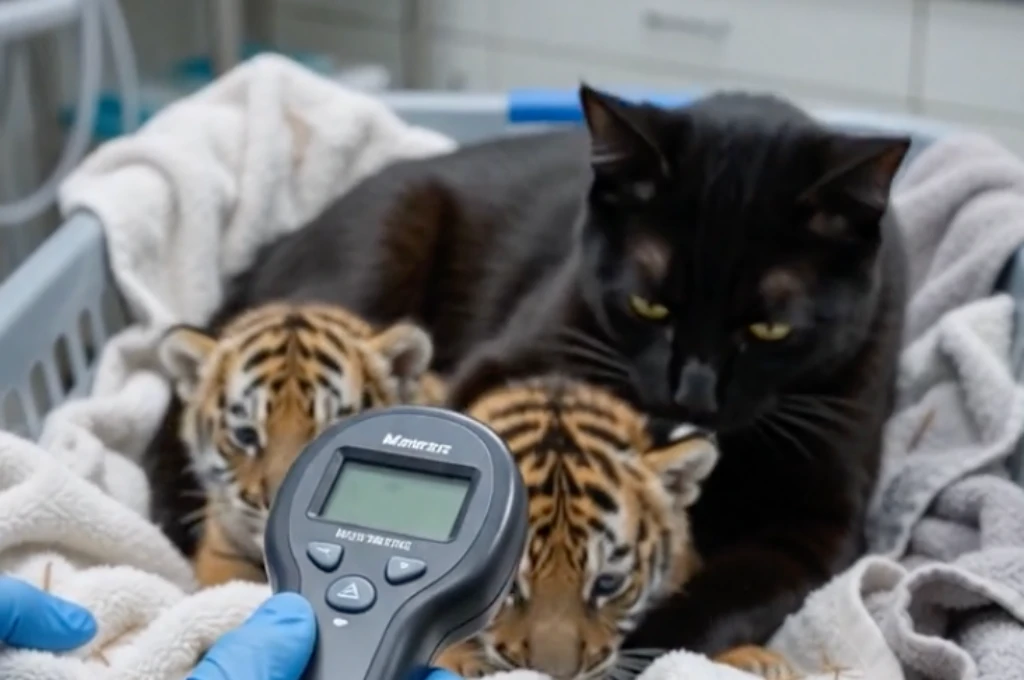
The cat turned. She climbed onto the pad, folded herself beside the cubs, and began scrubbing mud from the female’s forehead with hard, practical strokes of her tongue. The little body stopped shaking. The male pushed his nose under Cricket’s chin, and she hooked one black foreleg over his back without interrupting her work.
Sadie pressed both hands to her mouth. Kate’s shoulder touched Owen’s, not quite an embrace and not an accident.
“She knows they’re babies,” Sadie whispered.
“She knows they need cleaning,” Elise said. Her voice was brisk, but she turned away to give herself a moment at the counter. “Let’s not assign her a philosophy.”
Owen should have been calling the state animal health office and the federal wildlife agent whose number he could still recite. Instead he watched the female cub’s paw relax against Cricket’s side. Delilah had relaxed that way once, near the end, when Owen laid his hand between the old tiger’s shoulders. He had mistaken trust for permission to keep trying.
He forced his attention to the broken kennel pieces Kate had brought from the culvert. A shipping label clung beneath the handle, scraped nearly blank. Only three words remained readable under the mud: RUSK WILD COUNTRY.
The roadside menagerie sat four miles upstream. Its owner had surrendered nine adult cats the previous winter after losing his exhibitor’s license. Owen had helped inspect two transport trailers, then refused the job when he learned who owned them. He had driven past the locked gate since and accepted the quiet as proof that the place was empty.
He called Deputy Lena Ward. Elise called the state. By eight, the clinic lot held two official vehicles and no one was saying the cubs belonged to anybody.
At half past eight, a woman in a wet canvas coat appeared at the side door. She was in her sixties, limping badly, with blood dried along one wrist. In one hand she carried a grocery sack full of feeding bottles. In the other, she held a black stuffed cat no longer than Owen’s forearm. She saw the cubs through the isolation-room window and folded against the doorframe in relief.
“My name is Jo Bell,” she said. “I kept them alive after their mother died.” Her eyes went to the road behind her. “Dale Rusk is coming. He has papers, and he’ll tell you those babies are his.”
Cricket lifted her head from the warmed pad. Jo tightened her grip on the stuffed cat. “If you let him through that door,” she said, “you won’t see either one alive again…”
To read the rest of the story – CLICK the NEXT button 👇👇👇