


The first thing I saw was a red balloon dragging its ribbon through spilled french fries. It bumped an abandoned stroller, caught under one wheel, and stretched toward the hand of a little boy whose father was carrying him into the gift shop. Beyond it, in the middle of Stonebridge Zoo’s main plaza, a male lion walked with his head low and his mane lifting in the May wind.
For half a second, the plaza held still. Then a woman pulled two children behind a lemonade cart, somebody knocked over a rack of postcards, and the glass doors of the gift shop slammed shut on a crowd of faces gone pale.
Scout did not look at any of them.
He was twelve years old, close to four hundred and thirty pounds, and strong enough to make every distinction I had learned in sixteen years of carnivore work feel dangerously academic. He was not stalking. His ears were forward, not flat, and his tail hung low instead of lashing. None of that made him safe. It only meant he had not yet decided the noise around him required a response.
He was following something on the ground.
I pressed the transmit button on my radio. “Lion out in Main Plaza. Initiate full guest shelter. Lock the public perimeter and stop traffic at the north service entrance. Dr. Shah to mobile response.”
The channel filled at once—questions, door locations, somebody calling for a child separated from his mother. Beneath the voices, the evacuation alarm kept giving its broken three-note bleat from the renovation corridor behind the lion building.
An hour earlier, Talia Greene had stood beside the rear shift gate with one hand on its steel frame.
“Listen,” she had said.
She was twenty-eight, a keeper for four years, and better at hearing machinery than anyone on my team. She opened the gate six inches, closed it, and waited. The latch struck with a flat clack instead of the deeper double sound it usually made when the pin seated.
The contractors had disconnected the position sensor while they replaced a section of conduit. I pulled hard on the handle. The gate held.
“It needs a second check,” Talia said.
“The truck is at North Delivery, and we’re already late on meds.” I pulled once more, harder. “It’s seated. Flag it for maintenance and we’ll check it together after unload.”
She did not argue. She looked at the latch, then at me, and went to meet the produce driver.
After sixteen years, I had become good at making a temporary decision sound like a finished one.
Now Scout crossed the plaza while my keys struck my hip and the radio shook in my hand. The alarm had driven staff from the work corridor. The produce truck had been halfway through the outer service gate. Somewhere inside that layered failure, the shift latch had lifted under Scout’s weight.
He paused beside a drinking fountain. The ridge of old bone above his right wrist showed when he leaned forward, nose barely an inch from the concrete. The injury had been in his records since his arrival as a yearling. In winter he favored it; in summer he used it without apology.
A child cried inside the gift shop. Scout raised his head, and every muscle along his shoulders changed. I moved sideways into his sight line without approaching him directly.
“Easy, Scout.”
His amber eyes found me. I was part of his routine—the man who checked the pads of his feet, hid meat inside cardboard barrels, and knew which scrape of a shift door would bring him in from the rain. Recognition was not affection, and routine was not obedience. Still, his ears turned toward my voice.
Then he looked past me toward the north passage.
That morning, an older woman in a blue cardigan had stood at the open-air rail above Scout’s habitat. I had noticed her because she did not raise her phone. She held a battered green album against her chest and watched him sleep on the shaded ridge.
When Scout rolled onto his side, the woman gripped the railing. “That leg,” she said.
I was on my way to the service corridor, already irritated by the disabled sensor and the delivery delay. I slowed because her voice sounded less surprised than hurt.
“Excuse me,” she said. “Did he come from a clinic outside Otjiwarongo? He would have arrived here about eleven years ago.”
Visitors often believed they recognized animals from television clips, old calendars, or sanctuaries they had once toured. I gave her the answer I used when I could not stop to untangle hope from fact. “Guest services can submit a records request for you.”
“His name was Scout.”
That made me turn. Our lion’s transfer records were not posted on the exhibit sign, but his name was.
She opened the album. On the first page was a faded photograph of a tawny cub inside a laundry basket, one front leg wrapped in white bandage. Before I could look closely, my radio sounded with Talia’s call from the shift corridor.
“I’m sorry,” I told the woman. “I have to go.”
She closed the album. A younger woman beside her—her granddaughter, I assumed—put a hand under her elbow. As they walked toward the north garden exit, I heard the younger woman tell her to wait on the park bench while she brought the car around.
Scout was moving toward that same passage now.
“North Delivery,” I said into the radio. “Close the outer gate.”
Talia answered, breathless. “Truck is still across the threshold. Driver’s pulling forward.”
“Don’t get between the vehicle and the wall. Clear the yard.”
Scout passed the shuttered snack kiosk and entered the service lane. I followed far enough behind not to drive him forward. At the loading dock, he brushed his mane against stacked produce crates, stepped around the idling truck, and slipped through the gap before the outer gate could close.
The north lane was a narrow strip of pavement between the zoo fence and a line of maple trees. It ran less than a quarter mile to Hawthorn Park, but there were houses on one side and a daycare beyond the next intersection. A delivery driver froze with one boot on his running board. Two teenagers dropped their bicycles and climbed onto the hood of a parked car.
Scout ignored them. He tested the air, moved to the grass beside the curb, and continued toward the park with the uneven rolling stride the old injury gave him.
I called county dispatch from my phone because the zoo channel had become useless. I gave them the route, the animal’s weight, and the one thing that mattered most.
“He has not threatened anyone. Stop traffic, keep sirens back, and do not chase him toward the houses.”
“Do you have chemical immobilization?” the dispatcher asked.
“Our veterinarian is coming. It takes time to work, and he can cover a lot of ground before it does.”
At the edge of Hawthorn Park, Scout stopped. The pigeons under the old oak tree rose before I saw why, their wings beating hard enough to sound like cloth snapping on a line.
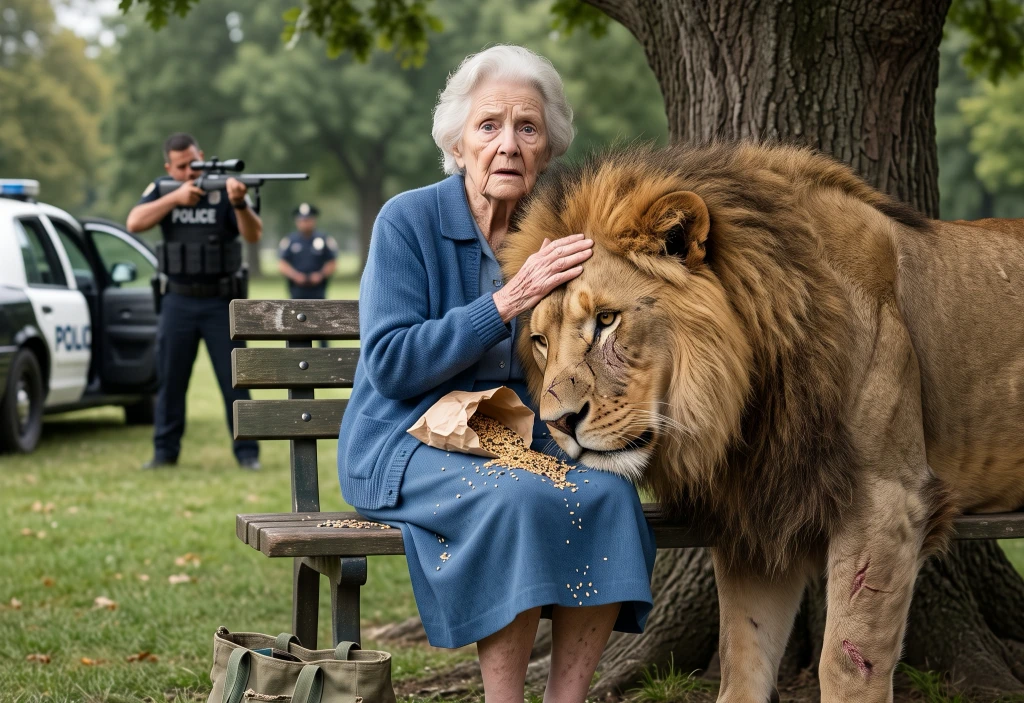
The woman in the blue cardigan sat on the bench beneath them.
Her green album lay inside a canvas tote by her sensible brown shoes. A paper sack of birdseed rested in her lap. She looked up as the pigeons cleared the branches, saw the lion thirty feet away, and went completely still.
I wanted to shout, but a frightened person running from a lion can change the meaning of a scene in one step. I slowed and raised one hand, though I had no reason to think she was looking at me.
Scout entered the grass. On pavement he had seemed impossible, an animal cut from another landscape and laid over ours. Under the oak, his paws made no sound. His head rose, and his nostrils widened.
The woman’s fingers closed around the paper bag. Seeds spilled across her skirt.
“Scout?” she said.
He stopped four feet from her knees.
She made a quiet sound then—not a word, but two low notes with a pause between them. Scout’s ears tipped forward. He took the last steps slowly and lowered his great head until the scarred side of his face rested across the blue wool in her lap.
A rifle bolt moved behind me. “Keeper,” a police sergeant said, “if that cat comes up on her, we fire…”
To read the rest of the story – CLICK the NEXT button 👇👇👇