


The tire stood up in the weeds and walked. Kate Rourke hit the brakes so hard that the veterinary truck shuddered on the rutted service road. Beyond the locked back gate of Briarwood Wildlife Park, a black tractor tire moved through waist-high bluestem in two slow, uneven jolts. Then a small gray head lifted above the grass, and Kate understood what she was seeing. The tire was around an elephant calf.
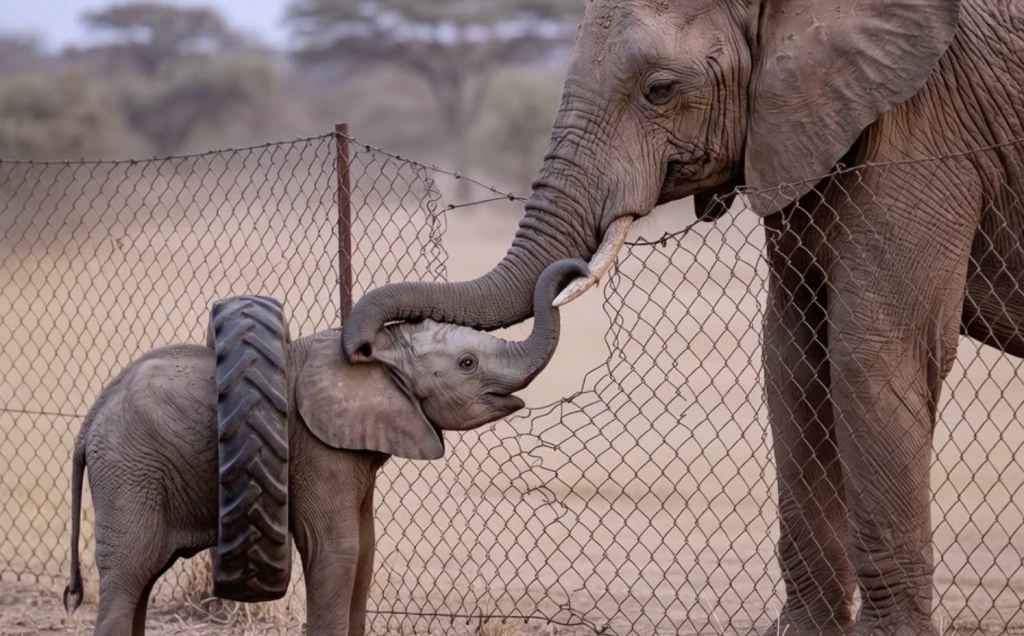
It sat behind the front legs and across the narrowest part of her body, canted lower on one side. Mud had dried in the tread. The calf took another step, stopped when the rubber dragged, and stood with her trunk hanging as if even the weight of that had become negotiable.
Kate was out of the truck before she remembered to take the keys. Heat pressed through the soles of her boots. She had followed the location signal from her daughter’s phone seven miles down a county road and another mile past Briarwood’s chained entrance, angry enough to rehearse the entire drive home in her head. Molly was seventeen, not seven. She knew the park had been closed to visitors since March. She knew Kate had forbidden her to come here alone.
Then Kate saw the red bandanna tied around a wrist inside the outer pen.
“Molly.”
Her daughter turned. She was crouched beside a dented feed pan with a gallon jug in her hand, her dark braid pasted to the back of her shirt. Alarm crossed her face, followed by the quick, flat look she had learned during the year since her father died—the look that meant she had already built a wall and was waiting for Kate to hit it.
“Keep your voice down,” Molly said.
Kate stopped at the gate. Ben’s old front-gate key, square-headed and worn smooth, still hung on her ring beside the clinic key and his house key, which she had not yet been able to remove. She did not use it. A newer chain had been wound twice through the bars, and Wade had added a silver padlock the old key would not fit.
“Come out,” Kate said. “Now.”
“She hasn’t had enough water.”
“You are inside a closed wildlife park with an adult elephant somewhere I can’t see.” Kate kept her tone low because Molly was right about the noise, not because the argument was over. “Set the jug down and come to the gate.”
The calf turned at the sound of Kate’s voice. Kate saw the points of her hips and the shallow motion along her ribs. She knew that face. Clover had been born on a wet May morning while Ben sat in the straw outside the maternity stall and called Kate every forty minutes, pretending each update was medically necessary. The park had sold green-frosted cupcakes that weekend. Molly, sixteen then, had slept in the keeper’s office so she could be there when the calf first followed her mother into sunlight.
Clover no longer looked like the round-bellied animal in those photographs. She looked reduced around the tire, as if the rest of her had been spending itself to survive what the rubber would not permit.
“Molly,” Kate said again, but the order had lost its clean edge.
“I put the pan under the bottom rail. She comes when I back away.” Molly rose carefully and retreated toward an overturned feed cart. “If I leave now, she won’t try again until dark.”
Kate watched Clover reach for the water. The tire stopped her from bending far enough. She spread her front feet, tried once more, and caught the rim of the pan with the tip of her trunk. Most of the water sloshed into the dust.
Veterinary judgment arrived before grief, anger, or common sense could stop it. Kate noted the sunken temples, the dry skin, the tremor in the front legs. Clover’s breaths were too quick for an animal standing still. Along the lower edge of the tire, flies gathered and lifted in a dark shimmer.
“How close can you get?” Kate asked.
Molly glanced at her, suspicious of the change. “Close enough to pour. I don’t touch the tire.”
“Good. Don’t.” Kate took two more water jugs from the rack behind the truck seat. She set them beside the gate and held out her hand. “You have the inner key?”
“Uncle Wade gave it to me.”
That answer carried its own argument, but Kate put it aside. “Open only this gate. Then lock it behind me.”
“You just said—”
“I know what I said.” Kate looked toward the cedar trees beyond the second enclosure. Nothing moved there, but an elephant did not have to be visible to be near. “Where is Ruth?”
“North pen. The transfer gate is between them.”
“Does it hold?”
Molly looked at the ground.
“That wasn’t a difficult question.”
“Most days.”
Kate nearly ordered her out again. She could call the sheriff, call the state veterinarian, call anybody whose authority would keep her from stepping back into the place she had spent fourteen months refusing to see. Clover swayed in the heat and made the decision smaller.
Molly unlocked the narrow keeper gate. Kate entered with the water and waited until the bolt dropped behind her. Briarwood smelled the same underneath the neglect: sun-warmed hay, old manure, iron-rich soil, and the faint sweetness from the mulberry tree Ben had planted where it had no business growing. The familiar mixture reached her before she could defend herself against it.
“Don’t go straight at her,” Molly said. “She follows if you walk past.”
Kate looked at her daughter. “You’ve been doing this often enough to have a method?”
Molly picked up the pan. “Do you want to fight now, or do you want her to drink?”
It was the kind of sentence Kate would have punished for its tone a year earlier. Instead she carried the jugs toward the shade cloth, moving parallel to Clover and keeping her shoulders turned. Molly slid the pan into a shallow depression where the calf would not have to bend as far, then poured.
Clover watched them. One ear gave a tired flap. When Molly backed away, the calf shuffled forward, braced her front feet, and lowered her trunk. This time she found the water.
She drank without hurry. That frightened Kate more than thirst would have. Clover did not gulp or splash; she curled her trunk around each mouthful and paused before reaching for another.
A vibration passed through the ground.
Kate felt it in her knees before she heard the low note from behind the cedars. Clover lifted her head with water dripping from her trunk. Molly put down the empty jug.
“That’s why she came,” she said. “Ruth calls around sunset.”
Branches separated beyond the inner fence. The adult elephant stepped into view so quietly that her size seemed like a mistake in the landscape. Ruth’s left ear had the small crescent notch Kate remembered. Dust silvered her back, and the hollows above her eyes were deeper than they had been the last time Kate examined her.
Ruth did not look at Kate. She went to the transfer gate and threaded her trunk through a place where two steel bars had been pulled apart. Clover turned toward her, but the tire forced her to take the distance sideways, one dragging step at a time.
Molly began speaking in the unremarkable voice people used while folding laundry. She told Ruth there was water. She told Clover the flies were bad and the Cardinals had lost again. She said Kate’s name once, without calling her Mom, as if presenting a fact the elephants could decide how to use.
Clover reached the fence. The tips of the two trunks met through the bars.
Ruth explored her calf’s mouth and face, then moved down to the tire. Her touch changed there. She followed the upper curve, paused at the packed mud along the underside, and made a low sound that seemed too large to come from one body.
Kate had heard elephants rumble in greeting, warning, impatience, and grief. She would not pretend to translate this one. She only knew Ruth had touched the same place before.
“She brings hay after dark,” Molly said. “She pushes it through that gap. Clover can eat if she keeps her head up.”
Kate crouched several feet away. Clover’s tail flicked, exposing a wet line beneath the rubber. The smell reached Kate then—infected tissue, old debris, skin that had been denied air. She set down the jug and pulled on gloves, but she did not reach for the calf.
“Molly, get behind the cart.”
“She knows me.”
“Behind it. Please.”
The last word made Molly obey. Kate waited until Ruth’s trunk returned to Clover’s cheek, then moved close enough to see under the lifted edge of rubber. Hair had been rubbed away in a band. Swollen flesh pressed into the tire’s inner wall, and one narrow channel oozed where every breath shifted the pressure.
Kate’s first thought was clinical: restriction, infection, dehydration, compromised expansion of the chest. Her second was of a photograph Molly had sent months ago, a blurry gray shape with a black curve across it. Kate had opened it between two difficult farm calls and answered without enlarging the image.
Stay away from Wade’s equipment. That tire is one of their toys.
She stood slowly. Molly’s face had closed again.
“How long?” Kate asked…
To read the rest of the story – CLICK the NEXT button 👇👇👇