


The first motorcycle came through Ruth Harlan’s gate while her daughter was calling for the third time. Ruth had covered the phone with a dish towel, though the vibration still made the spoon jar chatter against the kitchen wall. Clare had already left two messages about the storm line crossing northwest Arkansas, as if seventy-four years beneath an Ozark sky had taught Ruth nothing. She had seen the black shelf of clouds gathering over the Boston Mountains. She had also seen the damp crescent spreading above her pantry door, and that was the thing she preferred not to discuss.
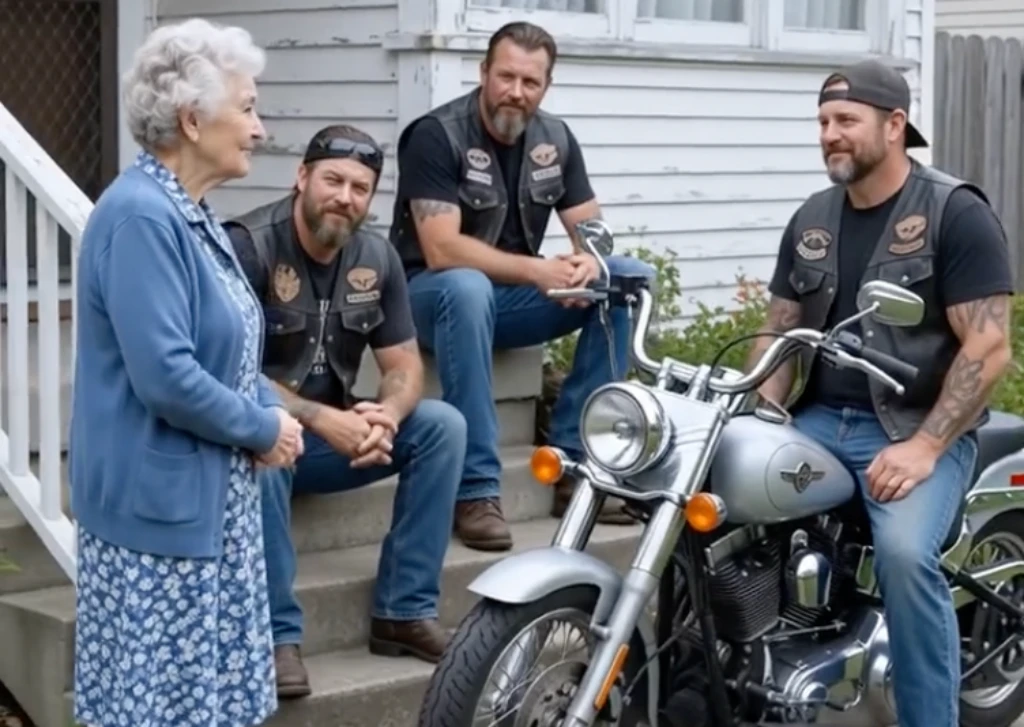
The motorcycle stopped short of the porch. Behind it, more headlights curved off Highway 7—three, then six, then so many that their beams crossed in the dust. Wind turned the silver undersides of the maples toward the road.
Ruth stepped outside before anyone could knock. The screen door dragged over the porch boards and stayed crooked behind her.
The lead rider took off his helmet. He was around sixty, big without being heavy, with gray hair pressed flat at the temples and a face browned above a pale line where sunglasses usually sat. A black crow flew over a green ridge on the back of his vest. CROW RIDGE RIDERS was stitched above it.
“Sorry to bother you,” he said. “Is the old church pavilion another mile south?”
“It is. Half the tin roof is in a pasture.”
He looked over his shoulder. The other twelve riders had gathered in the drive, trying to keep their bikes upright as the gusts struck from the west. The nearest thunder did not roll. It cracked.
“We’ll keep moving,” he said. “Just wanted to make sure.”
The first rain hit the porch roof in wide, hard drops. Ruth pointed around the house. “Ben’s equipment shed is out back. Put the motorcycles in close and come through the laundry room. Leave space beside the red mower or you’ll hear language neither of us wants.”
His eyes went to the broken corner of the second porch step, then to the bowed gutter above her. “There are thirteen of us.”
“Then one of you had better know how to count handlebars.”
He studied her for half a second, perhaps deciding whether kindness required another protest. Ruth had spent thirty-two years feeding middle-school children. She knew that look and had no patience for it.
“Yes, ma’am,” he said.
“My name is Ruth.”
“Wade Talbot.” He put on his helmet and turned toward the others. “You heard Ruth. Tight formation behind the house.”
They moved with surprising order. By the time the rain blurred the chicken-wire fence at the end of the yard, ten motorcycles were angled beneath the shed and three were secured under tarps along its lee side. The riders entered through the laundry room one at a time. Without being told, they left their boots on the concrete floor and carried their wet jackets over their arms.
Ruth had expected swagger, or at least noise. What came into her house was caution.
A woman with a long salt-and-pepper braid asked where she could hang a dripping jacket. A young man with a reddish beard moved the braided rug away from the door before it could soak through. Wade found the towel Ruth kept against the warped threshold and laid it flat, not folded, so the door could close over it.
“You’ve done enough,” he told Ruth. “We have food in the saddlebags.”
“Thirteen people can’t eat protein bars in my dining room while I have a stove.” She opened the freezer and began looking, not for what she lacked but for what would stretch. “Who can chop without taking off a finger?”
The braided woman raised a hand. “Marisol. Ten fingers as of this morning.”
“Keep them. Onion and squash, small dice.” Ruth pointed to the red-bearded rider. “You can open cans.”
“Ty,” he said.
“That isn’t a can-opening credential.”
“I worked three summers at a convenience store.”
“Marginally relevant. Rinse the beans.”
Someone contributed smoked sausage from a cooler. Another produced two bags of corn chips and a jar of salsa whose lid had not broken. Ruth browned ground beef in her largest pot, added tomatoes, beans, elbow noodles, and the last yellow squash from the garden. Wade tried twice to take the spoon from her. On the third attempt, she handed it over.
“Scrape the bottom,” she said. “If it burns, you eat that part.”
Outside, water began running brown along the low side of the yard. Inside, the kitchen filled with onion, damp denim, coffee, and the small courtesies of too many bodies in an old house. People asked before moving chairs. Phone flashlights pointed at the floor when the power failed, never into Ruth’s face. Ty fetched two battery lanterns from his motorcycle, and Marisol lowered the flame beneath the pot because Ruth’s gas range did not need electricity to keep working.
The dish towel buzzed again on the counter.
Wade glanced toward it. “Somebody worried?”
“Somebody in Little Rock with access to weather radar and too much imagination.”
“Family?”
“My daughter.” Ruth put the cast-iron trivet on top of the towel. “Stir.”
Wade did.
They ate wherever a person could fit: five at the dining table, three on the living-room floor, two on the bottom stairs, and the rest in mismatched chairs Ruth had stopped apologizing for years ago. She served herself last and took the chipped blue bowl that held less than the others.
Wade looked into it, then exchanged it for his.
“That one was mine,” Ruth said.
“I noticed.”
“Give it back.”
“No.”
The answer was plain, not gallant. Around them, the other twelve riders became fascinated by their food. Ruth sat with the fuller bowl rather than turn supper into a trial.
Rain battered the roof. Ty found a deck of cards in the drawer beneath the television and taught two riders a game whose rules changed whenever he began to lose. Someone recognized the upright piano as a Kimball and asked permission before lifting the fallboard. He played the opening of an old gospel song, missed a chord, and drew a correction from the woman on the stairs.
For a little while, the house sounded like it had when Clare was young and Ben’s crew came in at noon with sawdust in their hair. Ruth had forgotten that crowded rooms could make walls feel farther apart.
Then cold water struck the back of her hand.
She looked up from the stove. The damp crescent above the pantry had become a dark seam reaching toward the light fixture.
Marisol was beside her before she asked. She did not touch the center of the stain. She pressed two fingers near the wall and looked along the ceiling toward the rear of the house.
“How long has that been wet?” she asked.
“It leaks when rain comes from the west.”
“How many rains?”
“That seems like the same question dressed differently.”
Marisol’s expression did not change. “I design retaining walls and inspect damaged structures. I can’t tell you what’s above this ceiling without seeing it, but we need to move everyone out from under it.”
Ruth disliked the word need from strangers. She disliked the cold weight of the drop on her hand more.
Wade and Ty shifted the dining table into the living room. The riders carried their bowls without complaint, and Marisol set a bucket beneath the lowest part of the seam. Ruth had just reached for a second one when the plaster gave a wet, tired sound.
Wade caught her by the elbow and moved her through the doorway. A broad piece of ceiling struck the linoleum where the table had stood, broke along the edge of the bucket, and scattered pale green fragments across the floor. Dust lifted and settled on thirteen pairs of socked feet.
No one was hurt. That should have made the damage feel smaller. Ruth could only stare at the exposed wooden lath and the torn edge of paint she and Ben had chosen in 1992 because the clerk called it spring celery.
Marisol kept everyone back while two riders stretched plastic across the kitchen opening. Wade released Ruth’s arm as soon as she was steady.
“I know how to stand,” she said.
“I saw.” He did not apologize, which irritated her less than an apology would have.
They settled again in the living room. Ruth brought quilts down from the upstairs hall closet, one armful at a time, refusing Ty’s help on the stairs. Most had been made after Ben died, during the years when four in the morning lasted longer than the rest of the night. By midnight, riders lay beneath stars, pinwheels, and crooked wedding-ring patterns from the piano to the front door.
Wade took the patch of floor nearest the entrance. Ruth was carrying the last quilt past the pantry when she noticed him looking at the steel framing square hanging beside the shelves.
The tool had not been useful in years. Rust freckled the long edge, and one corner was scarred from a fall off a roof. B. HARLAN had been stamped near the heel. Ben’s thumb had worn the metal smooth beneath the B.
Wade did not reach for it. He stood very still, his reserve gone in a way that made him look younger and less certain.
“Ruth,” he said, “was Ben Harlan your husband…”
To read the rest of the story – CLICK the NEXT button 👇👇👇