


The euthanasia authorization lay beneath Dr. Ben Harlan’s coffee mug, unsigned and already marked by a brown crescent. At dawn, Elise Navarro found Daisy on the heated rubber floor of the quarantine barn. The twelve-day-old giraffe calf had folded her long legs beneath herself sometime during the night and no longer tried to lift her head when the bottle cart rattled past the gate.
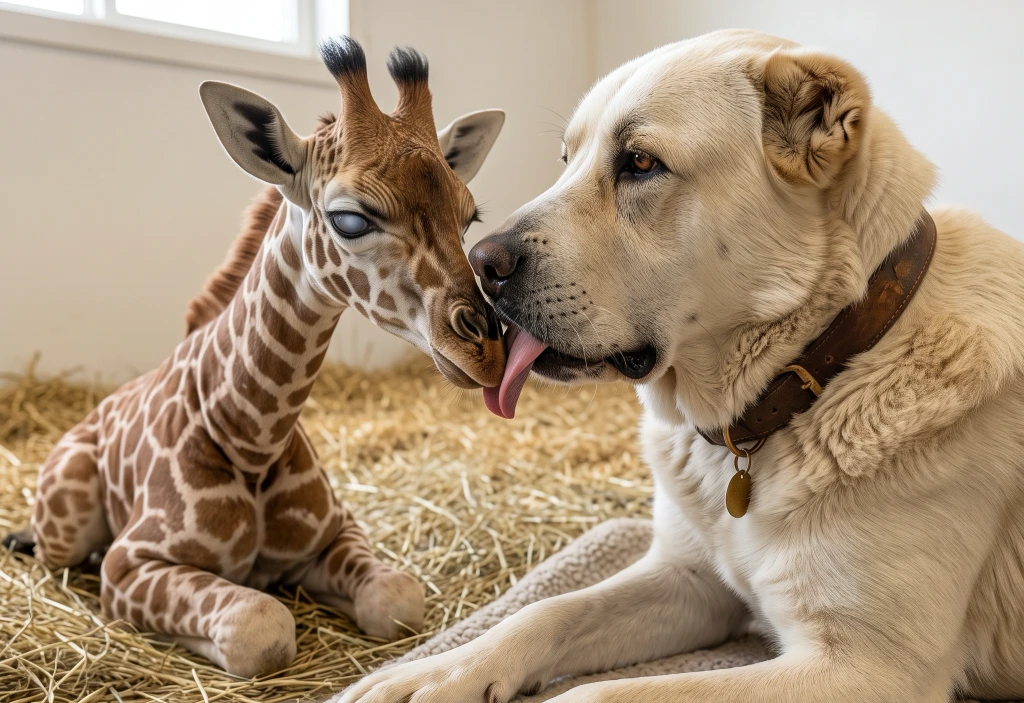
Elise stopped outside the stall and tapped twice on the floor.
“Daisy. I’m coming in.”
One of the calf’s ears turned toward her. Nothing else moved.
Elise entered slowly and rested a hand against Daisy’s neck. Her coat felt cool. Both eyes remained open beneath a milky web of scar tissue, but they followed neither movement nor light.
The infection had begun before Daisy arrived at the Panhandle Wildlife Recovery Center. County officers had found her at a failing roadside animal park west of Odessa, five days old and stumbling beside her mother, Pearl, whose water trough had been dry long enough for dust to collect beneath the valve.
Pearl died during the first night of transport.
The ophthalmologist saved Daisy’s eyes from rupturing, but the damage to her corneas could not be repaired. She would never see.
Blindness did not decide whether an animal could have a worthwhile life. Ben had worked with animals that mapped their enclosures through smell, vibration and memory. The harder problem was that Daisy had stopped participating in her own survival.
She had refused five feedings. Fluids kept her kidneys working, and dextrose kept her blood sugar from falling through the floor, but neither could replace milk for long.
Ben arrived while Elise was checking the catheter taped to Daisy’s leg. He listened to the calf’s heart and pressed a thumb against her gums.
“Did she stand overnight?”
“Not since two.”
“Any interest in the bottle?”
“She smelled it.”
“That wasn’t what I asked.”The euthanasia authorization lay beneath Dr. Ben Harlan’s coffee mug, unsigned and already marked by a brown crescent.
At dawn, Elise Navarro found Daisy on the heated rubber floor of the quarantine barn. The twelve-day-old giraffe calf had folded her long legs beneath herself sometime during the night and no longer tried to lift her head when the bottle cart rattled past the gate.
Elise stopped outside the stall and tapped twice on the floor.
“Daisy. I’m coming in.”
One of the calf’s ears turned toward her. Nothing else moved.
Elise entered slowly and rested a hand against Daisy’s neck. Her coat felt cool. Both eyes remained open beneath a milky web of scar tissue, but they followed neither movement nor light.
The infection had begun before Daisy arrived at the Panhandle Wildlife Recovery Center. County officers had found her at a failing roadside animal park west of Odessa, five days old and stumbling beside her mother, Pearl, whose water trough had been dry long enough for dust to collect beneath the valve.
Pearl died during the first night of transport.
The ophthalmologist saved Daisy’s eyes from rupturing, but the damage to her corneas could not be repaired. She would never see.
Blindness did not decide whether an animal could have a worthwhile life. Ben had worked with animals that mapped their enclosures through smell, vibration and memory. The harder problem was that Daisy had stopped participating in her own survival.
She had refused five feedings. Fluids kept her kidneys working, and dextrose kept her blood sugar from falling through the floor, but neither could replace milk for long.
Ben arrived while Elise was checking the catheter taped to Daisy’s leg. He listened to the calf’s heart and pressed a thumb against her gums.
“Did she stand overnight?”
“Not since two.”
“Any interest in the bottle?”
“She smelled it.”
“That wasn’t what I asked.”
“No.”
Elise rarely softened an answer for him. It was one of the reasons he trusted her.
Rebecca Shaw, the center’s operations director, waited in the aisle with a folder held against her chest. Everyone called her Beck except people asking for money or permission.
“The board meets at four,” she said.
Ben kept his eyes on Daisy. “Then they can meet.”
“They want your recommendation.”
“They have my medical report.”
“They want the sentence at the bottom of it.”
Daisy’s ear moved when Elise shifted her boot. The calf’s body remained slack.
Ben had signed plenty of euthanasia authorizations during twenty-four years of wildlife medicine. Sometimes the decision was obvious and mercy arrived as certainty. More often, it came down to a line only the people in the room could see: the place where treatment stopped serving the animal and began serving the humans who could not bear to quit.
He was afraid Daisy had reached it. He was equally afraid that exhaustion had made the line look closer than it was.
“Tomorrow morning,” he said.
Beck’s mouth tightened. “You asked for yesterday.”
“Give me until ten.”
“For what?”
Ben looked at the bottle standing in its warming pail. “I don’t know.”
“That’s a feeling, not a treatment plan.”
“If her breathing changes, if the kidney values worsen, if Elise sees pain we can’t control, we don’t wait. Otherwise, ten tomorrow.”
Beck set the folder on the feed cabinet. “Ten. If you try something outside the usual plan, write down what would make you stop.”
“You think I’m about to improvise?”
“I’ve worked with you for fourteen years.”
An hour later, Ben listened to a voicemail he had ignored the previous evening.
It came from Marcy Lowell at a county shelter north of Amarillo. Ben sometimes handled surgeries their small clinic could not manage, and Marcy had been trying to get his opinion on an old livestock dog.
Her second message was shorter.
The dog still hasn’t stood. Call me before we lose him.
Ben called.
“I’ve got a Central Asian shepherd, maybe eleven,” Marcy said. “Owner died three weeks ago. The injuries are healing, but the dog’s disappearing on us.”
“What injuries?”
“Raw paw pads, dehydration, some heat stress. Nothing that explains this.”
“What does disappearing mean?”
“He eats if I sit inside the kennel and put food under his nose. Won’t walk. Won’t look at the other dogs. Spends all day facing the service entrance.”
Ben glanced through the clinic window toward the quarantine barn.
“How did the owner die?”
“Stroke in a pasture. The ranch hand found him the next morning. Dog was lying against his back.”
“And he stayed there all night?”
“Closer to twenty hours.”
Ben closed his eyes briefly.
“What’s his name?”
“Boone.”
The shelter’s quiet ward smelled of disinfectant, wet concrete and the cooked chicken Marcy used for frightened dogs. Boone occupied the last kennel. Even curled on a raised cot, he looked too large for the room.
His coat was cream-white beneath the stains that remained around his legs. One ear bore an old split, and a scar slanted across his muzzle. He opened his eyes when Ben entered but continued watching the door behind him.
“His owner was Wade Ramsey,” Marcy said. “Raised sheep outside Dumas. Boone worked with him since he was a yearling.”
“Family?”
“Daughter in Austin. Nora. She surrendered him because she couldn’t keep him in an apartment. He broke a window trying to get outside the first night.”
Boone’s shelter record showed current vaccinations, negative screening tests and arthritis controlled well enough for ordinary movement. His body could recover. The question was whether he had any reason to use it.
Ben crouched several feet from the cot.
“Boone.”
The dog’s eyes moved toward him, then returned to the service door.
Ben reached into his medical bag and removed a sealed pouch. Before leaving the center, he had asked Elise to collect Daisy’s scent on sterile cotton while changing the padding beneath her neck. The sample had left through the disposal side of quarantine and would not return.
Elise had handed it over without asking what he intended to do. She had only warned him not to mistake curiosity for consent.
Marcy watched him open the pouch.
“Is that from the giraffe?”
“Yes.”
“That is not a sentence I expected to hear today.”
Ben placed the cloth on the floor without pushing it toward Boone.
The dog’s nostrils moved.
His head rose an inch. He drew another breath, longer this time, and looked away from the service door.
Boone did not leap up or wag. He examined the cloth from across the kennel as if it belonged to a problem he had not yet decided to solve.
Then he unfolded himself from the cot.
His hind legs shook. He stood with his back rounded until the joints loosened, crossed the kennel and lowered his nose over the cotton.
When Ben reached for the pouch, Boone covered the cloth with one paw.
Marcy leaned against the gate. “That’s the first thing he’s asked to keep.”
Boone smelled Ben’s sleeve, found another trace of Daisy and walked to the kennel door. He waited there with his broad head level and his weight shifted forward.
Ben called Beck.
She listened without interrupting.
When he finished, she said, “You want to bring a grieving guardian dog into wildlife quarantine.”
“Outside quarantine. Separate corridor, solid door, no contact.”
“Based on him smelling one piece of cloth.”
“Based on two animals who still respond to another animal when they’ve stopped responding to us.”
“They have never met.”
“That may be why it works.”
She was quiet long enough for him to hear typing.
“Marcy sends every health record before you leave. He gets a full exam and bath there. Separate handlers, separate equipment, and the dog stays in the unused recovery room outside the inner hygiene barrier. One supervised exposure.”
“Agreed.”
“If either animal shows distress, it ends.”
“Agreed.”
“And this is not approval for whatever you think of during the drive.”
By the time they reached the center, the sun had gone down behind the flat Texas horizon. Boone rode in a secured transport crate. He remained lying down until Ben opened the rear doors and the dry air carried the scent of hay, manure and unfamiliar animals across the service yard.
Then he stood.
Elise waited in clean coveralls near the unused recovery room.
“He’s smaller than I expected,” she said.
“He weighs a hundred and sixty-eight pounds.”
“I expected more dog around the weight.”
Boone came down the ramp carefully. He surveyed the roofs, gates and fence lines before lowering his nose toward the ground.
Daisy’s barn stood fifty yards away.
Boone turned toward it.
They brought him only as far as the outer service corridor, where a solid steel door and a second locked barrier separated him from Daisy’s stall. Ben held the leash. Elise watched the calf through the observation window.
Boone approached the door and smelled the narrow gap beneath it. His nails scraped once against the concrete.
Inside, Daisy lifted her head.
Elise looked at Ben. “Again.”
No one moved Boone. After several seconds, he shifted his front feet.
Scrape.
Daisy’s nostrils widened.
Boone lowered himself beside the door. His chest struck the floor with a dull, heavy sound. He exhaled through his nose, a low rush of breath that vibrated faintly against the metal.
Daisy turned her muzzle toward him.
Elise entered from the opposite side, tapping twice before she crossed the stall. She raised the warm bottle but did not press the nipple between the calf’s lips.
Daisy smelled it and turned away.
Boone breathed against the bottom of the door.
The calf turned back. Her mouth found the nipple. She held it without sucking, released it, then searched again.
Her tongue curled.
She swallowed.
Elise’s hand tightened around the bottle, but her voice remained level. “Easy, Daisy.”
The calf swallowed again. She drank only a few ounces before stopping, yet she kept her head raised after Elise removed the bottle.
Boone shifted on the concrete.
Daisy gathered one front leg beneath herself.
Ben moved closer to the monitoring screen. Her heart rate climbed but remained steady.
She brought the other leg forward, rocked once and pushed.
For one long second, her chest hovered above the mat. Then, with no sling and no hands beneath her, the blind calf stood…
To read the rest of the story – CLICK the NEXT button 👇👇👇