


The left wheel of the game cart struck a root, and James Mercer’s right shoulder knocked against the aluminum rail. Pain flashed white behind his eyes. He tried to tell Mary to stop, but the word tangled somewhere between his mind and his mouth. What came out was a wet, ruined sound that would have embarrassed him eleven months ago. Now it frightened him.
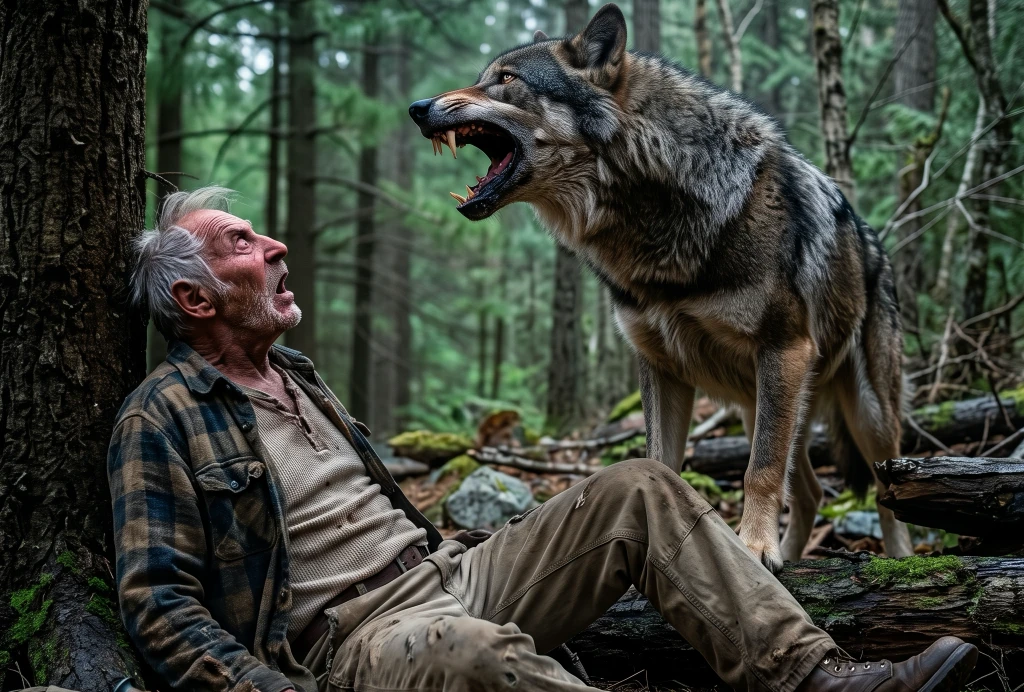
Mary kept pulling.
The cart had once carried elk quarters out of the mountains. James had ordered it after his knees began complaining on steep ground, then modified the handles in his shop, wrapping them in strips of saddle leather so they would not freeze to his gloves. He knew every weld and bolt. He knew, too, exactly how much weight it could bear.
He had never imagined the weight would be him. Above him, ponderosa branches moved against an October sky the color of old tin. Mary’s boots found the narrow spaces between roots without hesitation. She wore the brown work jacket she had owned since their cabinetmaking years, when she had mixed stains in coffee cans and kept customers from talking James into giving away a week of labor for the price of two days.
He lifted his left hand and struck the cart rail twice. Their signal meant no. Stop. Not that.
Mary’s shoulders tightened, but she did not look back. They had left the pickup nearly half a mile behind them, at the washed-out end of a private timber road above Cedar Vale. The old line cabin waited somewhere ahead. James could smell its country before he could see it: dry pine, cold stone, the faint mineral breath of Alder Creek below the ridge.
For one foolish mile in the truck, he had believed Mary was giving him something he had wanted. One last look, she had typed on his speech tablet that morning. Before the snow.
He had pressed YES with his left index finger.
The cabin had been theirs before the house, before Leah, before thirty-eight years of invoices and sawdust and arguments over whether walnut needed brass or black iron. James had built it when he was twenty-seven, using beetle-killed pine and windows salvaged from a schoolhouse. Mary had carried shingles up the ridge on her back because the road had washed out that summer. On the evening they finished the roof, they ate peaches from the can and slept on the bare floor beneath a quilt her mother had made.
Mary had laughed in the dark when a mouse ran over James’s boot. He could still hear that laugh. He had not heard it in years.
The trail bent around a granite shoulder. The cabin appeared below them, small and gray between the trees, its porch sagging toward the creek. The stovepipe leaned. One shutter hung by a single hinge.
Mary stopped the cart. For a moment neither of them moved. Wind scraped a pinecone across the roof.
“You wanted to see it,” she said.
Her voice was low from exertion. A damp strand of hair had come loose from her braid and adhered to her cheek. At sixty-six, she was still strong, but the strength had changed. Once it had been loose and capable, a strength that made room for other people. Now it seemed bolted into her bones.
James raised his left hand toward the speech tablet strapped across his chest. The screen stayed black.
He pressed the power button again. Nothing.
Mary watched him try. “I didn’t charge it.”
He looked at her.
“Maybe I forgot.”
She walked behind the cart and released the canvas strap across his waist. James grabbed the rail. His fingers had good strength, but one hand was not enough to control the slide when she tipped the frame. He landed on a folded moving blanket under the porch eave. His hip struck first, then the bad shoulder. Air left him in a grunt.
Mary crouched immediately. The reflex was so fast and familiar that hope leaped before he could stop it. She checked his head for blood, adjusted the twisted leg, and tucked the blanket beneath his neck exactly as the occupational therapist had taught her. Her hands were gentle.
Then she removed the dead speech tablet from his chest and slid it into a canvas daypack hanging from the cart handle. James caught her cuff.
“Let go.”
He held on.
“James.” Her face contracted. “Please don’t make this harder.”
He pulled her closer with the only arm that obeyed him and forced out a sound. “Hh—ome.”
It was not a clean word. It was barely a word at all. Mary understood it.
She sat back on her heels. Beyond her, the game cart rested on its side, one wheel turning slowly.
“Home,” she repeated. “You mean the place where I sleep in ninety-minute pieces? The place where I change your sheets at two in the morning and listen to you hit the rail because the pillow isn’t right?”
James’s grip loosened.
“The place where your daughter comes on Sunday with a casserole and a new suggestion, then drives back to her own life?” Mary rubbed both hands over her face. “The place where everyone tells me I’m doing an amazing job because that lets them go home?”
He wanted to say Leah had offered. Home aides. Respite. A short stay at the rehabilitation center when Mary’s back went out in August. He wanted to say Mary had refused some of it.
He also remembered his own answers. No stranger bathing me.
No hospital bed in the front room. No selling the shop tools.
No facility, not even for a week. He had delivered each refusal with his left finger against the tablet, furious at the body that made other people ask. Mary had stood beside him during those conversations, silent enough that he mistook silence for agreement.
She freed her sleeve from his hand and stood. From the cart she took a fleece blanket, a squeeze bottle of water, and two vanilla nutrition shakes. She arranged them within reach of his left hand. She even loosened the bottle cap.
The care in those small acts was worse than cruelty. It showed how carefully she had thought.
James struck the ground twice. No.
Mary stared at his hand. “You said you’d rather die up here than let us put you in a home.”
The sentence had been spoken six years earlier, after they visited Mary’s brother in a nursing facility outside Pendleton. Her brother had not known their names. The hallway had smelled of disinfectant and canned gravy. Driving home, James had said he would rather die at the cabin with the trees around him.
It had been a boast made by a healthy man who still believed dying would be a choice conducted on his terms. James shook his head so hard the branches blurred.
“You did.” Mary’s voice cracked. “I remember because I remember everything. Every pill. Every appointment. Which side to place the spoon. How many seconds to wait after you point at a letter. I remember all of it, James, and I can’t carry one more thing.”
He held his left palm open toward her. Wait.
That gesture had once meant many things between them. Hand me the chisel. Come look at this grain. Dance with me in the kitchen while Leah is asleep. Since the stroke, it meant only one: give me time to get the thought out.
Mary looked at the offered hand. For half a second, her own hand began to rise.
Then she stepped back.
“Leah scheduled another woman to come Monday,” she said. “Four hours. Four hours so I can sit in the grocery-store parking lot and cry where you won’t see me. Then the woman leaves and it starts again.”
James pointed at her, then at the road. You go. Get rest. I accept.
The thought was clear inside him. His body reduced it to two blunt motions.
Mary read something else—or chose to.
“Don’t order me home.”
She slung the daypack over one shoulder, then folded the cart’s pull handles against its frame. Metal clicked against stone.
James lunged with his left arm and caught the blanket under her boot. She stumbled. For an instant they were both on the ground, face-to-face, breathing hard. He saw the burst capillaries around her eyes, the yellowing bruise on her forearm where he had grabbed her during a transfer three nights ago. He had been falling. He had not meant to hurt her.
He remembered how she had said, It’s okay, though neither of them believed it. Mary pulled free and got to her feet.
“I was good to you,” she said, almost wonderingly. “I was. For a long time.”
James nodded. Tears slid cold into his ears.
Yes. Her mouth trembled. That single acknowledgment seemed to reach her more deeply than any accusation could have.
She turned away.
Her boots scraped up the trail. James listened until he could no longer hear them, then until a pickup door slammed far above the ridge. The engine started. It idled long enough for him to imagine her gripping the wheel, unable to move.
At last it receded down the timber road. James lay beneath the porch and watched afternoon drain from the trees.
The cabin door stood six feet away. Mary had left it open. Inside, he could see the iron woodstove, a cot frame without a mattress, and the worktable he had built from two-by-tens. Six feet was nothing. He had crossed joists narrower than his boot soles three stories above ground. He had carried sheets of oak plywood alone because asking for help took longer.
Now six feet might as well have been the county line.
He hooked his left heel against the earth and pulled. His shoulder screamed. The right side of his body dragged behind him, useless weight. He moved perhaps an inch.
He rested, tried again, and moved another.
By the time he reached the porch board, sweat had soaked the collar of his flannel shirt. The temperature was falling. Clouds massed over the Wallowas, turning the western light a bruised purple. If rain came before he got inside, the blanket would become another cold thing laid across him.
He reached for a post and missed. Something moved beyond the cabin.
Not a deer. A deer stepped lightly and paused between sounds. This was lower, deliberate. Brush whispered along an animal’s flank.
James stopped breathing. The first thing he saw was not the wolf itself but the eyes, pale amber beneath the trees. Then a gray muzzle entered the last of the light. The animal stood at the edge of the clearing, long-legged and narrow through the hips, its winter coat beginning to thicken along the shoulders.
It was larger than any coyote James had seen and far too still to mistake for a dog. The wolf tested the air.
James smelled his own sweat, the nutrition shake Mary had set beside him, and the sour edge of fear. He thought of every warning he had ever heard: do not run, do not crouch, do not offer food. The instructions had been written for a man who could stand.
He closed his fingers around the squeeze bottle. It was not a weapon, but it was the only object within reach.
The wolf took three steps into the clearing.
“Easy,” James tried to say.
Only the first vowel emerged, a breath shaped around an old word. The animal halted. It turned slightly, and the fading light caught its left hind leg. Above the paw, where gray fur should have lain smooth, a pale band circled the joint. James forgot the bottle in his hand. He knew that scar…
To read the rest of the story – CLICK the NEXT button 👇👇👇