


The forty bison had made a wall around Number Twenty-Seven. Tessa Ward saw it from the edge of the liquidation yard, beyond the coils of used fencing she had driven sixty miles to buy. The weakest cow stood in the center of the herd with her head low and one foreleg trembling. The older cows faced outward, shoulder to shoulder, while two young bulls watched every person who passed the pen.
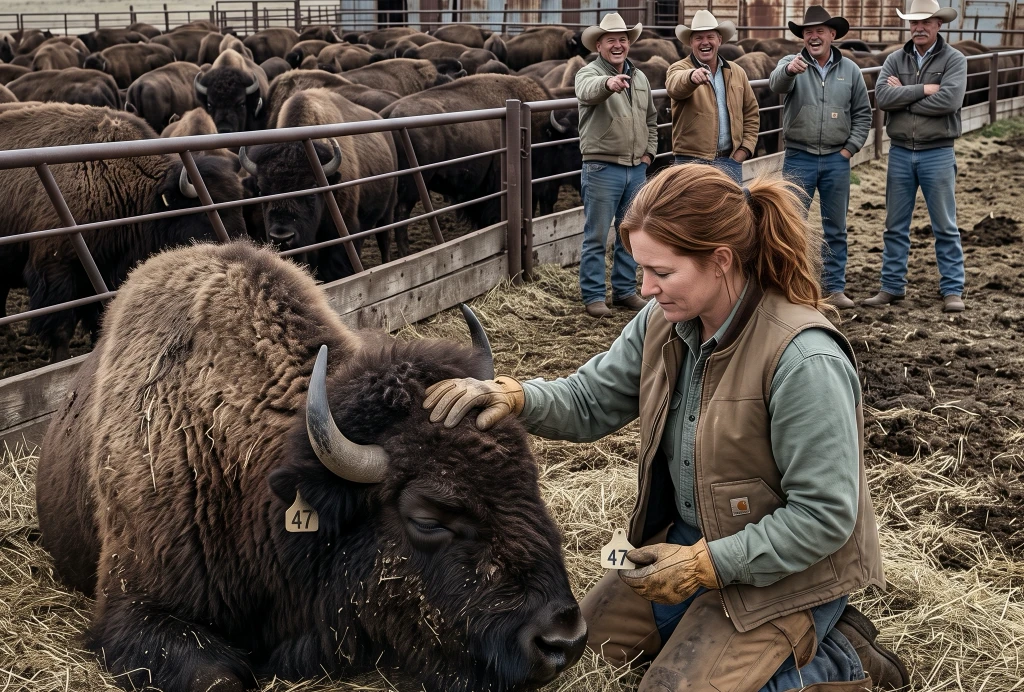
Everyone else saw ribs, dirty coats, and forty expensive ways to fail.
Tessa saw animals that were hungry but still organized.
“Mom,” Caleb said. “They’re selling the wire.”
Her twelve-year-old son stood beside her with his father’s weather notebook tucked beneath one arm. He had written thirty-one degrees at dawn, northwest wind, snow possible after dark. Since Daniel’s death, Cal recorded weather as if a careful enough list might keep the world from surprising them again.
“I know.” Tessa did not move.
Painted Mesa Wildlife Park had gone bankrupt at the end of October. The receiver was selling everything from feed troughs to office chairs, and the bison were the last lot nobody wanted.
The park’s identification and health records had collapsed along with its management. The state veterinarian had restricted the herd to a buyer who could move the animals into isolated pasture while their tags, testing, and ownership records were sorted out. They could not be sent directly through an ordinary livestock sale or to a processor.
Feeding forty thin bison through that holding period would cost more than most buyers expected to recover. If they remained unsold, the receiver would have to keep paying for their care or arrange for them to be humanely destroyed.
Either way, the animals had to leave Painted Mesa by noon the following day.
Tessa had spent six years inspecting rangeland for the county conservation district before Daniel persuaded her to help run Juniper Draw full-time. The old job had trained her to look beyond what land appeared to be in a bad season. Dormant was not dead. Neglected was not always ruined.
She walked closer to the pen.
The bison tracked her with clear eyes. Their hooves were overgrown in places, and one cow had a raw patch where a broken ear tag had rubbed, but Tessa saw no nasal discharge, no vacant staring, no animal standing apart in the manner of serious illness. They shifted when she moved, alert despite their condition.
Everett Sloan came up beside her. His ranch bordered Juniper Draw’s deeded ground on two sides and covered more country than Tessa could see from her highest ridge.
“Don’t,” he said.
She kept watching the animals. “I didn’t ask you.”
“You came for wire.”
“I’m aware of why I’m here.”
Everett rested both hands on the top rail. He was fifty-eight, broad through the shoulders, and careful with nearly everything except other people’s pride. During Daniel’s illness, he had hauled their cattle to market without charging mileage. Six months after the funeral, he had offered to buy Juniper Draw for less than its appraised value but enough to clear the mortgage.
Tessa had never decided which act revealed him more accurately.
“Your north pasture has old game fence,” he said. “The west stretch is patched horse wire. One frightened animal hits that, you’ll have twelve hundred pounds on the county road.”
“I know what my fence is.”
“Then you know it isn’t ready.”
The auctioneer’s speaker crackled. He asked for five thousand dollars for the entire herd. No paddle rose. He dropped to three, then two, then one.
Men who had spent freely on used tractors stared at their boots.
“Eight hundred,” the auctioneer called. “Forty head, one lot. Eight hundred dollars and they leave tomorrow.”
Tessa felt Cal turn toward her.
She raised paddle 47.
For one clean second, no one made a sound. Then laughter moved across the yard, beginning near the equipment buyers and spreading toward the folding chairs.
The auctioneer peered over his glasses. “You understand that’s eight hundred for the group, ma’am? Not eight hundred a head?”
“I understand.”
Everett stepped away from the rail. “Tessa.”
The warning in his voice only hardened something in her. She had spent two years hearing what a widow should sell, what a mother should avoid, and how much smaller her life ought to become now that Daniel was gone.
The auctioneer called for another bid. No one offered one.
The gavel struck the plywood table.
Cal looked at the bison, then at his mother. “You bought them?”
“We bought them.”
“No.” His voice remained quiet, which was worse than if he had shouted. “You bought them.”
The receiver handed Tessa a sheet of conditions. The purchase price was due immediately. Veterinary clearance, loading, transportation, isolation fencing, and feed were her problem. If the animals remained after noon the following day, the sale could be voided.
The eight hundred dollars had been the least expensive part of what she had done.
By dusk, Tessa had called everyone she knew who might answer. Jo Mercer, a livestock hauler with two commercial stock trailers, agreed to bring in her brother and make three runs. Dr. Sam Reddick, who had worked with bison before retiring from full-time veterinary practice, drove over to determine whether they could be transported safely.
Sam examined the herd from outside the handling alley before asking Painted Mesa’s former keeper to guide small groups through the chute.
“They’re malnourished,” he told Tessa. “That doesn’t mean you can pour grain into them. Good grass hay, small increases, clean water, minerals. We watch them closely.”
“How many are sick?”
“Three worry me. Maybe four. The rest have a chance.”
“A chance,” Jo repeated as she studied the loading gate. “That a medical term?”
“It’s the term I use when somebody buys forty bison without calling me first.”
Tessa accepted both rebukes. She had already emptied most of the ranch operating account to pay the haulers, veterinary costs, hay, and portable panels. The money had been meant for the aging well pump and the winter mortgage payment.
She told Cal they would manage.
He looked through the truck window at the first group of bison entering Jo’s trailer. “Is that true?”
“It will be.”
“That isn’t what I asked.”
Tessa tightened her hands around the steering wheel. Daniel had answered hard questions slowly, often while cleaning a tool or working a knot loose. Tessa answered them too quickly and spent the next hour regretting the shape of the words.
“Yes,” she said. “It’s true.”
Cal opened the weather notebook and wrote something she could not see.
Snow began before the final load reached Juniper Draw. The ranch owned one square mile of ground and held grazing leases across nearly four thousand adjoining acres. Tessa and Daniel had sold their cattle during his illness, leaving much of that range lightly used for two seasons.
Juniper Draw was modest by eastern Wyoming standards, but it was not a backyard pasture. In a normal year, it could support the herd if Tessa managed the grass carefully and continued providing hay during recovery.
The three-hundred-acre northern pasture was enclosed by six-foot game fence left from a short-lived elk operation decades earlier. It could satisfy the isolation requirement once its weak corners were repaired.
Tessa, Jo, and three neighbors worked under portable lights to close gaps and brace those corners with steel panels Everett sent from his ranch.
He arrived behind the flatbed carrying them.
“I need those back,” he said.
“I didn’t ask for them.”
“No, Jo did. She has better sense.”
Everett checked every connection himself. He showed Cal how to keep the wire spool from kicking loose without allowing him inside the enclosure, then sent the boy to place reflective markers along the outer gate.
Tessa resented needing him. She resented even more that he was useful.
Shortly after midnight, Number Twenty-Seven went down.
She was the cow that had stood inside the herd’s protective ring at the auction. Now she lay near the windward fence, breathing hard while snow gathered along the ridge of her back. The other bison formed a ragged crescent nearby, too unsettled to feed.
Sam instructed Tessa by phone. Keep the herd quiet. Block the wind. Offer water within reach. Do not force the cow up, crowd her, or give her rich feed.
Tessa and Jo secured two panels and a tarp into a windbreak outside the fence. By two in the morning, Jo had gone home to sleep before another hauling job. Tessa remained in the truck with the engine off, watching Twenty-Seven through the windshield.
Cal appeared on the porch wrapped in Daniel’s old canvas coat.
“Go inside.”
“I can sit in the truck.”
“You can watch from the kitchen.”
“It’s nine degrees.”
“I know what the temperature is.”
His face closed. “I thought you wanted my notebook.”
“I want you safe.”
He went back into the house without answering.
Tessa remembered Daniel talking to a frightened mare in this same pasture, his voice low and ordinary. He never promised an animal that nothing bad would happen. He talked about the gate hinge he meant to fix and what he wanted for breakfast, as though staying with a terrified creature mattered more than finding the right words.
Tessa lowered the window a few inches.
“You picked a miserable place to lie down,” she told the cow. “Wind comes straight off Nebraska and doesn’t pay rent.”
Twenty-Seven’s ear moved.
Tessa talked until her throat hurt. She described the standing grass beneath the snow and the cottonwoods that would leaf out along the creek in May. She told the cow about the rusted water tank Daniel had sworn he would replace and about a boy in the kitchen who worried in columns of numbers.
At four thirty, the wind eased. At five, Twenty-Seven brought her front legs beneath her and failed to rise.
Tessa did not move toward her. She kept both hands on the steering wheel and waited.
The second attempt brought the cow to her knees. On the third, she rose.
Twenty-Seven stood with her legs spread and her head hanging. The herd closed around her until only the ridge of her back remained visible.
Cal had returned to the porch. He did not cheer. He wrote down the time.
Sam arrived at first light. Everett came soon afterward to inspect his panels, carrying a thermos and two bales of the plainest grass hay Tessa had ever seen. Neither man commented on the fact that Twenty-Seven was standing.
As the cow moved toward water, a clump of dried mud broke from her left hip. Beneath the ragged winter coat, pale hair formed an old freeze brand: a diamond split cleanly down the middle.
Sam stopped walking. Everett’s thermos slipped a fraction in his hand before he caught it. Tessa looked from the mark to his face. “How much did you know before the auction…”
To read the rest of the story – CLICK the NEXT button 👇👇👇