


By the time the first motorcycle nosed through Evelyn Mercer’s gate, her daughter had called four times and the sky above the north Georgia ridges had turned the color of a deep bruise. Evelyn had tucked the phone beneath a folded dish towel, but each vibration still made the spoon jar tremble against the kitchen wall. Leah had left messages about wind speeds, flash flooding, and a line of thunderstorms crossing from Alabama—as if seventy-four years beneath a mountain sky had taught Evelyn nothing.
She knew a bad storm when she saw one. She also knew the brown stain above the pantry door had widened since the last rain.
That was the part she had not mentioned.
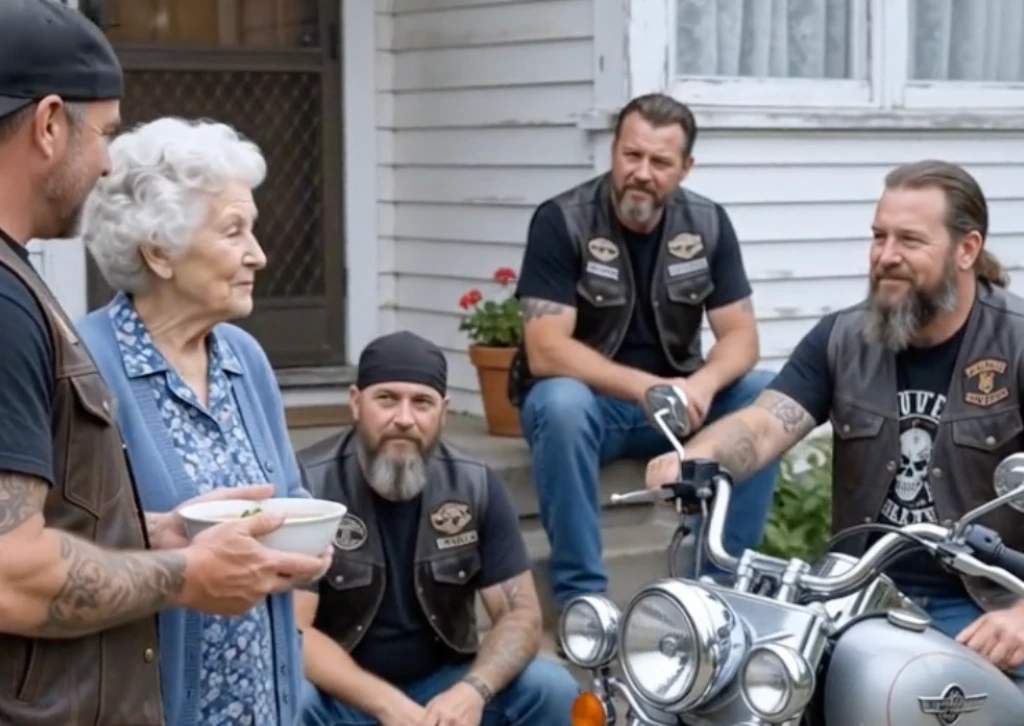
The motorcycle stopped in front of her porch. More headlights appeared along the county road, then curved through the gate behind it. Evelyn counted thirteen riders before the wind lifted dust across the yard and made counting unpleasant.
The lead rider removed his helmet. He was in his late fifties, broad through the shoulders, with gray at his temples and a pale strip across his forehead where sunglasses usually sat. His vest bore a patch of a lantern above a blue mountain road.
LANTERN RIDGE TOURING CLUB.
“Ma’am,” he called over the wind, “is the old church pavilion another mile east?”
“It is. A pine tree went through its roof last winter.”
He looked back at the riders clustered in her drive. The first drops struck the porch boards hard enough to leave dark circles.
“We’ll keep looking.”
Lightning opened above the ridge. Thunder followed without room for a breath between them.
Evelyn pointed toward the gravel lane beside the house. “There’s an equipment shed out back. Put the motorcycles in tight and come through the mudroom.”
The man glanced at the sagging gutter, the broken corner of her bottom step, and then at her.
“There are thirteen of us.”
“I counted. If you arrange yourselves as badly as you arranged those motorcycles, I’ll send half of you back into the rain.”
For a moment, he seemed unsure whether she was serious.
Then he smiled. “Yes, ma’am.”
“My name is Evelyn.”
“Cole Barrett.” He replaced his helmet and turned to the others. “Shed behind the house. Leave her mower room.”
They moved with an order she had not expected. Nine motorcycles fit beneath the metal roof. The others were rolled against the sheltered wall and tied beneath tarps. By then the rain had swallowed the fence at the far end of the garden.
The riders entered one at a time. Every one of them removed muddy boots on the concrete mudroom floor without being asked.
A woman with a thick silver-streaked braid carried wet jackets to the hooks beside the washing machine. A young man with a red beard rolled Evelyn’s braided rug away from the door before it soaked through. Cole flattened an old towel across the warped threshold so the door could close over it.
Thirteen strangers should have made the house feel invaded. Instead, they moved as though everything inside it might belong to someone who would notice if it were disturbed.
“We have food in the saddlebags,” Cole said. “You’ve already done more than enough.”
“Thirteen people are not eating protein bars in my living room while I have a stove.”
Evelyn opened her freezer and began taking inventory. A pound of ground beef. Two links of smoked sausage. Frozen tomatoes from the previous summer. Half a bag of corn. Enough, if nobody developed expensive tastes.
She pointed to the braided woman. “Can you cut an onion evenly?”
“I’m June Alvarez. And yes.”
“That wasn’t what I asked.”
June held up both hands. “Ten fingers. Reasonable knife skills.”
“You’ll do.”
The red-bearded rider introduced himself as Mason.
“Can you open beans?”
“I rebuilt a carburetor in a motel parking lot last month.”
“So long as you understand cans are less forgiving.”
Evelyn had managed an elementary-school cafeteria for thirty-one years. She knew how to turn a small quantity of meat into a meal people remembered as generous. Soon onions softened in her largest pot while June diced squash, Mason rinsed beans, and two other riders contributed crackers, coffee, and a jar of salsa that had survived the ride.
Cole tried twice to take the wooden spoon from Evelyn. On his third attempt, she handed it over.
“Keep scraping the bottom.”
“I know how to stir.”
“Then this will be a chance to prove it.”
The electricity failed just after seven. Battery lanterns appeared from motorcycle cases, and June lowered the flame beneath the pot before the noodles could catch. Nobody shone a flashlight into Evelyn’s eyes or complained about the heat gathering in the kitchen.
Her phone buzzed again beneath the towel.
Cole looked toward the sound. “Someone worried about you?”
“Someone in Atlanta with access to radar and a professional belief that every problem requires a response team.”
“Your daughter?”
Evelyn placed the cast-iron trivet on top of the towel. “The stew needs pepper.”
They ate wherever a body could fit. Five riders sat at the dining table, three took the living-room floor, two settled on the bottom stairs, and the rest used chairs Evelyn had stopped trying to match years ago.
She served herself last, choosing the shallow blue bowl with the chip along its rim. Before she could sit, Cole exchanged it for his full one.
“That was mine,” Evelyn said.
“I know.”
“Put it back.”
“No.”
He did not make the refusal gallant. He simply began eating from the smaller bowl. Around them, twelve riders developed an intense interest in their dinners.
Evelyn sat down rather than conduct an argument in front of company.
Rain hammered the roof. Mason found a deck of cards beneath the television and taught four people a game whose rules changed whenever he started losing. Someone asked permission to open the upright piano and played half of an old hymn before June corrected his left hand from across the room.
For a while, the house sounded as it had when Leah was young and Daniel’s carpentry crew came in for lunch with sawdust in their hair. Evelyn had forgotten how voices could push the walls outward.
Then cold water struck the back of her wrist.
She looked up. The stain above the pantry door had darkened into a seam running toward the kitchen light.
June was beside her before Evelyn spoke. She pressed her fingers near the edge of the wet plaster, then followed the line with her eyes.
“How long has it leaked?”
“Only when rain comes from the west.”
“How many times?”
“That sounds like the same question wearing different shoes.”
June did not smile. “I’m a structural engineer. I can’t tell what’s happening above this ceiling without opening it, but everyone needs to move out of this room.”
Evelyn disliked strangers issuing instructions in her kitchen. She disliked the cold drop sliding beneath her sleeve more.
Cole and Mason shifted the dining table into the living room while the others carried bowls and lanterns. June positioned a stockpot beneath the lowest part of the seam. Evelyn had just opened the pantry for another container when the ceiling made a wet, tearing sound.
Cole caught her above the elbow and pulled her through the doorway.
A section of plaster fell where the table had stood. It broke across the stockpot and scattered pale green pieces over the linoleum. Dust rose around thirteen pairs of socked feet.
Nobody was hurt. Evelyn understood that fact and could not make it larger than the sight of the exposed lath above her kitchen.
Daniel had chosen the paint in 1993 because the clerk called it garden celery. He had laughed for years whenever Evelyn described the color as sick lettuce. A curled strip of it now hung from the ceiling like wet paper.
June stretched plastic across the opening while two riders swept the broken plaster toward the center of the room. Cole released Evelyn as soon as she was steady.
“I can stand by myself,” she said.
“I noticed.”
He offered no apology. She was grateful, though she had no intention of saying so.
The storm blocked the road with fallen limbs before anyone could leave. Evelyn brought quilts from the upstairs closet, refusing help until her third trip made refusal ridiculous. Most of the quilts had been pieced after Daniel died, during the years when four in the morning seemed to last longer than the rest of the night.
By midnight, stars, pinwheels, and crooked wedding-ring patterns covered riders from the piano to the front door.
Cole chose the patch of floor nearest the entrance. Evelyn was carrying him the last quilt when she noticed where he was looking.
Daniel’s steel framing square hung beside the pantry shelves. Rust freckled the long arm, and one corner carried a notch from a fall off a church roof. D. MERCER had been stamped near the heel. Daniel’s thumb had worn the metal smooth beneath the D.
Cole did not touch it. His face had lost the guarded courtesy he had worn all evening.
“Evelyn,” he said, “was Daniel Mercer your husband…”
To read the rest of the story – CLICK the NEXT button 👇👇👇