


The forty bison had made themselves into a fence. Mara Ellison saw them from the edge of the liquidation yard, beyond the rolls of woven wire she had driven sixty miles to buy. The herd stood shoulder to shoulder around one thin cow whose plastic ear tag read 27. Two young bulls faced the buyers while older cows blocked every opening with their bodies.
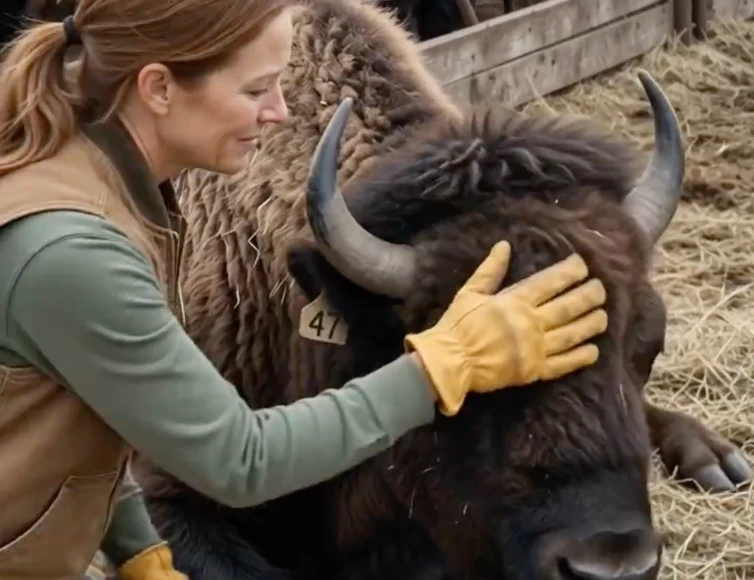
“Mom,” Owen said. “They’re starting the fencing.”
Her twelve-year-old son had his father’s weather notebook tucked under one arm. Before breakfast he had recorded twenty-nine degrees, a northwest wind, and snow possible after dark. Since Luke’s death, Owen had begun writing down weather as if surprise were a problem that could be solved with enough columns.
“I heard them.” Mara kept watching the herd.
Silver Butte Wildlife Park had failed after a year of unpaid feed bills and three months of legal arguments. The receiver was selling everything that could be loaded: office furniture, utility carts, steel gates, hay racks, and the fencing Mara needed at Cottonwood Draw.
The bison were the last lot.
Their records were incomplete, several ear tags were missing, and the state veterinarian had placed conditions on their movement. A buyer needed secure isolation pasture, approved transport, and veterinary supervision while identification and health testing were completed. If nobody accepted those costs by noon the following day, the receiver would arrange for the herd to be destroyed.
Everyone else saw forty underfed animals with uncertain histories.
Mara saw clear eyes, deliberate movement, and cows that were hungry but still organized.
Grant Halvorsen came to the rail beside her. His ranch bordered Cottonwood Draw on two sides, and his cattle grazed country that disappeared beyond Mara’s highest ridge.
“Don’t,” he said.
“I didn’t ask you.”
“You came for fence.”
“I remember.”
Grant was fifty-nine and careful with almost everything except another person’s pride. During Luke’s illness, he had hauled the Ellisons’ cattle to market without charging them. Six months after the funeral, he had offered to buy Cottonwood Draw for less than its appraisal but enough to clear the mortgage.
Mara had never decided which act showed the truer man.
“Your north pasture has old game fence,” he said. “The west corner is patched with horse wire. One frightened cow hits that, you’ll have twelve hundred pounds on the county road.”
“I know my own fence.”
“Then you know it isn’t ready.”
The auctioneer opened at five thousand dollars for the herd. Nobody moved. He dropped to three thousand, then two, then one.
Buyers who had spent freely on rusted tractors studied their boots.
“Eight hundred dollars,” the auctioneer called. “Forty head, one lot. Buyer removes them by noon tomorrow.”
Owen turned toward Mara.
She raised paddle 47.
A few men near the equipment rows laughed before realizing she was serious. The auctioneer leaned over his microphone.
“Ma’am, you understand that’s eight hundred for the lot, not eight hundred per animal?”
“I understand.”
Grant stepped away from the rail. “Mara.”
The warning in his voice hardened the thing that had lifted her arm. For nearly two years, people had told her what a widow should sell, what a mother could no longer risk, and how much smaller Cottonwood Draw needed to become.
No one raised another paddle.
The gavel struck plywood.
Owen looked from the auctioneer to the bison. “You bought them?”
“We bought them.”
“No.” He spoke quietly, which was worse than shouting. “You did.”
The receiver handed Mara two pages of conditions. The purchase price was due immediately. Transportation, veterinary work, feed, isolation fencing, and any losses belonged to her.
The eight hundred dollars was the cheapest part of what she had done.
By late afternoon, Mara had reached everyone likely to answer. Jo Alvarez agreed to bring both of her livestock trailers and make three trips. Dr. Neil Carver, a semiretired large-animal veterinarian who had handled bison before, drove to Silver Butte to assess whether the herd could travel safely.
Neil watched the animals from outside the handling alley before asking the former keeper to move them through in small groups.
“They’re malnourished,” he told Mara. “That doesn’t mean you fix them with grain. Grass hay, clean water, minerals, and slow increases. Three of them worry me. Maybe four.”
“Can they make the trip?”
“Most can. I wouldn’t move Twenty-Seven until last.”
Jo examined the loading gate. “Is ‘most’ the medical opinion you were hoping for?”
“It’s the opinion you get after buying forty bison before calling your veterinarian.”
Mara accepted both rebukes. She had already emptied most of the ranch operating account to pay for trailers, hay, portable panels, and Neil’s first visit. That money had been reserved for the aging well pump and the winter mortgage payment.
She told Owen they would manage.
He watched the first animals enter Jo’s trailer. “Do you know that?”
“I’ll make it true.”
“That wasn’t what I asked.”
Luke used to answer difficult questions while cleaning a tool or worrying a knot loose. Mara answered too fast, then spent the next hour wishing she could put the words back.
“Yes,” she said. “I know.”
Owen opened the weather notebook and wrote something she could not see.
Snow began during the final trip to Cottonwood Draw. Mara owned one square mile of deeded land and leased nearly four thousand adjoining acres. She and Luke had sold their cattle during his illness, leaving much of the range lightly grazed for two seasons.
In a normal year, the land could support forty bison once they recovered. The immediate problem was keeping them inside it.
The northern pasture still had six-foot game fence from an abandoned elk operation. Jo recruited two neighbors to help brace the weak corners, and Grant sent a flatbed loaded with steel panels.
He followed it in his pickup.
“I need these back,” he said.
“I didn’t ask for them.”
“Jo did. She has better judgment tonight.”
Grant checked every connection himself. He showed Owen how to control the wire spool without letting the boy enter the enclosure, then sent him along the outer gate with reflective markers.
Mara resented needing Grant. She resented more that he was useful.
Shortly after midnight, Twenty-Seven went down.
The cow lay near the windward fence, breathing hard while snow collected along her spine. The herd formed a ragged crescent around her and ignored the hay.
Neil instructed Mara by phone. Keep the animals quiet. Block the wind from outside the fence. Put water within the cow’s reach, but do not crowd her or force her to stand.
Mara and Jo built a windbreak from two panels and a tarp. At two in the morning, Jo left to sleep before another hauling job. Mara remained in her truck with the engine off, watching through the windshield.
Owen appeared on the porch wearing Luke’s old canvas coat.
“Go inside,” Mara said.
“I can sit with you.”
“You can watch from the kitchen.”
“It’s eight degrees.”
“I know the temperature.”
His expression closed. “I thought you wanted my notebook.”
“I want you safe.”
He returned to the house without answering.
Luke had once spent half a night beside a frightened mare in this pasture. He had not promised the animal it would live. He had talked about a gate hinge he meant to repair and what he wanted for breakfast, as though staying mattered more than finding the right words.
Mara lowered her window.
“You chose the worst place on the ranch to lie down,” she told Twenty-Seven. “That wind comes straight out of South Dakota and has never paid rent.”
The cow’s ear moved.
Mara talked until her throat hurt. She described the grass beneath the snow, the cottonwoods along the creek, and the rusted stock tank Luke had intended to replace. She mentioned the boy in the kitchen who measured storms because his mother kept telling him not to be afraid of them.
Before dawn, Twenty-Seven pulled her front legs beneath her and tried to rise. Mara kept both hands on the steering wheel.
The second attempt brought the cow to her knees. On the third, she stood.
Her legs were spread wide and her head hung low, but the herd closed around her until only the ridge of her back remained visible.
Owen had returned to the porch. He did not cheer. He wrote down the time.
Neil arrived at first light. Grant came soon afterward to inspect his panels, carrying a thermos and two bales of plain grass hay. Neither man commented on the standing cow.
As Twenty-Seven moved toward the water, a slab of frozen mud fell from her left hip. Beneath the ragged coat, pale hair formed an old freeze brand—a diamond divided cleanly through its center.
Neil stopped walking.
Grant’s thermos slipped in his hand before he caught it.
Mara looked from the mark to his face. “How long have you known those animals were here…”
To read the rest of the story – CLICK the NEXT button 👇👇👇